
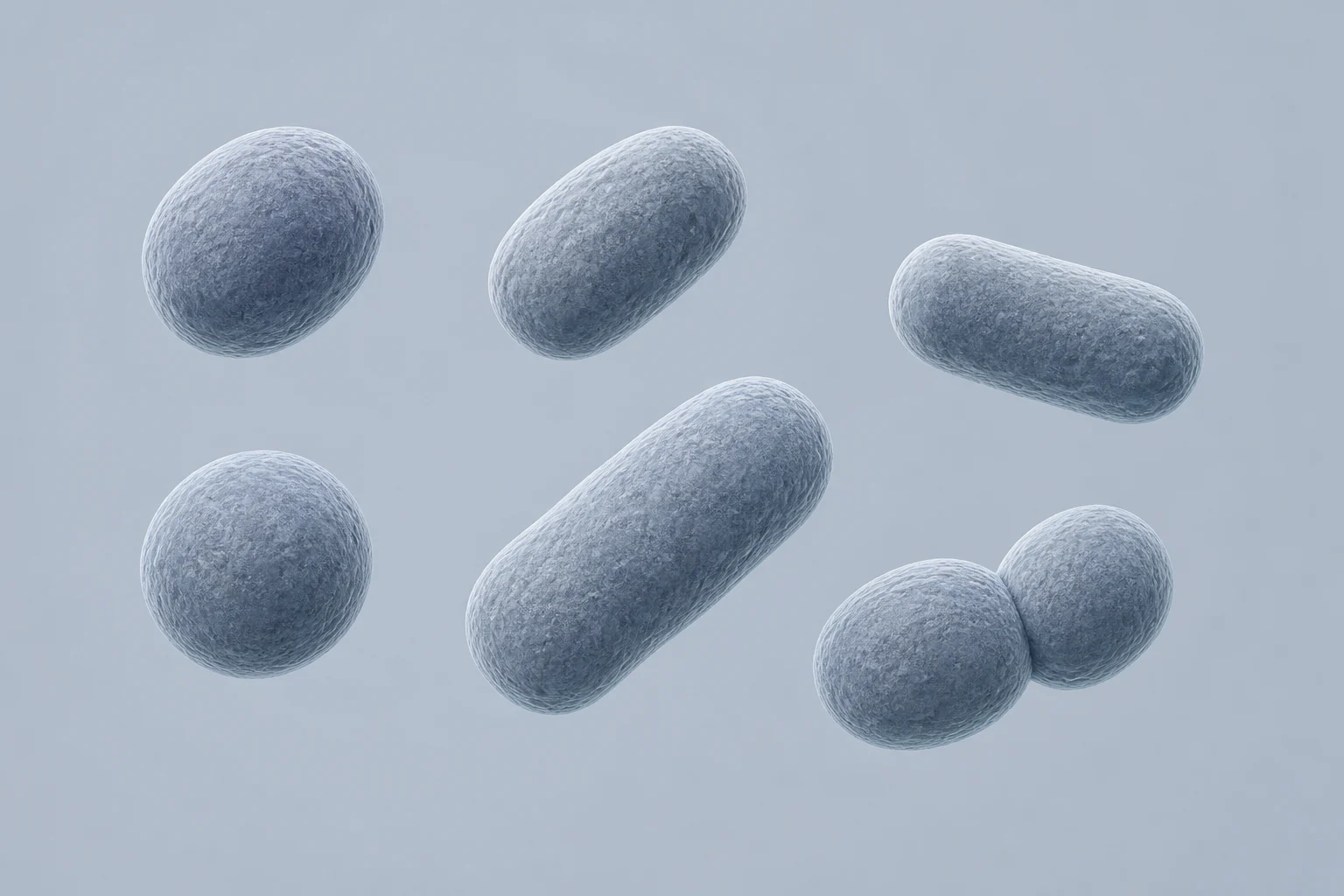
Representative Alistipes morphology, spanning ovoid to short rounded rods among described species. These obligate anaerobes are nonmotile and non-spore-forming; the image is not diagnostic.
Scientific media record1 verified identifier
- Subject
- Alistipestaxon · genus
- Identifiers
- NCBITaxon:239759
- Review
- Editorial review completeIdentifiers authority-verified · Accessibility validated · · alistipes|alistipes-morphology-v1.webp
- Digital source
- Trained-algorithmic mediaCreated with a trained generative algorithm and reviewed by WikiBiome for subject identity, scientific framing, identifiers, provenance, and accessibility.
- Scientific basis
- Alistipes — NCBI TaxonomyAlistipes species descriptions
- License
- CC BY-SA 4.0Created
A Gram-negative, obligate anaerobic genus within the Bacteroidetes phylum (family Rikenellaceae). Alistipes occupies a complex and context-dependent role in the gut ecosystem—some species carry well-documented anti-inflammatory properties, while the genus is paradoxically enriched in Colorectal Cancer and associated with Western dietary patterns.
Key species include A. finegoldii, A. putredinis, A. indistinctus, and A. shahii, each with distinct disease associations that illustrate why species-level resolution matters.
Evidence map16 cited passagesInspect provenance +
Community ecology: One of the 18 dominant bacterial genera identified in the human colon, with consistent presence across diverse human populations.
Western diet association: Enrichment in Western diet is documented—diets high in fat and low in fiber favor Alistipes, Bilophila, and Bacteroides over fiber-dependent commensals.
Lead depletion: A. indistinctus and A. putredinis are among the taxa most reproducibly depleted by prenatal lead (Pb) exposure. In the PROGRESS birth cohort (n=123 mother-child pairs), both species exceeded the WQS importance threshold in ≥80% of repeated holdouts across both second and third trimester exposures,.
A. indistinctus—positively correlated with mast cell infiltration, IL-6, and IL-6R immune activators in advanced-stage (III–IV) CRC; enriched in schizophrenia patients alongside succinate producers,
A. shahii—negatively correlated with Crohn's disease severity; higher abundance associated with less severe CD in machine-learning analysis
Enriched in CRC and contributes to cancer progression. A. indistinctus is positively correlated with mast cell infiltration, IL-6, and IL-6R in advanced-stage (III–IV) CRC. Part of the progression-associated microbiome signature distinguishing early from advanced CRC, alongside Proteus and parabacteroides. Enrichment in CRC may reflect altered bile acid prof
Significantly depleted in graves disease alongside bacteroides fragilis and parabacteroides, contributing to the loss of anti-inflammatory commensals that characterizes thyroid autoimmunity. The depletion correlates with reduced Treg activity and elevated Th17/Treg ratios, consistent with the loss of AhR-ligand production.
Elevated baseline abundance in MS patients as part of a broader Bacteroidetes expansion (higher Prevotella, Butyricimonas, Coprobacter, Parabacteroides, Alistipes), though this is driven by Firmicutes reduction rather than selective Alistipes proliferation. The context-dependent direction of change (enriched in MS, depleted in Graves') reflects different imm
A. shahii abundance is negatively correlated with CD severity—higher levels predict less severe disease in WMS-based machine learning analysis. This is a counter-intuitive finding given genus-level CRC enrichment and underscores the species-level dependence of disease associations.
Hypertension causally decreases Alistipes abundance in reverse Mendelian randomization analysis, indicating that cardiovascular disease states alter this genus—alongside Bilophila, Butyricomonas, and Phascolarctobacterium. Additionally, ischemic stroke causally affects Alistipes in reverse MR analysis.
A. indistinctus is negatively correlated with dopamine levels in schizophrenia microbiome profiling (enriched in patients alongside other succinate-pathway bacteria). Altered abundance has also been reported in ASD, though the direction varies across studies.
Western diet (high fat, low fiber): enriches Alistipes alongside Bilophila and Bacteroides, reflecting its bile-tolerant niche and capacity to subsist on protein fermentation.
—dominant colonic genus catalog
—prenatal Pb depletion data
—A. shahii protective in Crohn's
—A. indistinctus, dopamine correlation
Contents
1. Classification and Habitat2. Role in Gut Ecosystem3. Metal Dependencies and Lead Sensitivity4. Key Enzymes and Metabolites5. Species-Level Complexity6. Disease Associations7. Dietary Modulation8. What Wikipedia Doesn't Cover9. Cross-ReferencesClassification and Habitat#
Alistipes belongs to the family Rikenellaceae within the phylum Bacteroidota (formerly Bacteroidetes). It is a strict anaerobe that colonizes the human colon and cecum, where it thrives in the oxygen-depleted zones favored by bile-acid-tolerant commensals.
The genus was formally described relatively recently and remains incompletely characterized at the species level, contributing to inconsistencies in genus-level microbiome studies.
Role in Gut Ecosystem#
Bile acid metabolism: Bile-resistant anaerobe that contributes to secondary bile acid production, sharing this metabolic niche with Parabacteroides and Bacteroides fragilis. Deoxycholic acid and lithocholic acid produced by bile acid deconjugators in this niche have complex immunomodulatory effects via FXR and TGR5 receptors.
Tryptophan metabolism: Produces indole and indole derivatives (indole-3-acetic acid, indole-3-propionic acid) from tryptophan, generating aryl hydrocarbon receptor (AhR) ligands that support mucosal immunity, gut barrier integrity, and Treg differentiation.
SCFA production: Ferments complex carbohydrates to produce Short-Chain Fatty Acids (SCFAs), primarily acetate and propionate, contributing to colonocyte energy supply and barrier maintenance.
Community ecology: One of the 18 dominant bacterial genera identified in the human colon,[1]Microbial dysbiosis in colorectal cancer (CRC) patientsIradj Sobhani, Julien Tap, Francoise Roudot-Thoraval et al. · 2011Open reference 1 ↓ with consistent presence across diverse human populations.
Western diet association: Enrichment in Western diet is documented—diets high in fat and low in fiber favor Alistipes, Bilophila, and Bacteroides over fiber-dependent commensals.[2]The interplay between diet and the gut microbiome: implications for health and diseaseFiona C. Ross, Dhrati Patangia, Ghjuvan Grimaud et al. · 2024Open reference 2 ↓
Metal Dependencies and Lead Sensitivity#
Although Alistipes has no confirmed essential metal dependencies unique to the genus, it is notably sensitive to heavy metal exposure. Lead depletion: A. indistinctus and A. putredinis are among the taxa most reproducibly depleted by prenatal lead (lead (Pb)) exposure.
In the PROGRESS birth cohort (n=123 mother-child pairs), both species exceeded the WQS importance threshold in ≥80% of repeated holdouts across both second and third trimester exposures.[3]Eggers 2023 — Prenatal lead exposure is negatively associated with gut microbiome in childhood (PROGRESS cohort)Shoshannah Eggers, Vishal Midya, Moira Bixby et al. · 2023Open reference 3 ↓[4]Prenatal Lead Exposure is Negatively Associated with the Gut Microbiome in ChildhoodEggers S, Midya V, Bixby M et al. · 2023Open reference 4 ↓
This lead-driven depletion persists into childhood (ages 9–11), indicating that prenatal metal exposure can alter commensal colonization trajectories well beyond infancy. The mechanism likely involves lead-induced disruption of bile acid metabolism and anaerobic niche competition, as lead preferentially disrupts Bacteroidetes over Firmicutes.
Key Enzymes and Metabolites#
| Enzyme / Product | Function |
|---|---|
| Bile salt hydrolase | Deconjugates primary bile acids → secondary bile acid pool |
| Tryptophan indole-lyase | Converts tryptophan → indole; precursor to AhR ligands |
| Indole-3-acetic acid (IAA) | AhR ligand; anti-inflammatory; mucosal immune regulator |
| Indole-3-propionic acid (IPA) | AhR ligand; gut barrier protectant; neuroprotective metabolite |
| Acetate / Propionate | SCFA; colonocyte fuel; GPR43 signaling; Treg differentiation |
Species-Level Complexity#
Alistipes illustrates a common problem in microbiome research: genus-level analysis masks important species-level heterogeneity.
A. finegoldii—associated with anti-inflammatory effects; produces AhR-active indole derivatives; enriched in healthy gut. A. putredinis—core commensal in healthy adults; depleted by prenatal lead exposure.
A. indistinctus—positively correlated with mast cell infiltration, IL-6, and IL-6R immune activators in advanced-stage (III–IV) CRC; enriched in schizophrenia patients alongside succinate producers.[5]Identification of colorectal cancer progression-associated intestinal microbiome and predictive signature constructionJungang Liu, Xiaoliang Huang, Chuanbin Chen et al. · 2023Open reference 5 ↓[6]Functional Associations of the Gut Microbiome with Dopamine, Serotonin, and BDNF in Schizophrenia: A Pilot StudyGhorbani M, Joseph GBS, Tew MM et al. · 2024Open reference 6 ↓
A. shahii—negatively correlated with Crohn's disease severity; higher abundance associated with less severe CD in machine-learning analysis.[7]Diagnosis of Crohn's Disease and Ulcerative Colitis Using the MicrobiomeKang DY, Park JL, Yeo MK et al. · 2023Open reference 7 ↓
This species-level divergence explains apparently contradictory findings where the same genus appears anti-inflammatory in one disease context and pro-inflammatory in another.
Disease Associations#
Colorectal Cancer—Enrichment#
Enriched in CRC and contributes to cancer progression. A. indistinctus is positively correlated with mast cell infiltration, IL-6, and IL-6R in advanced-stage (III–IV) CRC.[5]Identification of colorectal cancer progression-associated intestinal microbiome and predictive signature constructionJungang Liu, Xiaoliang Huang, Chuanbin Chen et al. · 2023Open reference 5 ↓ Part of the progression-associated microbiome signature distinguishing early from advanced CRC, alongside Proteus and Parabacteroides.
Enrichment in CRC may reflect altered bile acid profiles in the tumor microenvironment, where secondary bile acids promote epithelial proliferation and DNA Damage in Metal Carcinogenesis.
Autoimmune Disease—Depletion#
Significantly depleted in Graves' Disease alongside Bacteroides fragilis and Parabacteroides, contributing to the loss of anti-inflammatory commensals that characterizes thyroid autoimmunity.[8]Alteration in gut microbiota is associated with immune imbalance in Graves' diseaseSu X, Yin X, Liu Y et al. · 2020Open reference 8 ↓ The depletion correlates with reduced Treg activity and elevated Th17/Treg ratios, consistent with the loss of AhR-ligand production.
Multiple Sclerosis—Enrichment (Bacteroidetes Expansion)#
Elevated baseline abundance in MS patients as part of a broader Bacteroidetes expansion (higher Prevotella, Butyricimonas, Coprobacter, Parabacteroides, Alistipes), though this is driven by Firmicutes reduction rather than selective Alistipes proliferation.[9]B-cell-depletion reverses dysbiosis of the microbiome in multiple sclerosis patientsAlba Troci, Olga Zimmermann, Daniela Esser et al. · 2022Open reference 9 ↓
The context-dependent direction of change (enriched in MS, depleted in Graves') reflects different immune environments.
Crohn's Disease—A. shahii Protective#
A. shahii abundance is negatively correlated with CD severity—higher levels predict less severe disease in WMS-based machine learning analysis.[7]Diagnosis of Crohn's Disease and Ulcerative Colitis Using the MicrobiomeKang DY, Park JL, Yeo MK et al. · 2023Open reference 7 ↓ This is a counter-intuitive finding given genus-level CRC enrichment and underscores the species-level dependence of disease associations.
Cardiovascular Disease#
Hypertension causally decreases Alistipes abundance in reverse Mendelian randomization analysis, indicating that cardiovascular disease states alter this genus—alongside Bilophila, Butyricomonas, and Phascolarctobacterium.[10]Causality of gut microbiome and hypertension: A bidirectional mendelian randomization studyYihui Li, Ru Fu, Ruixuan Li et al. · 2023Open reference 10 ↓ Additionally, ischemic stroke causally affects Alistipes in reverse MR analysis.[11]Assessment of the causal relationship between gut microbiota and cardiovascular diseases: a bidirectional Mendelian randomization analysisXiao-Ce Dai, Yi Yu, Si-Yu Zhou et al. · 2024Open reference 11 ↓
Autism Spectrum Disorder#
A. indistinctus is negatively correlated with dopamine levels in schizophrenia microbiome profiling (enriched in patients alongside other succinate-pathway bacteria).[6]Functional Associations of the Gut Microbiome with Dopamine, Serotonin, and BDNF in Schizophrenia: A Pilot StudyGhorbani M, Joseph GBS, Tew MM et al. · 2024Open reference 6 ↓ Altered abundance has also been reported in ASD,[12]Strati 2017 — New Evidences on the Altered Gut Microbiota in Autism Spectrum DisordersFrancesco Strati, Duccio Cavalieri, Davide Albanese et al. · 2017Open reference 12 ↓ though the direction varies across studies.
Dietary Modulation#
Alistipes abundance responds markedly to dietary patterns. Western diet (high fat, low fiber): enriches Alistipes alongside Bilophila and Bacteroides, reflecting its bile-tolerant niche and capacity to subsist on protein fermentation.[2]The interplay between diet and the gut microbiome: implications for health and diseaseFiona C. Ross, Dhrati Patangia, Ghjuvan Grimaud et al. · 2024Open reference 2 ↓
Mediterranean diet: does not specifically enrich Alistipes; instead favors Faecalibacterium, Roseburia, and Ruminococcus through increased fermentable fiber.
The genus's enrichment in Western-diet contexts despite its anti-inflammatory metabolic products represents a paradox—bile acid enrichment from high-fat diets may select for bile-tolerant strains while the anti-inflammatory AhR-ligand producers (A. finegoldii) are depleted.
What Wikipedia Doesn't Cover#
Wikipedia describes Alistipes briefly as a Rikenellaceae commensal. This page adds: species-level disease association mapping, prenatal lead exposure as an environmental depletion driver with quantitative cohort data, the paradox of Western diet enrichment despite anti-inflammatory metabolites, and the mechanistic role of indole production in AhR-mediated mucosal immunity.
Cross-References#
- Colorectal Cancer—enriched; A. indistinctus linked to immune activation in advanced tumors
- Graves' Disease—depleted alongside other Bacteroidetes commensals
- Crohn's Disease—A. shahii negatively correlated with disease severity
- Multiple Sclerosis—enriched as part of Bacteroidetes expansion
- Cardiovascular Disease—abundance decreased by hypertension (reverse MR)
- Parabacteroides—co-depleted in autoimmunity; shared bile acid metabolic niche
- Bacteroides fragilis—co-depleted in Graves' disease; fellow Bacteroidetes commensal
- Short-Chain Fatty Acids (SCFAs)—acetate and propionate producer
- Lead—prenatal exposure depletes A. indistinctus and A. putredinis persistently into childhood
- Dysbiosis—context-dependent marker; depletion in autoimmunity, enrichment in cancer
- Metal-Driven Inflammation—species-dependent: anti-inflammatory (A. finegoldii) vs. pro-inflammatory (A. indistinctus in CRC)
References 13
Numbered by first appearance in the article, then reconciled with its declared source list.
- 1
Iradj Sobhani, Julien Tap, Francoise Roudot-Thoraval et al. (2011). Microbial dysbiosis in colorectal cancer (CRC) patients. PLoS ONE.
- 2
Fiona C. Ross, Dhrati Patangia, Ghjuvan Grimaud et al. (2024). The interplay between diet and the gut microbiome: implications for health and disease. Nature Reviews Microbiology.
- 3
Shoshannah Eggers, Vishal Midya, Moira Bixby et al. (2023). Eggers 2023 — Prenatal lead exposure is negatively associated with gut microbiome in childhood (PROGRESS cohort). Frontiers in Microbiology.
- 4
Eggers S, Midya V, Bixby M et al. (2023). Prenatal Lead Exposure is Negatively Associated with the Gut Microbiome in Childhood. Frontiers in Microbiology.
- 5
Jungang Liu, Xiaoliang Huang, Chuanbin Chen et al. (2023). Identification of colorectal cancer progression-associated intestinal microbiome and predictive signature construction. Journal of Translational Medicine.
- 6
Ghorbani M, Joseph GBS, Tew MM et al. (2024). Functional Associations of the Gut Microbiome with Dopamine, Serotonin, and BDNF in Schizophrenia: A Pilot Study. Egyptian Journal of Neurology, Psychiatry and Neurosurgery.
- 7
Kang DY, Park JL, Yeo MK et al. (2023). Diagnosis of Crohn's Disease and Ulcerative Colitis Using the Microbiome. BMC Microbiology.
- 8
Su X, Yin X, Liu Y et al. (2020). Alteration in gut microbiota is associated with immune imbalance in Graves' disease. EBioMedicine.
- 9
Alba Troci, Olga Zimmermann, Daniela Esser et al. (2022). B-cell-depletion reverses dysbiosis of the microbiome in multiple sclerosis patients. Scientific Reports.
- 10
Yihui Li, Ru Fu, Ruixuan Li et al. (2023). Causality of gut microbiome and hypertension: A bidirectional mendelian randomization study. Frontiers in Cardiovascular Medicine.
- 11
Xiao-Ce Dai, Yi Yu, Si-Yu Zhou et al. (2024). Assessment of the causal relationship between gut microbiota and cardiovascular diseases: a bidirectional Mendelian randomization analysis. BioData Mining.
- 12
Francesco Strati, Duccio Cavalieri, Davide Albanese et al. (2017). Strati 2017 — New Evidences on the Altered Gut Microbiota in Autism Spectrum Disorders. Microbiome.
- 13
Kishore Vipperla, Stephen J. O'Keefe (2016). Diet, microbiota, and dysbiosis: a 'recipe' for colorectal cancer. Food & Function.
Article network
Mentioned here 12
Pages linking here 7
Connect the evidence
Publicly readable discussion by ORCID-authenticated researchers. Questions, interpretation, methods, corrections, and new evidence stay attached to this record.
No discussion yet. Start with a precise question or a source-backed observation.
Activity and accepted changes
Accepted researcher context, editorial status, public discussion, and upstream Git revisions are shown together. Pending, declined, and withdrawn proposals remain private.
- published revision
massive wiki expansion: 149 stubs fixed, 100+ new pages, Rule 15 scan, keystone papers
WikiBiome Deploy Bot · +14 −14
Inspect exact Git diff ↗ - published revision
Deepen schizophrenia/CKD entities + 8 microbe entities; add 6 source pages
WikiBiome Deploy Bot · +87 −44
Inspect exact Git diff ↗ - published revision
WikiBiome update — 2026-04-15 17:23
WikiBiome Deploy Bot · +1 −2
Inspect exact Git diff ↗ - published revision
wiki: bulk entity upgrades, new article pages, and site regeneration
WikiBiome Deploy Bot · +6 −0
Inspect exact Git diff ↗ - published revision
WikiBiome update — integrity fixes, metallomic diet pages, cross-condition analyses
WikiBiome Deploy Bot · +14 −7
Inspect exact Git diff ↗ - published revision
WikiBiome update — 2026-04-10 13:49
WikiBiome Deploy Bot · +64 −0
Inspect exact Git diff ↗