

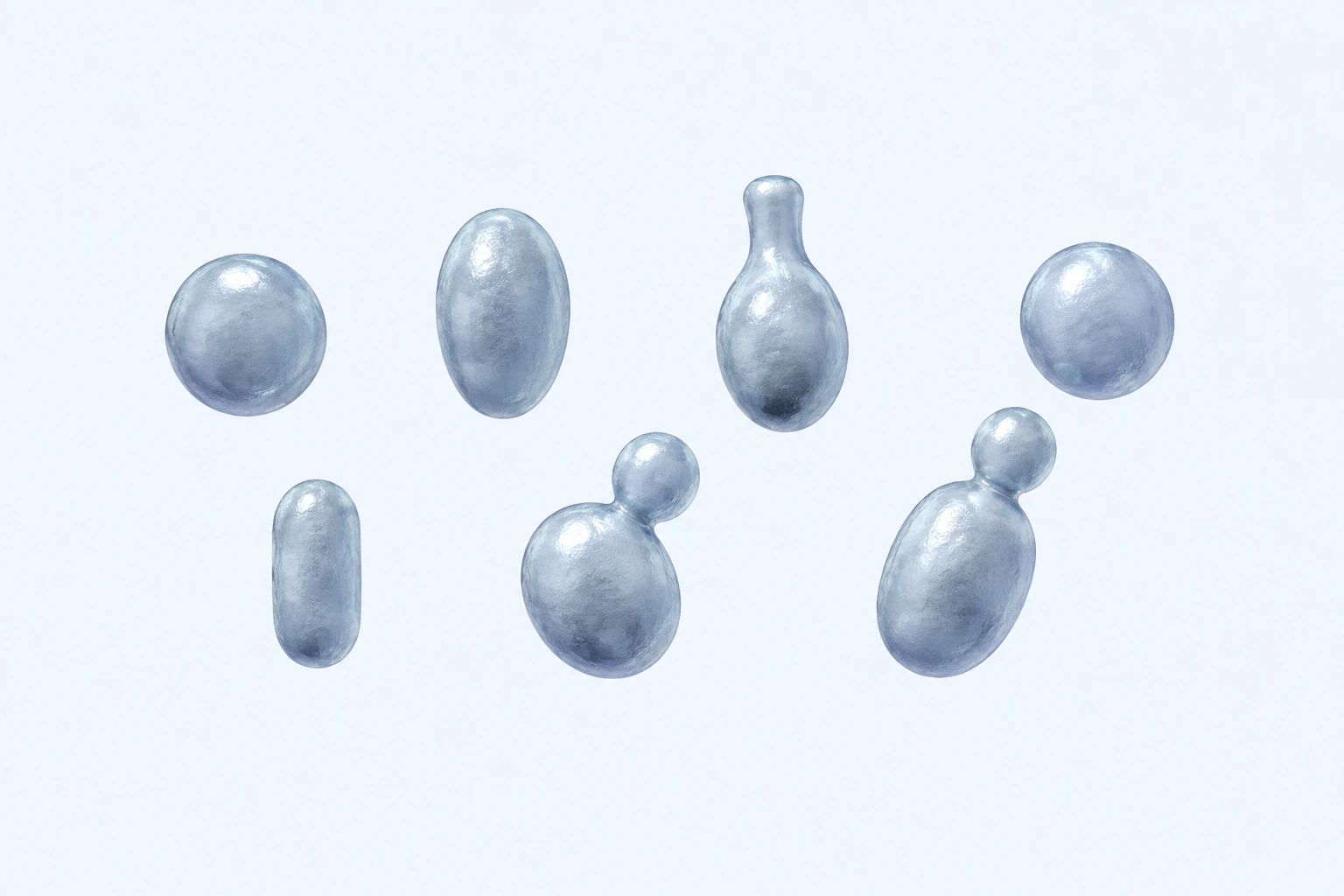
Type-species-anchored Malassezia yeast forms, shown as nine globose, ovoid, bottle-like, or cylindrical bodies in five single and two broad-base budding-pair groupings. This scientific reconstruction is representative, non-universal, non-diagnostic, and not a micrograph.
Scientific media record1 verified identifier
- Subject
- Malasseziataxon · genus
- Identifiers
- NCBITaxon:55193
- Review
- Editorial review completeIdentifiers authority-verified · Accessibility validated · · malassezia|malassezia-morphology-v1.webp
- Digital source
- Trained-algorithmic mediaCreated with a trained generative algorithm and reviewed by WikiBiome for subject identity, scientific framing, identifiers, provenance, and accessibility.
- Scientific basis
- Malassezia — NCBI TaxonomyMalassezia — Index Fungorum/KewThe Yeasts: MalasseziaMalassezia species morphologyMalassezia biology review
- License
- CC BY-SA 4.0Created
A genus of lipophilic basidiomycete yeasts that is the dominant fungus on human skin and has recently been recognized as a significant component of the gut mycobiome. M. restricta, M. globosa, and M. furfur are the primary species.
Originally studied as the cause of dandruff and seborrheic dermatitis, Malassezia has emerged as an unexpectedly important player in gut Dysbiosis, particularly in Cardiovascular Disease and hypertension.
Evidence map5 cited passagesInspect provenance +
In the gut, Malassezia interacts with bacterial communities: negatively correlated with Bifidobacterium, roseburia, and ruminococcus in IBD patients.
Positively correlated with candida albicans and Aspergillus in ASD gut mycobiome.
Malassezia abundance increases progressively from normotensive to pre-hypertensive to hypertensive subjects (significant between HTN and NT).
Enriched in HTN+CKD comorbidity (18.71% of fungal community vs lower in controls).
Increased in atherosclerotic CVD alongside Exophiala, Penicillium, and Wallemia.
Contents
1. Skin Commensal Role2. Gut Mycobiome Presence3. Enrichment in Cardiovascular Disease4. Immunomodulatory Properties5. Oral-Gut-Skin Axis6. Key Metabolites7. ConnectionsSkin Commensal Role#
Colonizes lipid-rich skin sites (scalp, face, chest, back) where it metabolizes host sebum triglycerides via secreted lipases, releasing unsaturated fatty acids (oleic acid) that can trigger Metal-Driven Inflammation in susceptible individuals.
M. restricta is the primary causative agent of dandruff and seborrheic dermatitis through lipase-mediated oleic acid release and subsequent inflammation. M. furfur causes pityriasis versicolor (skin depigmentation) and can cause systemic fungemia in neonates receiving lipid parenteral nutrition.
The genus is uniquely lipid-dependent—it lacks the genes for de novo fatty acid synthesis and must acquire lipids from its environment.
Gut Mycobiome Presence#
Despite being considered a skin organism, Malassezia is consistently detected in gut mycobiome surveys, likely arriving via ingestion and possibly establishing transient or semi-permanent colonization.
In the gut, Malassezia interacts with bacterial communities: negatively correlated with Bifidobacterium, Roseburia, and Ruminococcus in IBD patients.[1]Unveiling the overlooked fungi: the vital of gut fungi in inflammatory bowel disease and colorectal cancerYilin Huang, Yang Wang, Xiaotian Huang et al. · 2024Open reference 1 ↓
Positively correlated with Candida albicans and Aspergillus in ASD gut mycobiome.[2]Strati 2017 — New Evidences on the Altered Gut Microbiota in Autism Spectrum DisordersFrancesco Strati, Duccio Cavalieri, Davide Albanese et al. · 2017Open reference 2 ↓
Enrichment in Cardiovascular Disease#
Hypertension#
Malassezia abundance increases progressively from normotensive to pre-hypertensive to hypertensive subjects (significant between HTN and NT).[3]Gut mycobiome dysbiosis contributes to the development of hypertension and its response to immunoglobulin light chainsYeqing Zou, Anxing Ge, Brako Lydia et al. · 2022Open reference 3 ↓
Positively associated with immunoglobulin light chain kappa in pre-HTN (r=0.510, P=0.044) and both kappa and lambda in HTN, suggesting immune activation by Malassezia antigens.
Fungal dysbiosis detected already at the pre-hypertension stage, suggesting mycobiome changes precede clinical hypertension.
Broader Cardiometabolic Disease#
Enriched in HTN+CKD comorbidity (18.71% of fungal community vs lower in controls).[4]Exploring the gut mycobiome: differential composition and clinical associations in hypertension, chronic kidney disease, and their comorbidityJuan Qiu, Longyou Zhao, Yiwen Cheng et al. · 2023Open reference 4 ↓ Increased in atherosclerotic CVD alongside Exophiala, Penicillium, and Wallemia.[5]Gut mycobiome in cardiometabolic disease progression: current evidence and future directionsXiaoyu Wei, Zixin Guo, Jingyang Wang et al. · 2025Open reference 5 ↓ Also enriched in obesity: M. restricta increased in obese individuals.
Immunomodulatory Properties#
Malassezia cell wall components (mannans, beta-glucans) activate Dectin-1, Dectin-2, and TLR2 on innate immune cells. Produces arachidonic acid metabolites via phospholipase activity that can modulate local inflammation. Immunoglobulin light chain dysregulation associated with Malassezia enrichment in hypertension suggests a novel immune-fungal-cardiovascular axis.
In IBD, Malassezia may activate CARD9-dependent immune pathways in genetically susceptible individuals.
Oral-Gut-Skin Axis#
Malassezia presence in three body niches (skin, oral cavity, gut) raises the possibility of a fungal oral-gut-skin axis. Skin Malassezia infections may seed gut colonization via ingestion; conversely, gut immune responses to Malassezia may influence skin disease.
This multi-niche colonization is relevant to systemic diseases like Cardiovascular Disease where both gut and skin microbiome alterations have been documented.
Key Metabolites#
Lipase products—oleic acid and other unsaturated fatty acids from sebum/lipid metabolism; inflammatory triggers. Indole derivatives—some Malassezia species produce tryptophan-derived metabolites that act as aryl hydrocarbon receptor (AHR) ligands, modulating skin and gut immune responses. Arachidonic acid metabolites—phospholipase-derived inflammatory mediators.
Connections#
- Cardiovascular Disease—enriched in hypertension and atherosclerosis; immunoglobulin light chain associations
- Chronic Kidney Disease—enriched in HTN+CKD comorbidity
- Autism Spectrum Disorder—detected in ASD gut mycobiome; correlated with Candida
- Candida albicans—positively correlated; both enriched in disease mycobiomes
- Saccharomyces—co-occurring in gut mycobiome; both altered in CVD
- inflammation—lipase-mediated oleic acid release; Dectin-1/TLR2 activation
- dysbiosis—fungal dysbiosis precedes clinical hypertension
- Gut-Metal-Microbiome Interactions—indirect metal interactions; Heavy Metals may shift bacterial communities that normally suppress Malassezia
- Roseburia—negatively correlated in IBD; bacterial-fungal competitive dynamics
- Biofilm—forms biofilms on skin; potential for gut biofilm formation
- Oxidative Stress—arachidonic acid metabolites promote oxidative inflammatory damage
References 5
Numbered by first appearance in the article, then reconciled with its declared source list.
- 1
Yilin Huang, Yang Wang, Xiaotian Huang et al. (2024). Unveiling the overlooked fungi: the vital of gut fungi in inflammatory bowel disease and colorectal cancer. Gut Pathogens.
- 2
Francesco Strati, Duccio Cavalieri, Davide Albanese et al. (2017). Strati 2017 — New Evidences on the Altered Gut Microbiota in Autism Spectrum Disorders. Microbiome.
- 3
Yeqing Zou, Anxing Ge, Brako Lydia et al. (2022). Gut mycobiome dysbiosis contributes to the development of hypertension and its response to immunoglobulin light chains. Frontiers in Immunology.
- 4
Juan Qiu, Longyou Zhao, Yiwen Cheng et al. (2023). Exploring the gut mycobiome: differential composition and clinical associations in hypertension, chronic kidney disease, and their comorbidity. Frontiers in Immunology.
- 5
Xiaoyu Wei, Zixin Guo, Jingyang Wang et al. (2025). Gut mycobiome in cardiometabolic disease progression: current evidence and future directions. Frontiers in Microbiology.
Article network
Mentioned here 13
Pages linking here 6
Connect the evidence
Publicly readable discussion by ORCID-authenticated researchers. Questions, interpretation, methods, corrections, and new evidence stay attached to this record.
No discussion yet. Start with a precise question or a source-backed observation.
Activity and accepted changes
Accepted researcher context, editorial status, public discussion, and upstream Git revisions are shown together. Pending, declined, and withdrawn proposals remain private.
- published revision
Backfill heavy metals concept links
Karen Pendergrass · +1 −1
Inspect exact Git diff ↗ - published revision
Backfill inflammation concept links
Karen Pendergrass · +3 −3
Inspect exact Git diff ↗ - published revision
Complete corpus-wide Dysbiosis linking
Karen Pendergrass · +2 −2
Inspect exact Git diff ↗ - published revision
massive wiki expansion: 149 stubs fixed, 100+ new pages, Rule 15 scan, keystone papers
WikiBiome Deploy Bot · +5 −5
Inspect exact Git diff ↗ - published revision
nightly maintenance: 94 stub demotions, 181 source_count fixes, 22 auto-discovered stubs, 5 adversarial audits, 3 boundary fixes, 3 evidence-level corrections
WikiBiome Deploy Bot · +1 −0
Inspect exact Git diff ↗ - published revision
wiki: bulk entity upgrades, new article pages, and site regeneration
WikiBiome Deploy Bot · +6 −0
Inspect exact Git diff ↗ - published revision
WikiBiome update — integrity fixes, metallomic diet pages, cross-condition analyses
WikiBiome Deploy Bot · +7 −5
Inspect exact Git diff ↗ - published revision
WikiBiome update — 2026-04-10 13:49
WikiBiome Deploy Bot · +72 −0
Inspect exact Git diff ↗