
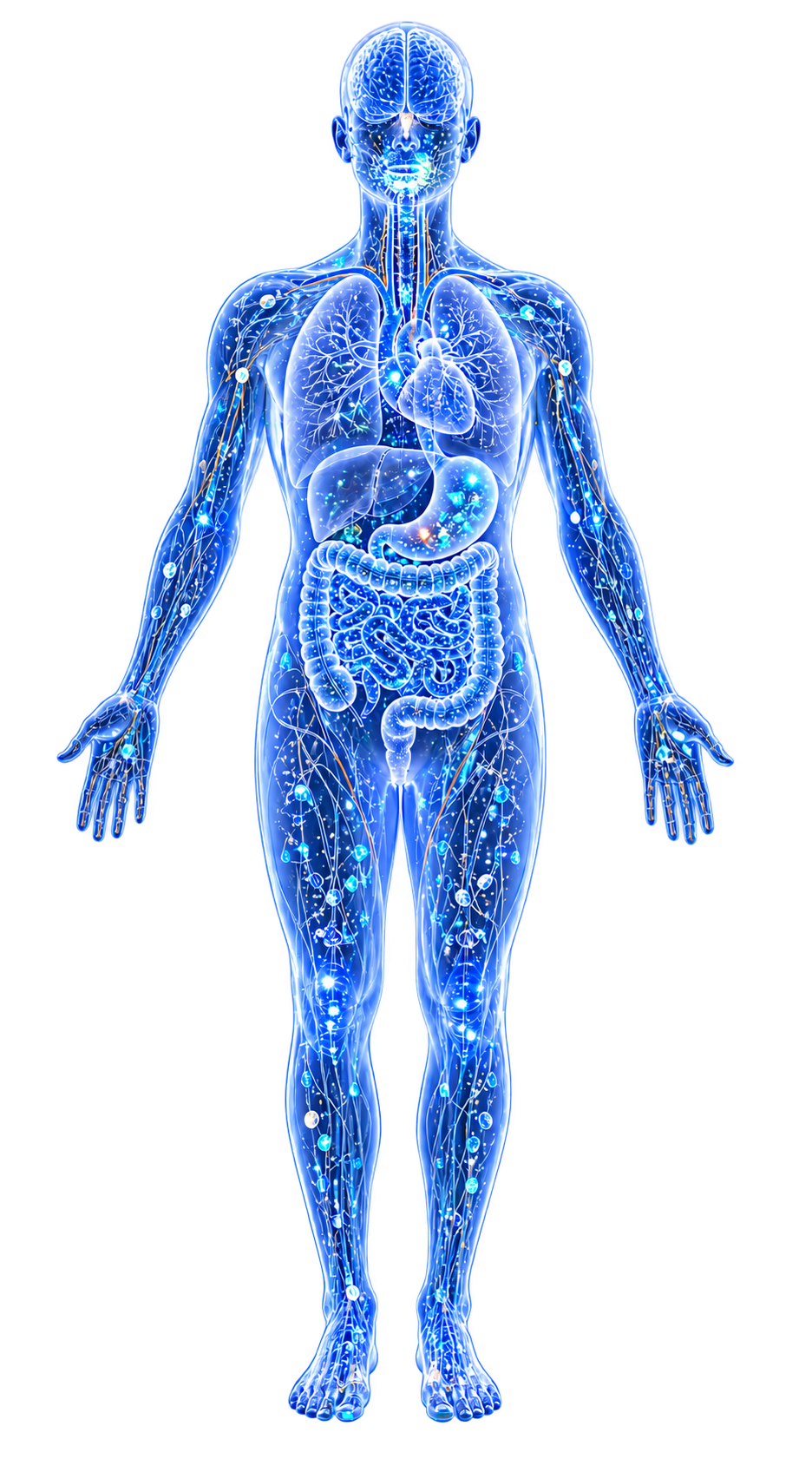
Lead (lead (Pb)) has no safe level of exposure. Unlike most dietary metals, lead does not play any known biological role—every atom absorbed represents toxic burden.
While environmental lead exposure (paint, soil, air) has decreased dramatically since leaded gasoline phase-outs, dietary lead exposure persists through water infrastructure, food processing, spices, and legacy soil contamination.
Evidence map7 cited passagesInspect provenance +
Water infrastructure. Lead service lines, lead solder in copper pipes, and brass fixtures leach lead into drinking water. The first draw from a faucet after stagnation contains the highest concentrations. The EU Drinking Water Directive (2020/2184) set a parametric value of 10 μg/L with a 15-year transition to 5 μg/L—acknowledging that current infrastructu
Lead's toxicity is fundamentally a mis metallation story. Pb²⁺ mimics Ca²⁺ and enters cells through calcium channels, then displaces calcium, zinc, and iron from critical enzymes and structural proteins:
Children absorb 40-50% of ingested lead (vs. 3-10% in adults) due to immature gut barrier function and developing calcium-absorption machinery:
All 10 commercial baby food products tested in one study contained detectable lead
Baby food jars (Tenerife study) showed lead among detected contaminants, alongside aluminum, nickel, and cadmium
FDA has established an action level of 20 ppb for lead in baby food (one of the few regulated metals in infant foods)
EU Drinking Water: 10 μg/L, transitioning to 5 μg/L
Contents
1. How Lead Enters the Diet2. Lead Content in Foods3. Lead and Calcium Channel Mis-metallation4. Infant and Child Vulnerability5. Lead and the Gut Microbiome6. Regulatory Landscape7. ConnectionsHow Lead Enters the Diet#
Water infrastructure. Lead service lines, lead solder in copper pipes, and brass fixtures leach lead into drinking water. The first draw from a faucet after stagnation contains the highest concentrations.
The EU Drinking Water Directive (2020/2184) set a parametric value of 10 μg/L with a 15-year transition to 5 μg/L—acknowledging that current infrastructure still delivers lead.[1]Directive (EU) 2020/2184 on the Quality of Water Intended for Human Consumption (Recast)European Parliament, Council of the European Union · 2020Open reference 1 ↓
Legacy soil contamination. Root vegetables, leafy greens, and herbs grown in lead-contaminated soil (urban gardens near pre-1978 buildings, areas with historical industrial activity) absorb lead through root uptake. Unlike cadmium, lead has relatively low translocation to above-ground plant parts—root vegetables carry higher burdens than leafy greens.
Food processing and packaging. Canned foods (especially from older production facilities), certain spices (turmeric adulteration with lead chromate is documented in South Asia), and imported candies/snacks have been identified as lead sources.
Animal products. Organ meats (liver, kidney) and bone broth can concentrate lead from the animal's lifetime environmental exposure.
Lead Content in Foods#
| Food Category | lead (Pb) Content Range | Notes |
|---|---|---|
| Drinking water (first draw) | 1-100+ μg/L | Infrastructure-dependent; no safe level |
| Root vegetables (urban gardens) | 0.01-5.0 mg/kg | Soil lead levels determine crop levels |
| Spices (turmeric, chili) | 0.1-500+ mg/kg | Intentional adulteration documented |
| Baby foods (commercial) | 0.001-0.02 mg/kg | All tested positive; low but non-zero |
| Rice | 0.01-0.30 mg/kg | Soil-dependent |
| Canned foods | 0.01-0.20 mg/kg | Solder and can lining leaching |
| Bone broth | Variable | Concentrates lead from bone stores |
| Chocolate | 0.01-0.20 mg/kg | Soil contamination + processing |
Lead and Calcium Channel Mis-metallation#
Lead's toxicity is fundamentally a Mis-Metallation story. lead (Pb)²⁺ mimics calcium (Ca)²⁺ and enters cells through calcium channels, then displaces calcium, zinc, and iron from critical enzymes and structural proteins.[2]Toxic Mechanisms of Five Heavy Metals: Mercury, Lead, Chromium, Cadmium, and ArsenicBalali-Mood M, Naseri K, Tahergorabi Z et al. · 2021Open reference 2 ↓
Lead crosses the blood-brain barrier via calcium channels, accumulating in the hippocampus and prefrontal cortex. Lead replaces calcium in bone, creating a decades-long storage depot that mobilizes during pregnancy, lactation, and osteoporosis.
Lead inhibits ALAD (aminolevulinic acid dehydratase)—a zinc-dependent enzyme in heme synthesis—causing anemia through enzyme displacement, not iron deficiency. Lead displaces zinc from zinc finger proteins, disrupting DNA repair and gene regulation.
Calcium and iron status modify lead absorption. Calcium deficiency increases lead absorption 2-3x through upregulated calcium channels. Iron deficiency does the same through shared DMT1 transporters.
This means populations with the poorest nutritional status—often the same populations with highest environmental lead exposure—absorb lead most efficiently.
Infant and Child Vulnerability#
Children absorb 40-50% of ingested lead (vs. 3-10% in adults) due to immature gut barrier function and developing calcium-absorption machinery.[2]Toxic Mechanisms of Five Heavy Metals: Mercury, Lead, Chromium, Cadmium, and ArsenicBalali-Mood M, Naseri K, Tahergorabi Z et al. · 2021Open reference 2 ↓ All 10 commercial baby food products tested in one study contained detectable lead.[3]Evaluation of Heavy Metals in Commercial Baby FoodsGaruba OD, Anglin JC, Good S et al. · 2024Open reference 3 ↓
Baby food jars (Tenerife study) showed lead among detected contaminants, alongside aluminum, nickel, and cadmium.[4]Baby Food Jars as a Dietary Source of Essential (K, Na, Ca, Mg, Fe, Zn, Cu, Co, Mo, Mn) and Toxic Elements (Al, Cd, Pb, B, Ba, V, Sr, Li, Ni)Gonzalez-Suarez S, Paz-Montelongo S, Niebla-Canelo D et al. · 2022Open reference 4 ↓
FDA has established an action level of 20 ppb for lead in baby food (one of the few regulated metals in infant foods).[5]Certification as a Framework for Reducing Heavy Metal Exposure in Infant and Child Foods: Integrating Legal Defensibility, Scientific Rigor, and Commercial ViabilityKaren Pendergrass · 2026Open reference 5 ↓
345 pending legal claims related to Heavy Metals in baby food underscore the regulatory failure.
Lead and the Gut Microbiome#
Lead exposure alters gut microbial ecology:
- Lead shifts microbiota composition toward increased Enterobacteriaceae and decreased Lactobacillus—a classic dysbiotic signature
- Lead depletes Glutathione (GSH) reserves, the same detoxification molecule cadmium depletes
- cobalt (Co)-exposure with other dietary metals (cadmium (Cd), arsenic (As)) produces synergistic gut disruption
- Gut microbial metabolites influence lead methylation and bioavailability
Regulatory Landscape#
Lead is the most heavily regulated dietary metal due to its recognized developmental neurotoxicity. CDC BLL reference value: 3.5 μg/dL (children); no safe level acknowledged. FDA action levels: 20 ppb in baby food; 50 ppb in fruit juice; 12.5 ppb in candy.
EU maximum: 0.02-0.30 mg/kg depending on food category.
EPA MCL for water: 15 μg/L action level (not a health-based standard). EU Drinking Water: 10 μg/L, transitioning to 5 μg/L.[1]Directive (EU) 2020/2184 on the Quality of Water Intended for Human Consumption (Recast)European Parliament, Council of the European Union · 2020Open reference 1 ↓
Connections#
- Lead—the metal entity page
- Mis-Metallation—lead enters through calcium channels, displaces zinc (Zn) from enzymes
- Heavy Metals in Infant Foods—lead in baby food and formula
- Dietary Cadmium Exposure—co-exposure in plant-based foods
- Developmental Metal Vulnerability: Critical Windows of Susceptibility—children absorb 5x more lead than adults
- Blood-Brain Barrier—lead crosses via calcium transporters
- Glutathione (GSH)—depleted by lead exposure
References 5
Numbered by first appearance in the article, then reconciled with its declared source list.
- 1
European Parliament, Council of the European Union (2020). Directive (EU) 2020/2184 on the Quality of Water Intended for Human Consumption (Recast). Official Journal of the European Union (L 435/1).
- 2
★Balali-Mood M, Naseri K, Tahergorabi Z et al. (2021). Toxic Mechanisms of Five Heavy Metals: Mercury, Lead, Chromium, Cadmium, and Arsenic. Frontiers in Pharmacology.
- 3
Garuba OD, Anglin JC, Good S et al. (2024). Evaluation of Heavy Metals in Commercial Baby Foods. Archive of Food and Nutritional Science.
- 4
Gonzalez-Suarez S, Paz-Montelongo S, Niebla-Canelo D et al. (2022). Baby Food Jars as a Dietary Source of Essential (K, Na, Ca, Mg, Fe, Zn, Cu, Co, Mo, Mn) and Toxic Elements (Al, Cd, Pb, B, Ba, V, Sr, Li, Ni). Applied Sciences.
- 5
Karen Pendergrass (2026). Certification as a Framework for Reducing Heavy Metal Exposure in Infant and Child Foods: Integrating Legal Defensibility, Scientific Rigor, and Commercial Viability. Zenodo Preprint.
Article network
Mentioned here 11
Pages linking here 5
Connect the evidence
Publicly readable discussion by ORCID-authenticated researchers. Questions, interpretation, methods, corrections, and new evidence stay attached to this record.
No discussion yet. Start with a precise question or a source-backed observation.
Activity and accepted changes
Accepted researcher context, editorial status, public discussion, and upstream Git revisions are shown together. Pending, declined, and withdrawn proposals remain private.
- published revision
Consolidate microbial metabolite knowledge
Karen Pendergrass · +1 −1
Inspect exact Git diff ↗ - published revision
Backfill heavy metals concept links
Karen Pendergrass · +1 −1
Inspect exact Git diff ↗ - published revision
massive wiki expansion: 149 stubs fixed, 100+ new pages, Rule 15 scan, keystone papers
WikiBiome Deploy Bot · +20 −20
Inspect exact Git diff ↗ - published revision
nightly maintenance: 94 stub demotions, 181 source_count fixes, 22 auto-discovered stubs, 5 adversarial audits, 3 boundary fixes, 3 evidence-level corrections
WikiBiome Deploy Bot · +1 −0
Inspect exact Git diff ↗ - published revision
pre-overnight checkpoint 2026-04-18
WikiBiome Deploy Bot · +3 −0
Inspect exact Git diff ↗ - published revision
WikiBiome update — 2026-04-15 17:23
WikiBiome Deploy Bot · +1 −1
Inspect exact Git diff ↗ - published revision
WikiBiome update — integrity fixes, metallomic diet pages, cross-condition analyses
WikiBiome Deploy Bot · +86 −0
Inspect exact Git diff ↗