
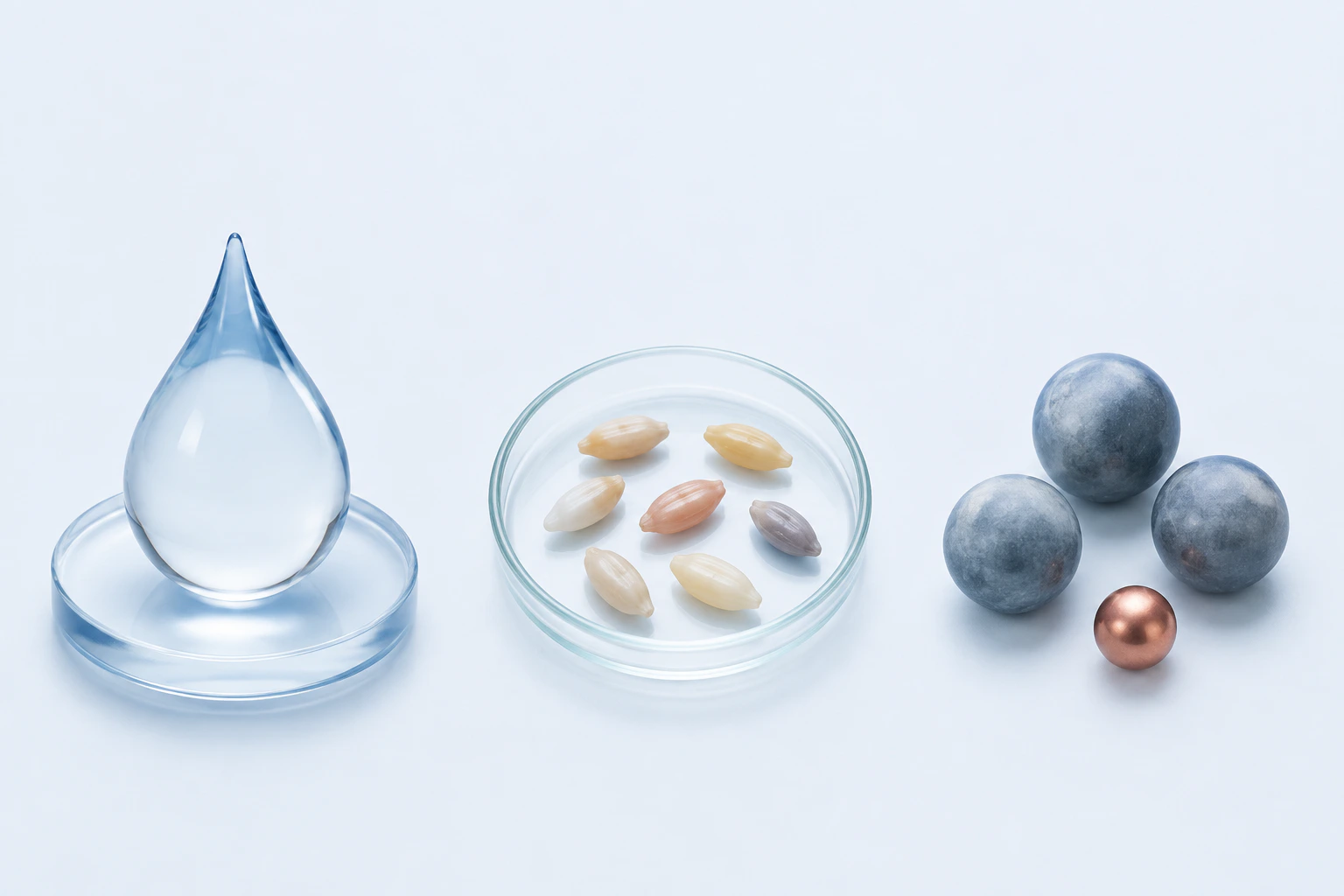
Dietary arsenic-exposure context. Separation does not establish that either matrix contains arsenic and does not identify a food, water source, arsenic species, concentration, dose, threshold, test result, toxicity, or individual risk.
Scientific media record2 verified identifiers
- Subject
- Dietary Arsenic Exposurebiological-process
- Review
- Editorial review completeIdentifiers authority-verified · Accessibility validated · · dietary-arsenic-exposure|dietary-arsenic-exposure-mechanism-v1.webp
- Digital source
- Trained-algorithmic mediaCreated with a trained generative algorithm and reviewed by WikiBiome for subject identity, scientific framing, identifiers, provenance, and accessibility.
- License
- CC BY-SA 4.0Created
Arsenic (arsenic (As)) is unique among dietary Heavy Metals because it exists in two fundamentally different forms with dramatically different toxicities: inorganic arsenic (iAs, the dangerous form) and organic arsenic (arsenobetaine, arsenosugars—largely non-toxic). Understanding which form dominates in which food is essential to evaluating true exposure risk.
Evidence map5 cited passagesInspect provenance +
Critical distinction: A person eating substantial seafood may have high total urinary arsenic but minimal health risk (arsenobetaine). A person eating moderate rice may have lower total arsenic but higher inorganic arsenic—the form that accumulates and causes harm.
Arsenic in infant foods is a critical exposure pathway:
German analysis found arsenic Margins of Exposure (MoE) below 1.0 in highly exposed infants—meaning exposure exceeds the level considered to pose negligible risk.
Microbial arsenic metabolism. Gut bacteria can both methylate and demethylate arsenic. Some species (e.g., certain E. coli strains) express arsenite efflux pumps and arsenic methyltransferases, conferring resistance. Arsenic exposure selects for these resistant organisms, shifting community composition toward arsenic-tolerant taxa.
Soil-plant-microbiome axis. In agricultural systems, 83% of soil microbes show RNA-level changes under arsenic stress, fundamentally altering the rhizosphere ecology that determines how much arsenic enters the food chain.
Contents
1. Inorganic vs. Organic Arsenic2. Arsenic Content in Foods3. Why Rice Is Special4. Infant Formula and Baby Foods5. Arsenic and the Gut Microbiome6. Regulatory Landscape7. Risk Reduction Through Preparation8. ConnectionsInorganic vs. Organic Arsenic#
| Form | Toxicity | Primary Food Sources |
|---|---|---|
| Inorganic As (iAs) | High—IARC Group 1 carcinogen | Rice, water, root vegetables, grains |
| Arsenobetaine | Very low—rapidly excreted | Seafood, fish |
| Arsenosugars | Low | Seaweed, algae |
| DMA/MMA | Moderate (methylation intermediates) | Formed during metabolism of iAs |
Critical distinction: A person eating substantial seafood may have high total urinary arsenic but minimal health risk (arsenobetaine). A person eating moderate rice may have lower total arsenic but higher inorganic arsenic—the form that accumulates and causes harm.[1]Toxic Mechanisms of Five Heavy Metals: Mercury, Lead, Chromium, Cadmium, and ArsenicBalali-Mood M, Naseri K, Tahergorabi Z et al. · 2021Open reference 1 ↓
Arsenic Content in Foods#
Rice—the dominant dietary source of inorganic arsenic. Rice uniquely concentrates arsenic because paddy (flooded) cultivation mobilizes arsenite from soil into the water column, and rice roots take up arsenite through silicon transporters.
| Food Category | Total As (μg/kg) | % Inorganic | Notes |
|---|---|---|---|
| Rice (white, polished) | 50-300 | 60-90% | Milling removes ~30% of arsenic with bran |
| Rice (brown) | 100-400 | 60-90% | Bran layer retains arsenic |
| Rice cakes/puffs | 50-250 | 60-90% | Popular infant snack; concentrated form |
| Infant rice cereal | 50-200 | ~100% iAs | Jackson 2012: first detected iAs in infant formulas |
| Wheat/barley | 10-50 | Variable | Much lower than rice |
| Root vegetables | 5-30 | Variable | Soil contact dependent |
| Drinking water | <10 μg/L (regulated) | Mostly iAs | Private wells unregulated in many areas |
| Seafood/fish | 1,000-50,000 | <5% | Almost entirely arsenobetaine (non-toxic) |
| Apple juice | 2-25 μg/L | Variable | FDA action level: 10 ppb |
Why Rice Is Special#
Rice concentrates arsenic 10x more than other cereal grains for three reasons:
- Flooded cultivation—anaerobic paddy conditions reduce arsenate (As⁵⁺) to arsenite (As³⁺), which is more soluble and more bioavailable to plant roots.
- Silicon transporter hijacking—arsenite (As³⁺) mimics silicic acid and enters rice roots through silicon transporters (Lsi1, Lsi2). Rice has exceptionally efficient silicon uptake, making it an efficient arsenic accumulator.
- Grain loading—arsenic translocates to the grain endosperm, the edible portion. Polishing (removing bran) reduces arsenic but does not eliminate it.
Infant Formula and Baby Foods#
Arsenic in infant foods is a critical exposure pathway.[2]Arsenic concentration and speciation in infant formulas and first foodsJackson BP, Taylor VF, Punshon T et al. · 2012Open reference 2 ↓ All tested infant formulas contained detectable arsenic (2.2-12.6 ng/g). Non-dairy formulas (soy, elemental) contained significantly higher arsenic than dairy-based.
The arsenic was almost exclusively inorganic—the toxic form.
Rice-based infant cereals are among the highest-iAs foods given to infants, at an age of maximum vulnerability.
German analysis found arsenic Margins of Exposure (MoE) below 1.0 in highly exposed infants—meaning exposure exceeds the level considered to pose negligible risk.[3]The contribution of infant formula to the food survey-based dietary exposure of nine selected elementsHopfner T, Wollenberg M, Jager A et al. · 2025Open reference 3 ↓
Arsenic and the Gut Microbiome#
Arsenic exposure reshapes the gut microbial community, creating a feed-forward loop:
Microbial arsenic metabolism. Gut bacteria can both methylate and demethylate arsenic. Some species (e.g., certain E. coli strains) express arsenite efflux pumps and arsenic methyltransferases, conferring resistance.
Arsenic exposure selects for these resistant organisms, shifting community composition toward arsenic-tolerant taxa.[4]Exposure to arsenic alters the microbiome of larval zebrafishDahan D, Jude BA, Lamendella R et al. · 2018Open reference 4 ↓
Dysbiosis amplifies arsenic toxicity. cobalt (Co)-exposure to arsenic and cadmium (common in rice-based diets) produces synergistic liver toxicity mediated through gut microbiota disruption—neither metal alone produced the same damage as the combination Zhang et al. 2015.
Soil-plant-microbiome axis. In agricultural systems, 83% of soil microbes show RNA-level changes under arsenic stress, fundamentally altering the rhizosphere ecology that determines how much arsenic enters the food chain.[5]Heavy metal stress alleviation through omics analysis of soil and plant microbiomePhurailatpam L, Dalal VK, Singh N et al. · 2022Open reference 5 ↓
Regulatory Landscape#
- FDA action level: 100 ppb iAs for infant rice cereal; 10 ppb iAs for apple juice
- EU maximum: 200 μg/kg iAs for white rice; 100 μg/kg for rice-based infant foods
- Codex Alimentarius: 200 μg/kg iAs for polished rice
- EPA MCL for water: 10 μg/L total arsenic
- No FDA action level for arsenic in infant formula
Risk Reduction Through Preparation#
Arsenic in rice can be reduced through cooking methods. Excess water cooking (6:1 water:rice, draining) removes 40-60% of arsenic. Pre-soaking overnight and discarding soak water reduces arsenic further.
Parboiled rice has lower arsenic than non-parboiled.
Basmati rice (from India/Pakistan) tends to have lower arsenic than US-grown rice. These methods also reduce some nutrient content—a tradeoff.
Connections#
- Arsenic—the metal entity page
- Heavy Metals in Infant Foods—arsenic as primary infant food contaminant
- Dietary Cadmium Exposure—co-exposure in rice-based diets
- Gut-Metal-Microbiome Interactions—arsenic-driven microbial community shifts
- Antimicrobial Resistance—arsenic co-selects for resistance genes
- Oxidative Stress—arsenic-driven ROS and enzyme inhibition
References 6
Numbered by first appearance in the article, then reconciled with its declared source list.
- 1
★Balali-Mood M, Naseri K, Tahergorabi Z et al. (2021). Toxic Mechanisms of Five Heavy Metals: Mercury, Lead, Chromium, Cadmium, and Arsenic. Frontiers in Pharmacology.
- 2
Jackson BP, Taylor VF, Punshon T et al. (2012). Arsenic concentration and speciation in infant formulas and first foods. Pure and Applied Chemistry.
- 3
Hopfner T, Wollenberg M, Jager A et al. (2025). The contribution of infant formula to the food survey-based dietary exposure of nine selected elements. Journal of Environmental Exposure Assessment.
- 4
Dahan D, Jude BA, Lamendella R et al. (2018). Exposure to arsenic alters the microbiome of larval zebrafish. Frontiers in Microbiology.
- 5
Phurailatpam L, Dalal VK, Singh N et al. (2022). Heavy metal stress alleviation through omics analysis of soil and plant microbiome. Frontiers in Sustainable Food Systems.
- 6
Kun Lu, Ryan P. Abo, Katherine A. Schlieper et al. (2014). Arsenic exposure perturbs the gut microbiome and its metabolic profile in mice: an integrated metagenomics and metabolomics analysis. Environmental Health Perspectives.
Article network
Mentioned here 9
Pages linking here 4
Connect the evidence
Publicly readable discussion by ORCID-authenticated researchers. Questions, interpretation, methods, corrections, and new evidence stay attached to this record.
No discussion yet. Start with a precise question or a source-backed observation.
Activity and accepted changes
Accepted researcher context, editorial status, public discussion, and upstream Git revisions are shown together. Pending, declined, and withdrawn proposals remain private.
- published revision
Backfill heavy metals concept links
Karen Pendergrass · +1 −1
Inspect exact Git diff ↗ - published revision
Complete corpus-wide Dysbiosis linking
Karen Pendergrass · +1 −1
Inspect exact Git diff ↗ - published revision
fix: reconcile WikiBiome source metadata
Karen Pendergrass · +1 −1
Inspect exact Git diff ↗ - published revision
massive wiki expansion: 149 stubs fixed, 100+ new pages, Rule 15 scan, keystone papers
WikiBiome Deploy Bot · +22 −22
Inspect exact Git diff ↗ - published revision
ingest: 87 papers (17 endometriosis, 67 erectile dysfunction, 3 cross-condition)
WikiBiome Deploy Bot · +1 −1
Inspect exact Git diff ↗ - published revision
nightly maintenance: 94 stub demotions, 181 source_count fixes, 22 auto-discovered stubs, 5 adversarial audits, 3 boundary fixes, 3 evidence-level corrections
WikiBiome Deploy Bot · +1 −0
Inspect exact Git diff ↗ - published revision
pre-overnight checkpoint 2026-04-18
WikiBiome Deploy Bot · +3 −0
Inspect exact Git diff ↗ - published revision
WikiBiome update — integrity fixes, metallomic diet pages, cross-condition analyses
WikiBiome Deploy Bot · +97 −0
Inspect exact Git diff ↗