
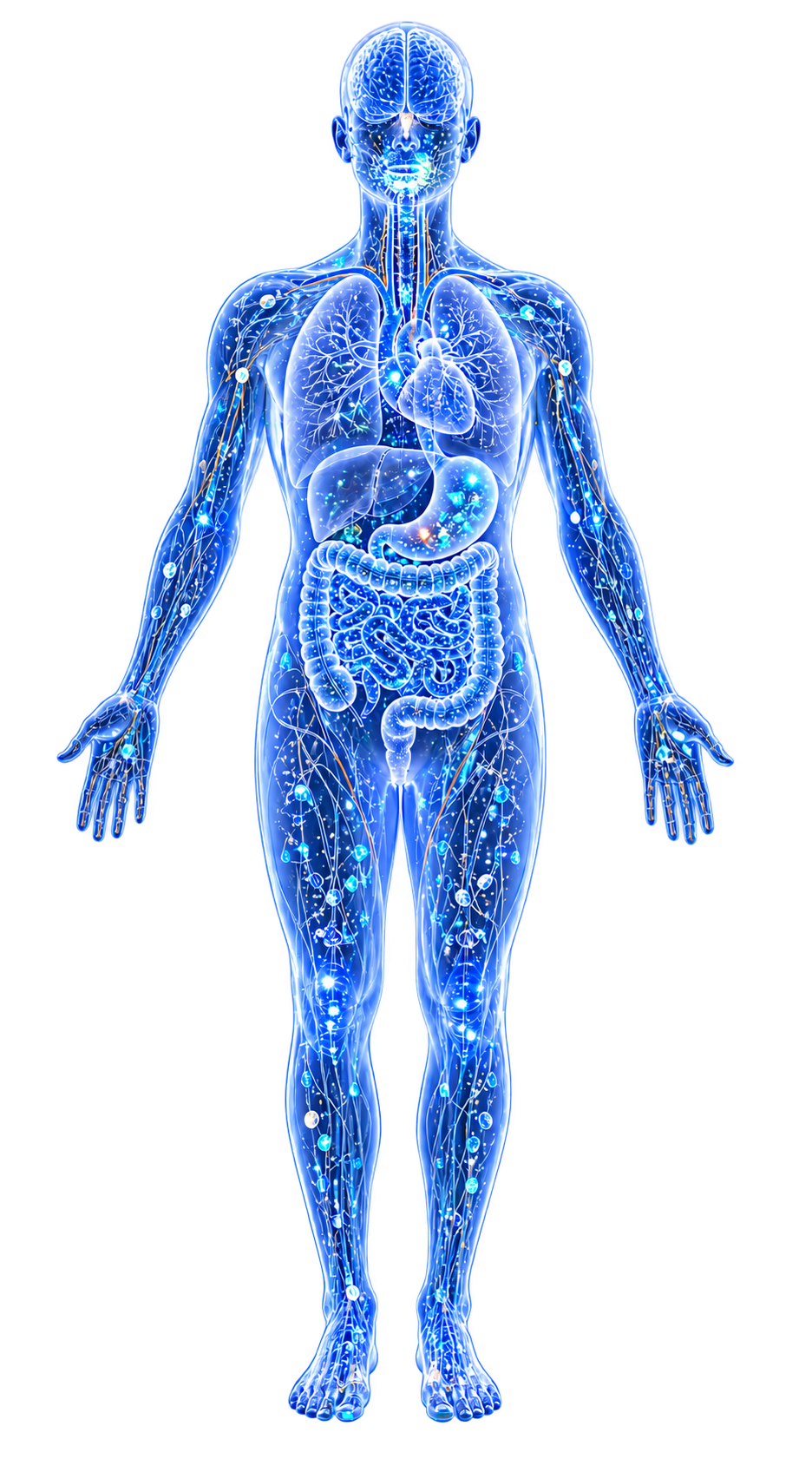
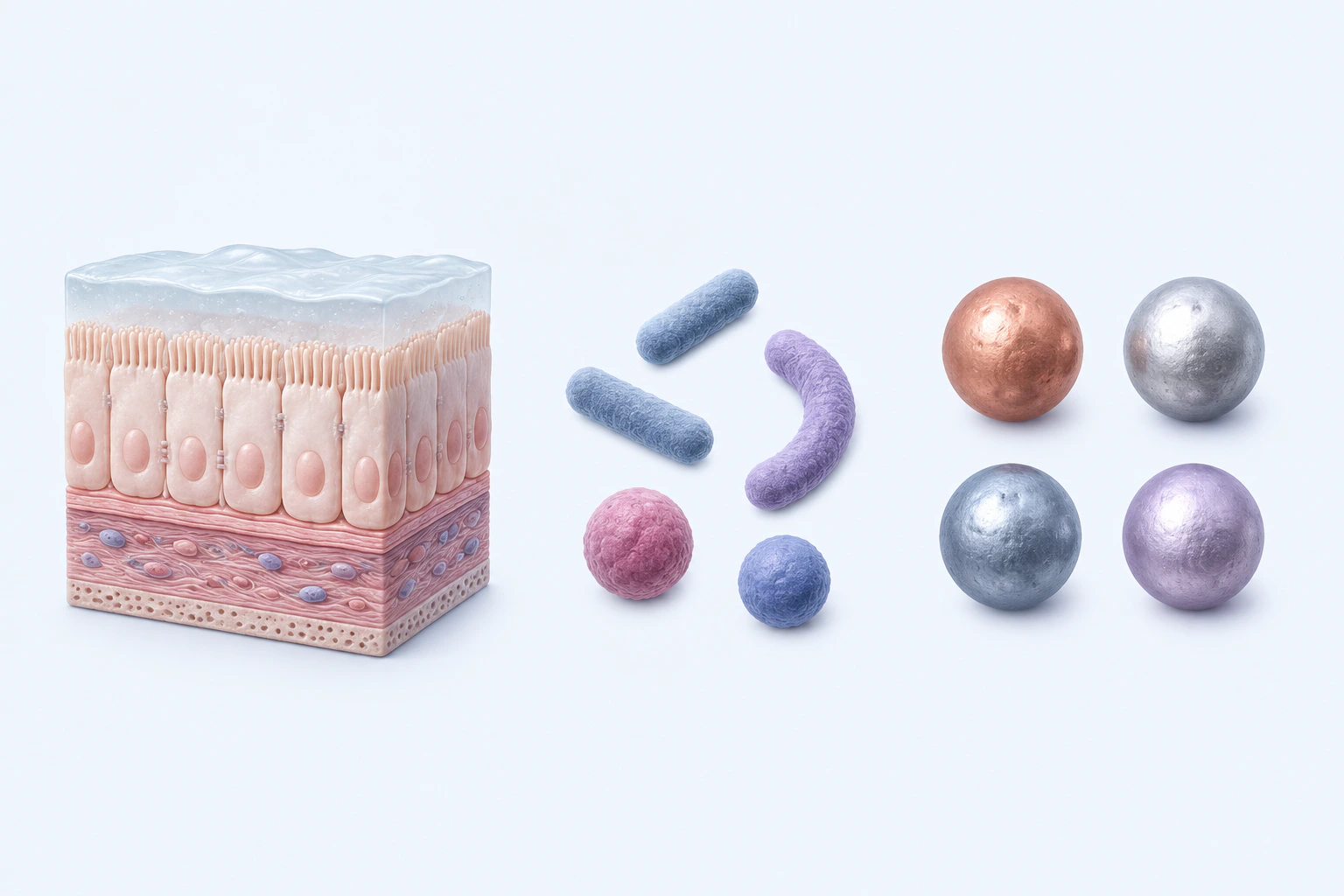
Dietary metal–microbiome context orientation. The separated host, microbial, and metal tokens do not show interaction direction, exchange, abundance, exposure, causal mechanism, disease, or treatment effect.
Scientific media record2 verified identifiers
- Subject
- Dietary Metal-Microbiome Interactionsbiological-process
- Review
- Editorial review completeIdentifiers authority-verified · Accessibility validated · · dietary-metal-microbiome-interactions|dietary-metal-microbiome-interactions-mechanism-v1.webp
- Digital source
- Trained-algorithmic mediaCreated with a trained generative algorithm and reviewed by WikiBiome for subject identity, scientific framing, identifiers, provenance, and accessibility.
- Scientific basis
- Dietary transition metals and host-bacterial interactionsMetal(loid)-gut microbiota interactionsDietary Metal-Microbiome Interactions
- License
- CC BY-SA 4.0Created
Every meal delivers metals to the gut lumen—essential minerals, trace elements, and contaminants alike. These metals do not passively transit the GI tract. They actively reshape the microbial ecosystem, selecting for metal-tolerant organisms, enabling virulence in metal-dependent pathogens, and depleting commensals that lack metal defense mechanisms.
Diet is the primary modifiable variable that determines the metal environment the Gut Microbiome experiences.
Evidence map7 cited passagesInspect provenance +
Microbiota → Metal fate. Gut bacteria modify metal speciation, bioavailability, and host absorption. Bacteria can methylate arsenic (changing its toxicity), reduce chromium (changing its valence state), bind lead and cadmium to cell walls (reducing absorption), and produce organic acids that solubilize insoluble metal complexes. The composition of your gut m
The combination most hostile to gut health also amplifies metal toxicity:
HFD also alters the gut resistome, increasing antibiotic resistance genes that co-select with metal resistance
The standard Western diet creates a worst-case metal ecology: high fat (increases absorption), low fiber (depletes commensals), high processed food (delivers contaminant metals in bioavailable forms from packaging and processing), and low diversity (reduces the metabolic redundancy that buffers against metal perturbation).
A critical and underappreciated connection: dietary metals co-select for antibiotic resistance.
Certain gut microbes provide metal detoxification as an ecosystem service to the host:
Metals do not arrive alone in food. They co-occur with other dietary xenobiotics that interact synergistically:
Contents
1. The Dual Effect: Metals Shape Microbiota, Microbiota Shape Metal Fate2. How Dietary Patterns Create Metal Ecologies3. Metal-Antibiotic Resistance Co-Selection4. Microbial Metal Detoxification as a "Service"5. Dietary Xenobiotics and Metal Interactions6. Practical Implications7. ConnectionsThe Dual Effect: Metals Shape Microbiota, Microbiota Shape Metal Fate#
This is a bidirectional relationship:
Metals → Microbiota. Dietary metals act as selective pressures (Primitive 1). Iron feeds siderophore-producers.
Nickel enables Urease-positive organisms. Cadmium selects for metallothionein-expressing taxa. The metal profile of the diet determines which microbial niches are viable.
Microbiota → Metal fate. Gut bacteria modify metal speciation, bioavailability, and host absorption. Bacteria can methylate arsenic (changing its toxicity), reduce chromium (changing its valence state), bind lead and cadmium to cell walls (reducing absorption), and produce organic acids that solubilize insoluble metal complexes.
The composition of your gut microbiome determines how much dietary metal actually reaches your tissues.[1]Gut Microbiota: A Target for Heavy Metal Toxicity and a Probiotic Protective StrategyHui Duan, Leilei Yu, Fengwei Tian et al. · 2020Open reference 1 ↓
How Dietary Patterns Create Metal Ecologies#
High-Fat, Low-Fiber Diet#
The combination most hostile to gut health also amplifies metal toxicity.[2]High-fat diet affects heavy metal accumulation and toxicity to mice liver and kidney probably via gut microbiotaLiu T, Liang X, Lei C et al. · 2020Open reference 2 ↓
HFD increases gut permeability, allowing more metal translocation to systemic circulation. HFD depletes Butyrate-producing bacteria that maintain gut barrier integrity. Mice on HFD showed increased arsenic (As), cadmium (Cd), and lead (Pb) accumulation in liver and kidney.
HFD mice excreted less metal in feces—meaning more was absorbed.
HFD also alters the gut resistome, increasing antibiotic resistance genes that co-select with metal resistance.[3]High-fat and low-fiber diet elevates the gut resistome: a comparative metagenomic studyYingbo Shen, Da Sun, Kun Chen et al. · 2025Open reference 3 ↓
High-Fiber, Plant-Rich Diet#
Fiber-rich diets generally reduce metal bioavailability to pathogens. Phytates in whole grains chelate iron, zinc, and other divalent metals in the gut lumen. Fiber feeds SCFA-producing commensals that maintain gut barrier function.
SCFAs (butyrate, propionate) lower colonic pH, which reduces solubility of some metal species.
However, plant-rich diets can also deliver more cadmium, nickel, and arsenic through hyperaccumulator crops.
The Western Diet Paradox#
The standard Western diet creates a worst-case metal ecology: high fat (increases absorption), low fiber (depletes commensals), high processed food (delivers contaminant metals in bioavailable forms from packaging and processing), and low diversity (reduces the metabolic redundancy that buffers against metal perturbation).[4]The interplay between diet and the gut microbiome: implications for health and diseaseFiona C. Ross, Dhrati Patangia, Ghjuvan Grimaud et al. · 2024Open reference 4 ↓
Metal-Antibiotic Resistance Co-Selection#
A critical and underappreciated connection: dietary metals co-select for antibiotic resistance.[5]Co-selection of multi-antibiotic resistance in bacterial pathogens in metal and microplastic contaminated environments: an emerging health threatImran M, Das KR, Naik MM · 2019Open reference 5 ↓
Metal resistance genes and antibiotic resistance genes are frequently located on the same mobile genetic elements (plasmids, transposons, integrons). When dietary metals select for metal-resistant organisms, they simultaneously select for antibiotic-resistant organisms—even in the absence of antibiotic exposure.
This means chronic low-level dietary metal exposure (cadmium (Cd) from rice, As from water, nickel (Ni) from legumes) may be contributing to the gut antimicrobial resistance crisis through a mechanism entirely outside the healthcare system.
Microbial Metal Detoxification as a "Service"#
Certain gut microbes provide metal detoxification as an ecosystem service to the host:[6]Heavy Metal-Gut Microbiota Interactions: Probiotics Modulation and Biosensors DetectionLiliana Anchidin-Norocel, Oana C. Iatcu, Andrei Lobiuc et al. · 2025Open reference 6 ↓
| Organism | Metal Detoxification Mechanism | |
|---|---|---|
| [[lactobacillus | Lactobacillus]] spp. | Cell-wall binding of lead (Pb), cadmium (Cd); reduction of chromium (Cr)⁶⁺ to chromium³⁺ |
| [[bifidobacterium | Bifidobacterium]] spp. | Cell-surface adsorption of cadmium, lead |
| [[saccharomyces-cerevisiae | Saccharomyces cerevisiae]] | Cell-wall mannoprotein binding of metals; intracellular metallothionein sequestration |
| [[bacillus | Bacillus]] spp. | Extracellular precipitation of metals; biofilm-mediated immobilization |
Dysbiosis that depletes these organisms reduces the gut's capacity to buffer against dietary metal exposure—creating a feed-forward loop where metal exposure causes dysbiosis that increases metal absorption that worsens dysbiosis.
Dietary Xenobiotics and Metal Interactions#
Metals do not arrive alone in food. They co-occur with other dietary xenobiotics that interact synergistically.[7]Editorial: Risk of dietary hazardous substances and impact on human microbiota: possible role in several dysbiosis phenotypesAguilera M, Lamas B, Van Pamel E et al. · 2021Open reference 7 ↓
Pesticide residues + metals—both disrupt gut microbiota; combined exposure worse than additive. Food additives (emulsifiers, preservatives) + metals—emulsifiers thin the mucus layer, increasing metal contact with epithelium.
Microplastics + metals—microplastics adsorb metals and deliver concentrated doses to the gut; metal leaching from microplastic surfaces provides bioavailable metals in novel locations.
Endocrine-disrupting compounds (EDCs) + metals—both present in processed foods; combined disruption of hormonal and microbial systems.
Practical Implications#
The metallomic lens on diet reveals that food quality is a microbial ecology question, not just a nutrition question. The metals in food determine which microbes can thrive, and the microbes present determine how much metal reaches the host.
Dietary interventions that ignore this bidirectional relationship are operating with an incomplete model.
Connections#
- Dietary Iron and Gut Ecology—iron as the most studied dietary metal-microbiome interaction
- Dietary Cadmium Exposure—cadmium in staple crops
- Dietary Arsenic Exposure—arsenic in rice and water
- Dietary Lead Exposure—lead from infrastructure and processing
- Dietary Nickel Exposure—nickel in plant-based foods
- Heavy Metals in Infant Foods—infant vulnerability to dietary metals
- Plant Metal Hyperaccumulation—why healthy crops accumulate toxic metals
- Antimicrobial Resistance—metal-antibiotic co-selection
- Gut-Metal-Microbiome Interactions—broader metal-microbiome concept
- dysbiosis—the end state of chronic dietary metal perturbation
References 8
Numbered by first appearance in the article, then reconciled with its declared source list.
- 1
★Hui Duan, Leilei Yu, Fengwei Tian et al. (2020). Gut Microbiota: A Target for Heavy Metal Toxicity and a Probiotic Protective Strategy. Science of the Total Environment.
- 2
Liu T, Liang X, Lei C et al. (2020). High-fat diet affects heavy metal accumulation and toxicity to mice liver and kidney probably via gut microbiota. Frontiers in Microbiology.
- 3
Yingbo Shen, Da Sun, Kun Chen et al. (2025). High-fat and low-fiber diet elevates the gut resistome: a comparative metagenomic study. npj Biofilms and Microbiomes.
- 4
Fiona C. Ross, Dhrati Patangia, Ghjuvan Grimaud et al. (2024). The interplay between diet and the gut microbiome: implications for health and disease. Nature Reviews Microbiology.
- 5
Imran M, Das KR, Naik MM (2019). Co-selection of multi-antibiotic resistance in bacterial pathogens in metal and microplastic contaminated environments: an emerging health threat. Chemosphere.
- 6
★Liliana Anchidin-Norocel, Oana C. Iatcu, Andrei Lobiuc et al. (2025). Heavy Metal-Gut Microbiota Interactions: Probiotics Modulation and Biosensors Detection. Biosensors.
- 7
Aguilera M, Lamas B, Van Pamel E et al. (2021). Editorial: Risk of dietary hazardous substances and impact on human microbiota: possible role in several dysbiosis phenotypes. Frontiers in Microbiology.
- 8
Richardson JB, Dancy BCR, Horton CL et al. (2018). Exposure to toxic metals triggers unique responses from the rat gut microbiota. Scientific Reports.
Article network
Mentioned here 17
Pages linking here 3
Connect the evidence
Publicly readable discussion by ORCID-authenticated researchers. Questions, interpretation, methods, corrections, and new evidence stay attached to this record.
No discussion yet. Start with a precise question or a source-backed observation.
Activity and accepted changes
Accepted researcher context, editorial status, public discussion, and upstream Git revisions are shown together. Pending, declined, and withdrawn proposals remain private.
- published revision
Backfill gut microbiome concept links
Karen Pendergrass · +1 −1
Inspect exact Git diff ↗ - published revision
Complete corpus-wide Dysbiosis linking
Karen Pendergrass · +2 −2
Inspect exact Git diff ↗ - published revision
Complete reviewed Urease contextual coverage
Karen Pendergrass · +1 −1
Inspect exact Git diff ↗ - published revision
massive wiki expansion: 149 stubs fixed, 100+ new pages, Rule 15 scan, keystone papers
WikiBiome Deploy Bot · +9 −9
Inspect exact Git diff ↗ - published revision
nightly maintenance: 94 stub demotions, 181 source_count fixes, 22 auto-discovered stubs, 5 adversarial audits, 3 boundary fixes, 3 evidence-level corrections
WikiBiome Deploy Bot · +1 −0
Inspect exact Git diff ↗ - published revision
pre-overnight checkpoint 2026-04-18
WikiBiome Deploy Bot · +3 −0
Inspect exact Git diff ↗ - published revision
WikiBiome update — 2026-04-15 17:23
WikiBiome Deploy Bot · +0 −1
Inspect exact Git diff ↗ - published revision
WikiBiome v2 migration: signature pages + safety fixes + gap analysis
WikiBiome Deploy Bot · +4 −4
Inspect exact Git diff ↗ - published revision
WikiBiome update — integrity fixes, metallomic diet pages, cross-condition analyses
WikiBiome Deploy Bot · +94 −0
Inspect exact Git diff ↗