
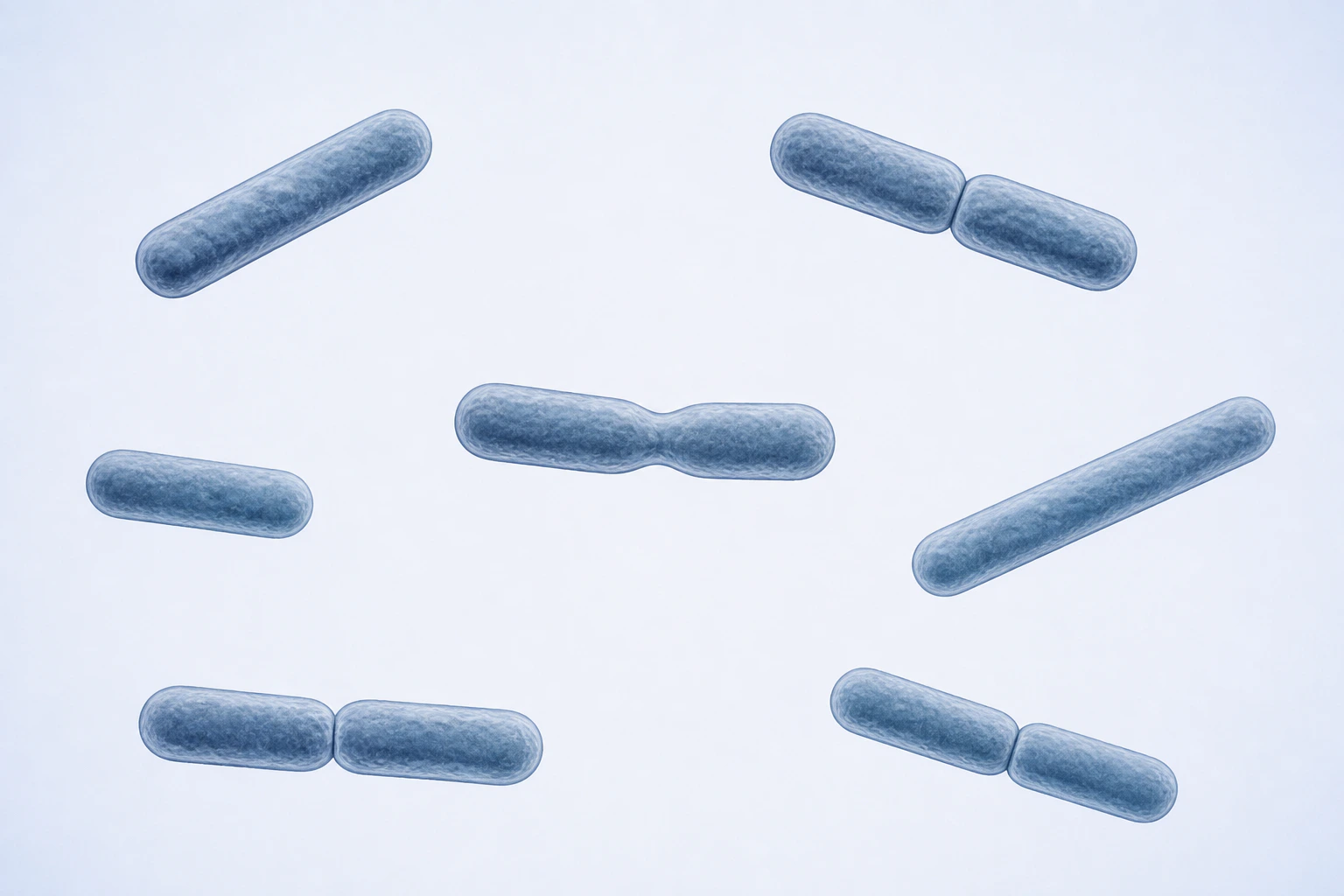
Selected type-species-anchored Faecalibacterium straight-rod forms, shown as eleven bodies in three single and four paired groupings. This genus-level scientific reconstruction is representative, non-diagnostic, and not a micrograph.
Scientific media record1 verified identifier
- Subject
- Faecalibacteriumtaxon · genus
- Identifiers
- NCBITaxon:216851
- Review
- Editorial review completeIdentifiers authority-verified · Accessibility validated · · faecalibacterium|faecalibacterium-morphology-v1.webp
- Digital source
- Trained-algorithmic mediaCreated with a trained generative algorithm and reviewed by WikiBiome for subject identity, scientific framing, identifiers, provenance, and accessibility.
- Scientific basis
- Faecalibacterium — NCBI TaxonomyFaecalibacterium — LPSNFaecalibacterium gen. nov.Faecalibacterium gen. nov. primary descriptionFaecalibacterium genus treatment
- License
- CC BY-SA 4.0Created
Faecalibacterium is a genus of obligate anaerobic, Gram-positive bacteria in the family Ruminococcaceae (phylum Firmicutes). It is the most abundant genus in the healthy human colon (5–15% of fecal bacteria) and its depletion is the single most reproducible microbiome finding across disease states.
The genus contains multiple species, but Faecalibacterium prausnitzii dominates in adults.
For the detailed species page with metal dependencies, arsenic protection data, and disease-specific depletion patterns, see Faecalibacterium prausnitzii.
Evidence map3 cited passagesInspect provenance +
F. prausnitzii—The dominant species; premier butyrate producer; directly protective against arsenic toxicity.
F. hominis—Recently characterized; produces indole derivatives that activate AhR signaling, with therapeutic implications for ASD.
Butyrate production depends on iron-sulfur cluster enzymes (butyryl-CoA dehydrogenase). Metal-driven disruption of iron homeostasis can impair Faecalibacterium function even without directly killing it—a subtle but critical mechanism.
Species#
F. prausnitzii—The dominant species; premier Butyrate producer; directly protective against arsenic toxicity.[1]The gut microbiome is required for full protection against acute arsenic toxicity in mouse modelsCoryell M, McAlpine M, Pinkham NV et al. · 2018Open reference 1 ↓
F. hominis—Recently characterized; produces indole derivatives that activate AhR signaling, with therapeutic implications for ASD.[2]Yu 2025 — The Gut Commensal Faecalibacterium hominis Attenuates Indole-AhR Signaling and Restores ASD-Like Behaviors with BTBR MiceYou Yu, Yujing Wang, Jie Zhang et al. · 2025Open reference 2 ↓
F. duncaniae—Newly described species from healthy gut.
Why Faecalibacterium Depletion Matters#
Faecalibacterium depletion triggers a cascade. Lost butyrate → colonocyte energy crisis → barrier failure → Endotoxemia. Lost HDAC inhibition → reduced Treg differentiation → immune dysregulation.
Lost oxygen consumption → luminal oxygenation → facultative anaerobe (Enterobacteriaceae) bloom.
Lost competitive exclusion → pathobiont expansion.
This single genus's loss explains why the same Enterobacteriaceae bloom, barrier failure, and systemic Metal-Driven Inflammation appear across such diverse conditions.
Metal Connection#
Butyrate production depends on iron-sulfur cluster enzymes (butyryl-CoA dehydrogenase). Metal-driven disruption of iron homeostasis can impair Faecalibacterium function even without directly killing it—a subtle but critical mechanism.[3]Effects of Heavy Metals on Gut Barrier Integrity and Gut MicrobiotaSweta Ghosh, Syam P. Nukavarpu, Venkatakrishna Rao Jala · 2024Open reference 3 ↓[4]Toxic and Essential Metals: Metabolic Interactions with the Gut Microbiota and Health ImplicationsQinheng Zhu, Boyan Chen, Fu Zhang et al. · 2024Open reference 4 ↓
Cross-References#
- Faecalibacterium prausnitzii—species page with full detail
- butyrate—primary metabolic output
- Short-Chain Fatty Acids (SCFAs)—broader SCFA context
- Iron—iron-sulfur cluster dependency
- Dysbiosis—Faecalibacterium depletion as universal dysbiosis marker
- Arsenic—direct arsenic protection
References 7
Numbered by first appearance in the article, then reconciled with its declared source list.
- 1
Coryell M, McAlpine M, Pinkham NV et al. (2018). The gut microbiome is required for full protection against acute arsenic toxicity in mouse models. Nature Communications.
- 2
You Yu, Yujing Wang, Jie Zhang et al. (2025). Yu 2025 — The Gut Commensal Faecalibacterium hominis Attenuates Indole-AhR Signaling and Restores ASD-Like Behaviors with BTBR Mice. Frontiers in Microbiology.
- 3
★Sweta Ghosh, Syam P. Nukavarpu, Venkatakrishna Rao Jala (2024). Effects of Heavy Metals on Gut Barrier Integrity and Gut Microbiota. Microbiota and Host.
- 4
★Qinheng Zhu, Boyan Chen, Fu Zhang et al. (2024). Toxic and Essential Metals: Metabolic Interactions with the Gut Microbiota and Health Implications. Frontiers in Nutrition.
- 5
★Hui Duan, Leilei Yu, Fengwei Tian et al. (2020). Gut Microbiota: A Target for Heavy Metal Toxicity and a Probiotic Protective Strategy. Science of the Total Environment.
- 6
Matteo Bronzini, Alessandro Maglione, Rachele Rosso et al. (2023). Feeding the gut microbiome: impact on multiple sclerosis. Frontiers in Immunology.
- 7
Han Z, Cen C, Ou Q et al. (2022). Han et al. 2022 — The Potential Prebiotic Berberine Combined With Methimazole Improved the Therapeutic Effect of Graves' Disease Patients Through Regulating the Intestinal Microbiome. Frontiers in Immunology.
Article network
Connect the evidence
Publicly readable discussion by ORCID-authenticated researchers. Questions, interpretation, methods, corrections, and new evidence stay attached to this record.
No discussion yet. Start with a precise question or a source-backed observation.
Activity and accepted changes
Accepted researcher context, editorial status, public discussion, and upstream Git revisions are shown together. Pending, declined, and withdrawn proposals remain private.
- published revision
Backfill inflammation concept links
Karen Pendergrass · +1 −1
Inspect exact Git diff ↗ - published revision
massive wiki expansion: 149 stubs fixed, 100+ new pages, Rule 15 scan, keystone papers
WikiBiome Deploy Bot · +54 −12
Inspect exact Git diff ↗ - published revision
nightly maintenance: 94 stub demotions, 181 source_count fixes, 22 auto-discovered stubs, 5 adversarial audits, 3 boundary fixes, 3 evidence-level corrections
WikiBiome Deploy Bot · +21 −0
Inspect exact Git diff ↗