
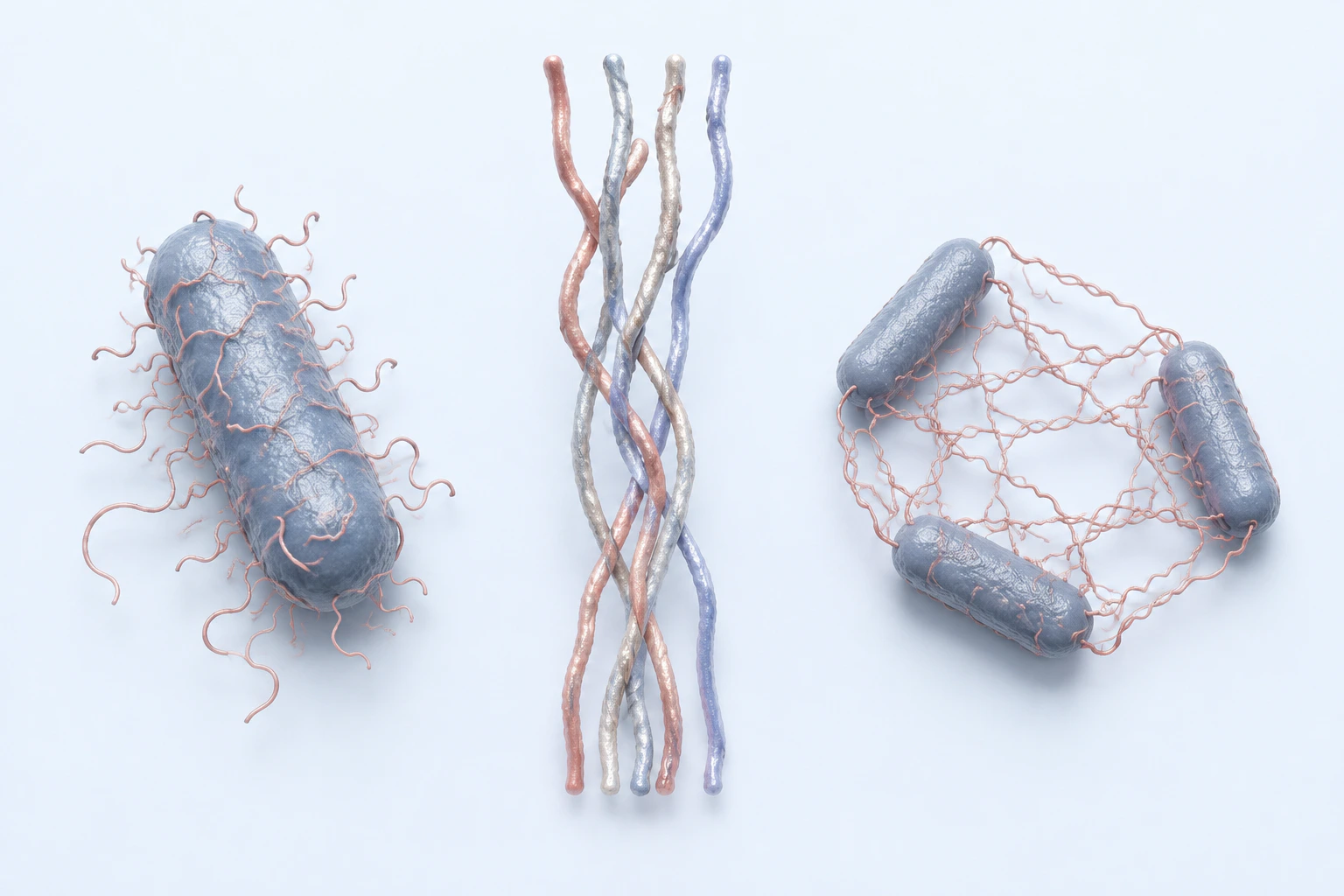
Curli functional-amyloid orientation. The models do not identify a species, measure fiber number or diameter, assign Csg proteins, depict host interaction, establish virulence or disease, or support a treatment claim.
Scientific media record3 verified identifiers
- Subject
- Curlibiological-process
- Identifiers
- WikiBiome:curliPMID:23313395PMCID:PMC6173796
- Review
- Editorial review completeIdentifiers authority-verified · Accessibility validated · · curli|curli-mechanism-v1.webp
- Digital source
- Trained-algorithmic mediaCreated with a trained generative algorithm and reviewed by WikiBiome for subject identity, scientific framing, identifiers, provenance, and accessibility.
- Scientific basis
- Microbial Amyloids—functions and interactions within the hostFunctional Amyloid and Other Protein Fibers in the Biofilm MatrixCurli
- License
- CC BY-SA 4.0Created
Curli are functional amyloid fibers produced by Escherichia coli, Salmonella, and other Enterobacteriaceae as the primary protein component of their extracellular biofilm matrix. The curli subunit CsgA polymerizes into cross-beta-sheet amyloid fibrils that are structurally homologous to human disease-associated amyloids (Aβ, α-synuclein, tau).
This structural homology enables cross-seeding—bacterial curli can nucleate the aggregation of host amyloid proteins, providing a direct microbial-to-neurodegeneration pathway.
Evidence map1 cited passagesInspect provenance +
CsgA fibers produced in the gut by E. coli/Shigella cross-seed amyloid-beta (Aβ) aggregation in Alzheimer's disease and α-synuclein aggregation in Parkinson's disease.
Cross-Seeding Mechanism#
CsgA fibers produced in the gut by E. coli/Shigella cross-seed amyloid-beta (Aβ) aggregation in Alzheimer's disease and α-synuclein aggregation in Parkinson's disease.[1]Pendergrass 2025 — From Dysbiosis to Dyshomeostasis: Why Parkinson's Requires a Metallomic–Microbiome LensKaren Pendergrass · 2025Open reference 1 ↓[2]Microbial Metallomics and Parkinson's Disease: A Unified Metal-Driven Framework Linking Ferroptosis, Dysbiosis, and alpha-Synuclein PathologyKaren Pendergrass · 2025Open reference 2 ↓
Curli fibers activate TLR2/TLR1 on macrophages and microglia, triggering Neuroinflammation.
The gut → brain translocation route: curli or curli-seeded amyloid aggregates may propagate via the vagus nerve (Gut-Brain Axis) or systemic circulation after barrier failure.
Metal Connection#
Iron and zinc are required for curli fiber assembly—CsgA polymerization is metal-dependent.
Metal-Driven Inflammation-driven iron availability in the dysbiotic gut selects for E. coli/Shigella expansion AND provides the metal cofactors for curli production—a convergent pathological mechanism.
This connects Microbial Metallomics directly to neurodegeneration: metal exposure → Enterobacteriaceae bloom → curli production → amyloid cross-seeding → Aβ/α-synuclein aggregation.
Cross-References#
- Escherichia—primary curli producer
- Amyloid-Beta—cross-seeding target in Alzheimer's
- Alpha-Synuclein—cross-seeding target in Parkinson's
- Microbial Metallomics—metals→microbes→neurodegeneration pathway
- Biofilm—curli as biofilm structural component
- Neuroinflammation—curli-TLR2 activation of microglia
- Iron—required for curli fiber assembly
References 3
Numbered by first appearance in the article, then reconciled with its declared source list.
- 1
Karen Pendergrass (2025). Pendergrass 2025 — From Dysbiosis to Dyshomeostasis: Why Parkinson's Requires a Metallomic–Microbiome Lens. Zenodo Preprint.
- 2
★Karen Pendergrass (2025). Microbial Metallomics and Parkinson's Disease: A Unified Metal-Driven Framework Linking Ferroptosis, Dysbiosis, and alpha-Synuclein Pathology. Conference Presentation.
- 3
Khatoon S, Kalam N, Rashid S et al. (2023). Effects of gut microbiota on neurodegenerative diseases. Frontiers in Aging Neuroscience.
Article network
Connect the evidence
Publicly readable discussion by ORCID-authenticated researchers. Questions, interpretation, methods, corrections, and new evidence stay attached to this record.
No discussion yet. Start with a precise question or a source-backed observation.
Activity and accepted changes
Accepted researcher context, editorial status, public discussion, and upstream Git revisions are shown together. Pending, declined, and withdrawn proposals remain private.
- published revision
Backfill inflammation concept links
Karen Pendergrass · +1 −1
Inspect exact Git diff ↗ - published revision
massive wiki expansion: 149 stubs fixed, 100+ new pages, Rule 15 scan, keystone papers
WikiBiome Deploy Bot · +44 −0
Inspect exact Git diff ↗