
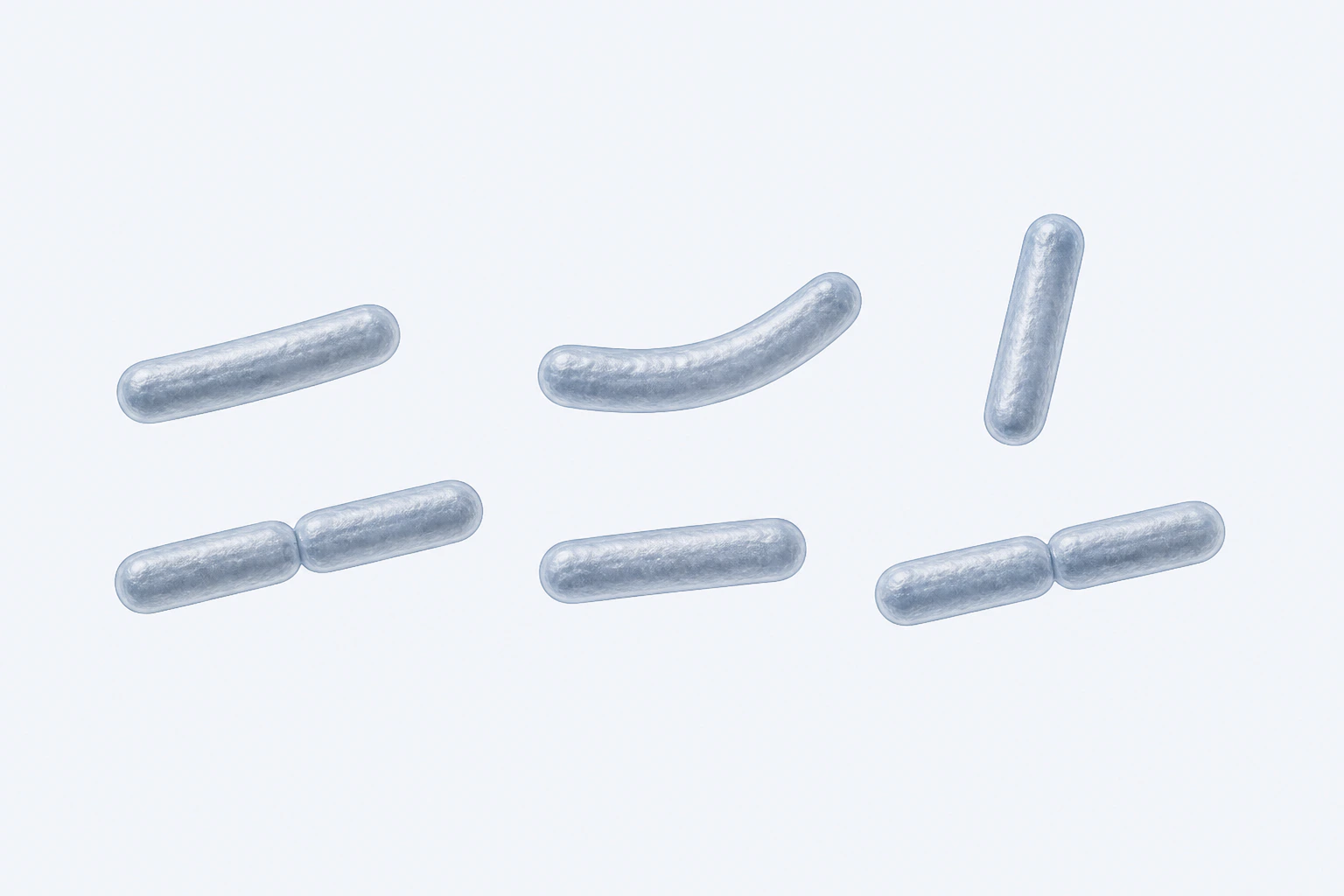
Type-strain-anchored Lactobacillus jensenii rods, shown as eight bodies in four single and two paired groupings. This scientific reconstruction is representative, non-diagnostic, not a micrograph, and makes no universal phenotype claim.
Scientific media record1 verified identifier
- Subject
- Lactobacillus jenseniitaxon · species
- Identifiers
- NCBITaxon:109790
- Review
- Editorial review completeIdentifiers authority-verified · Accessibility validated · · lactobacillus-jensenii|lactobacillus-jensenii-morphology-v1.webp
- Digital source
- Trained-algorithmic mediaCreated with a trained generative algorithm and reviewed by WikiBiome for subject identity, scientific framing, identifiers, provenance, and accessibility.
- Scientific basis
- Lactobacillus jensenii — NCBI TaxonomyLactobacillus jensenii — LPSNLactobacillus jensenii original descriptionLactobacillus jensenii type strain
- License
- CC BY-SA 4.0Created
Lactobacillus jensenii defines Community State Type vanadium (V) (CST-vanadium) in the vaginal microbiome. It produces hydrogen peroxide and lactic acid, contributing to vaginal defense against pathogens, though less dominant than Lactobacillus crispatus (CST-I).
Evidence map5 cited passagesInspect provenance +
HPV: Part of vaginal microbiome in cervical cancer/HPV mega-analysis.
PCOS: Vaginal microbiome context.
Preterm birth: Vaginal metabolomic associations.
Seminal microbiome: Present in male reproductive tract.
FMT: Component of reproductive tract FMT protocols.
Associations#
HPV: Part of vaginal microbiome in cervical cancer/HPV mega-analysis.[1]Rashwan et al. 2025 — Insights into the Tripartite Relationship between Cervical Cancer, HPV, and the Vaginal Microbiome: A Mega-AnalysisRashwan HH, Ali MH, Mostafa MM et al. · 2025Open reference 1 ↓ PCOS: Vaginal microbiome context.[2]Zheng 2024 — Differential enrichment of bacteria and phages in vaginal microbiomes in PCOS and obesity: shotgun sequencing analysisZheng S, Chen H, Yang H et al. · 2024Open reference 2 ↓ Preterm birth: Vaginal metabolomic associations.[3]Pruski & Correia 2021 — Direct On-Swab Metabolic Profiling of Vaginal Microbiome Host Interactions During Pregnancy and Preterm BirthPamela Pruski, Gonçalo D. S. Correia, Holly V. Lewis et al. · 2021Open reference 3 ↓
Seminal microbiome: Present in male reproductive tract.[4]Neto 2024 — Effect of Environmental Factors on Seminal Microbiome and Impact on Sperm QualityFilipe T. Lira Neto, Marina C. Viana, Federica Cariati et al. · 2024Open reference 4 ↓ FMT: Component of reproductive tract FMT protocols.[5]Quaranta 2019 — FMT as a Potential Tool for Female Reproductive Tract Diseases (Review)Georgina Quaranta, Mauro Pittiruti, Brunella Posteraro et al. · 2019Open reference 5 ↓
Cross-References#
- Lactobacillus—genus page
- Lactobacillus crispatus—more protective CST-I dominant species
- Lactobacillaceae—family context
References 5
Numbered by first appearance in the article, then reconciled with its declared source list.
- 1
Rashwan HH, Ali MH, Mostafa MM et al. (2025). Rashwan et al. 2025 — Insights into the Tripartite Relationship between Cervical Cancer, HPV, and the Vaginal Microbiome: A Mega-Analysis. Human Genomics.
- 2
Zheng S, Chen H, Yang H et al. (2024). Zheng 2024 — Differential enrichment of bacteria and phages in vaginal microbiomes in PCOS and obesity: shotgun sequencing analysis. Frontiers in Microbiomes.
- 3
Pamela Pruski, Gonçalo D. S. Correia, Holly V. Lewis et al. (2021). Pruski & Correia 2021 — Direct On-Swab Metabolic Profiling of Vaginal Microbiome Host Interactions During Pregnancy and Preterm Birth. Nature Communications.
- 4
Filipe T. Lira Neto, Marina C. Viana, Federica Cariati et al. (2024). Neto 2024 — Effect of Environmental Factors on Seminal Microbiome and Impact on Sperm Quality. Frontiers in Endocrinology.
- 5
Georgina Quaranta, Mauro Pittiruti, Brunella Posteraro et al. (2019). Quaranta 2019 — FMT as a Potential Tool for Female Reproductive Tract Diseases (Review). Frontiers in Immunology.
Article network
Mentioned here 3
Pages linking here 1
Connect the evidence
Publicly readable discussion by ORCID-authenticated researchers. Questions, interpretation, methods, corrections, and new evidence stay attached to this record.
No discussion yet. Start with a precise question or a source-backed observation.
Activity and accepted changes
Accepted researcher context, editorial status, public discussion, and upstream Git revisions are shown together. Pending, declined, and withdrawn proposals remain private.
- published revision
massive wiki expansion: 149 stubs fixed, 100+ new pages, Rule 15 scan, keystone papers
WikiBiome Deploy Bot · +44 −0
Inspect exact Git diff ↗