

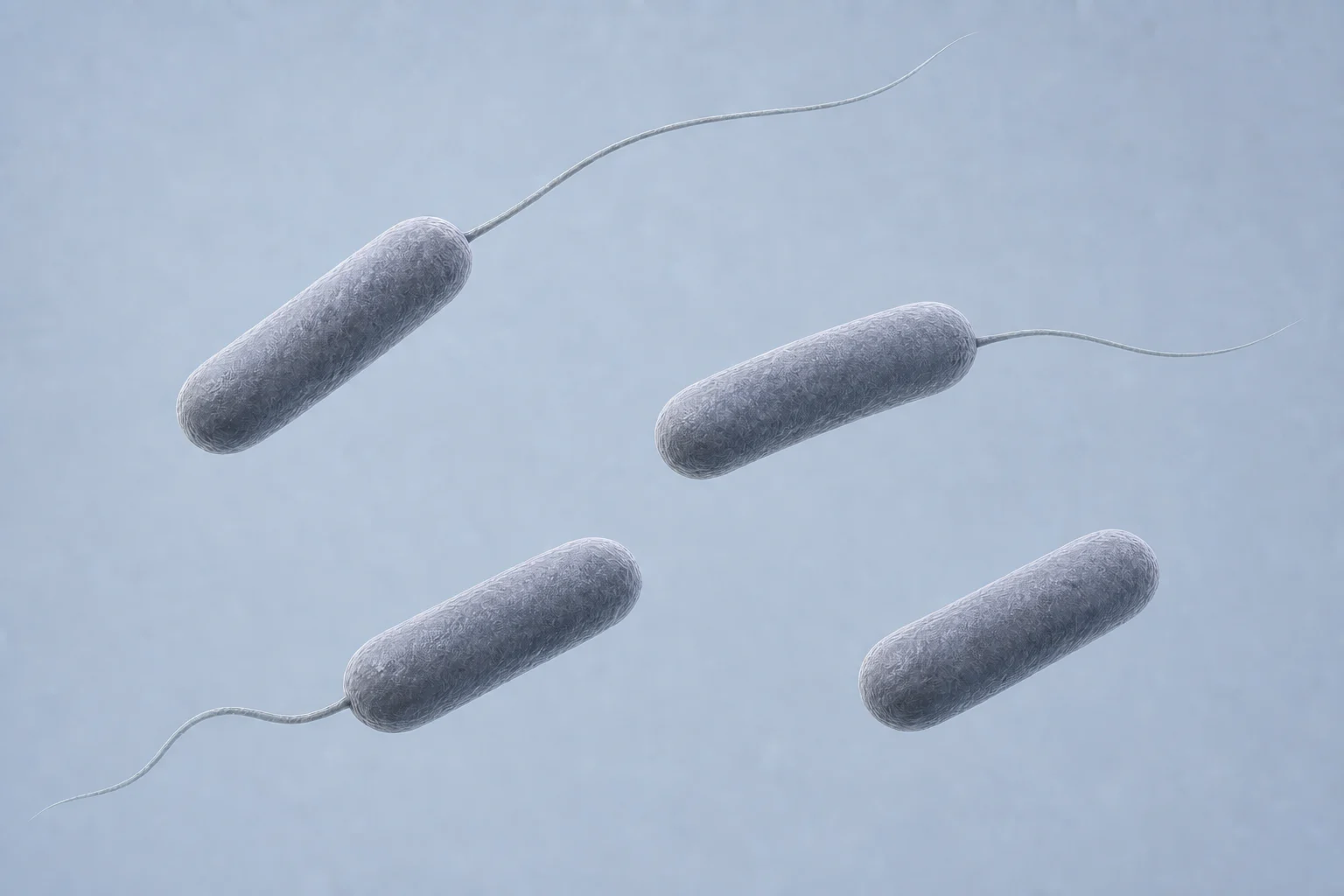
Representative motile Aeromonas rods with single polar flagella. Flagellar expression varies by species and growth condition; morphology alone does not identify a clinical isolate.
Scientific media record1 verified identifier
- Subject
- Aeromonastaxon · genus
- Identifiers
- NCBITaxon:642
- Review
- Editorial review completeIdentifiers authority-verified · Accessibility validated · · aeromonas|aeromonas-morphology-v1.webp
- Digital source
- Trained-algorithmic mediaCreated with a trained generative algorithm and reviewed by WikiBiome for subject identity, scientific framing, identifiers, provenance, and accessibility.
- Scientific basis
- Aeromonas — NCBI TaxonomyPolar and lateral flagella in AeromonasAeromonas hydrophila flagellar systems
- License
- CC BY-SA 4.0Created
Aeromonas is a genus of Gram-negative, facultatively anaerobic bacteria found in aquatic environments and, increasingly recognized as an opportunistic gut pathogen. Several species—particularly Aeromonas hydrophila, A. veronii, and A. caviae—are associated with gastrointestinal illness, dysbiosis, and, in immunocompromised hosts, systemic infection.
Within the gut microbiome literature, Aeromonas is increasingly observed as an enriched organism in dysbiotic signatures.
Contents
1. Metal Dependencies2. Virulence Mechanisms3. Gut Microbiome Context4. Clinical Significance5. Iron Ecology and the Dysbiotic Niche6. Cross-ReferencesMetal Dependencies#
Aeromonas species have a well-characterized dependence on iron for virulence (Byers & Arceneaux 1998 Met Ions Biol Syst; Najimi et al. 2008 Int Microbiol).
They produce siderophores (primarily amonabactin, a catecholate siderophore unique to Aeromonas, and aerobactin-like molecules in some strains) that enable competitive iron acquisition in the iron-limited gut environment (Barghouthi et al. 1989 J Bacteriol; Telford & Raymond 1997).
Iron availability directly regulates the expression of multiple Aeromonas virulence factors via the Fur (ferric uptake regulator) transcription factor (Ebanks et al. 2013). Zinc-dependent metalloproteases are among the primary secreted enzymes responsible for tissue damage (Cascon et al.
2000 Infect Immun).
Virulence Mechanisms#
Aerolysin—a pore-forming toxin that disrupts eukaryotic cell membranes; the defining toxin of the genus (Parker et al. 1994 Nature; Buckley 1999 Curr Top Microbiol Immunol).
Zinc metalloproteases—secreted enzymes that degrade collagen, elastin, and other extracellular matrix proteins, facilitating tissue invasion (Cascon et al. 2000 Infect Immun). Siderophores—iron-chelating molecules enabling survival and proliferation in iron-restricted host environments (Barghouthi et al.
1989 J Bacteriol).
Type III and Type VI secretion systems—direct injection of effector proteins into host cells and competitor bacteria respectively (Sha et al. 2013 Microbiology).
Biofilm formation—on mucosal surfaces and food/water contact surfaces (Jahid & Ha 2014 Microbes Environ).
Gut Microbiome Context#
Aeromonas species are environmental organisms that enter the gut through contaminated water and food (Janda & Abbott 2010 Clin Microbiol Rev).
In the context of gut dysbiosis—particularly when iron ecology is disrupted by conditions such as high luminal iron (from supplementation or heme iron diet)—Aeromonas may find favorable conditions for transient colonization or persistence.
It has been observed as an enriched genus in some inflammatory and dysbiotic gut conditions (Figueras & Beaz-Hidalgo 2015 Clin Microbiol Infect).
As an iron-dependent, siderophore-expressing pathobiont, Aeromonas fits the Karen's Brain Primitive 4 profile: its iron dependencies are Achilles' heels. Conditions that restrict luminal iron (lactoferrin, reduced heme iron dietary intake) would selectively disadvantage Aeromonas relative to iron-independent commensals.
Species-Specific Pathogenicity#
A. hydrophila—most frequently isolated clinical species; produces both aerolysin and ACT (cytotoxic enterotoxin); associated with severe gastroenteritis and wound infection (Chopra & Houston 1999 Microbes Infect).
A. veronii biovar sobria—common waterborne pathogen; implicated in traveler's diarrhea (Janda & Abbott 2010 Clin Microbiol Rev). A. caviae—most common species in pediatric gastroenteritis; produces enterotoxins but generally less invasive.
A. dhakensis—emerging species (formerly confused with A. hydrophila); high virulence in immunocompromised hosts (Figueras et al. 2013 Diagn Microbiol Infect Dis).
Clinical Significance#
Gastroenteritis—watery or bloody diarrhea following exposure to contaminated water; Aeromonas has been implicated in 2–10% of community-acquired diarrhea cases in some regions (Janda & Abbott 2010 Clin Microbiol Rev).
Wound infections—particularly in aquatic injury contexts; A. hydrophila necrotizing fasciitis carries 20–30% mortality in immunocompromised hosts (Furusu et al. 1997). Opportunistic sepsis—in immunocompromised patients (transplant, chemotherapy, cirrhosis); bacteremia mortality ~30% (Tena et al.
2007).
Traveler's diarrhea—an underrecognized contributor in some regions (Vila et al. 2003 J Travel Med). Biliary tract infections—reported in patients with underlying hepatobiliary disease.
Iron Ecology and the Dysbiotic Niche#
The Aeromonas siderophore system (amonabactin family) has strong iron affinity comparable to enterobactin, allowing the organism to compete with host iron-binding proteins (transferrin, lactoferrin) during inflammation (Telford & Raymond 1997).
In iron-rich luminal environments—such as occur with supplemental iron therapy, heme-iron-rich diets, or GI bleeding—Aeromonas gains competitive advantage over commensal anaerobes that rely on host-supplied iron or that have lower-affinity iron acquisition systems. This mirrors the ecological dynamics seen with Enterobacteriaceae and other siderophore-producing pathobionts.
Cross-References#
- Siderophores and Metallophores—iron acquisition mechanism shared with many pathobionts
- Iron—the primary metal driving Aeromonas virulence
- Zinc-Metalloprotease—key secreted enzyme class
- Biofilm—surface colonization mechanism
- Nutritional Immunity (Metal Sequestration)—host defense strategy that sequesters iron away from siderophore-expressing pathogens
- Enterobacteriaceae—co-enriched siderophore-producing family in dysbiotic iron-rich environments
Article network
Mentioned here 6
Pages linking here 1
Connect the evidence
Publicly readable discussion by ORCID-authenticated researchers. Questions, interpretation, methods, corrections, and new evidence stay attached to this record.
No discussion yet. Start with a precise question or a source-backed observation.
Activity and accepted changes
Accepted researcher context, editorial status, public discussion, and upstream Git revisions are shown together. Pending, declined, and withdrawn proposals remain private.
- published revision
massive wiki expansion: 149 stubs fixed, 100+ new pages, Rule 15 scan, keystone papers
WikiBiome Deploy Bot · +16 −16
Inspect exact Git diff ↗ - published revision
ingest: 87 papers (17 endometriosis, 67 erectile dysfunction, 3 cross-condition)
WikiBiome Deploy Bot · +26 −11
Inspect exact Git diff ↗ - published revision
nightly maintenance: 94 stub demotions, 181 source_count fixes, 22 auto-discovered stubs, 5 adversarial audits, 3 boundary fixes, 3 evidence-level corrections
WikiBiome Deploy Bot · +1 −0
Inspect exact Git diff ↗ - published revision
Deep content + citation pass: 10 entities enriched, 7 new sources, DOI integrity
WikiBiome Deploy Bot · +23 −11
Inspect exact Git diff ↗ - published revision
Health check fixes: 40 intervention pages + 14 entity Connections sections
WikiBiome Deploy Bot · +1 −0
Inspect exact Git diff ↗ - published revision
wiki: bulk entity upgrades, new article pages, and site regeneration
WikiBiome Deploy Bot · +6 −0
Inspect exact Git diff ↗ - published revision
WikiBiome v2 migration: signature pages + safety fixes + gap analysis
WikiBiome Deploy Bot · +48 −0
Inspect exact Git diff ↗