
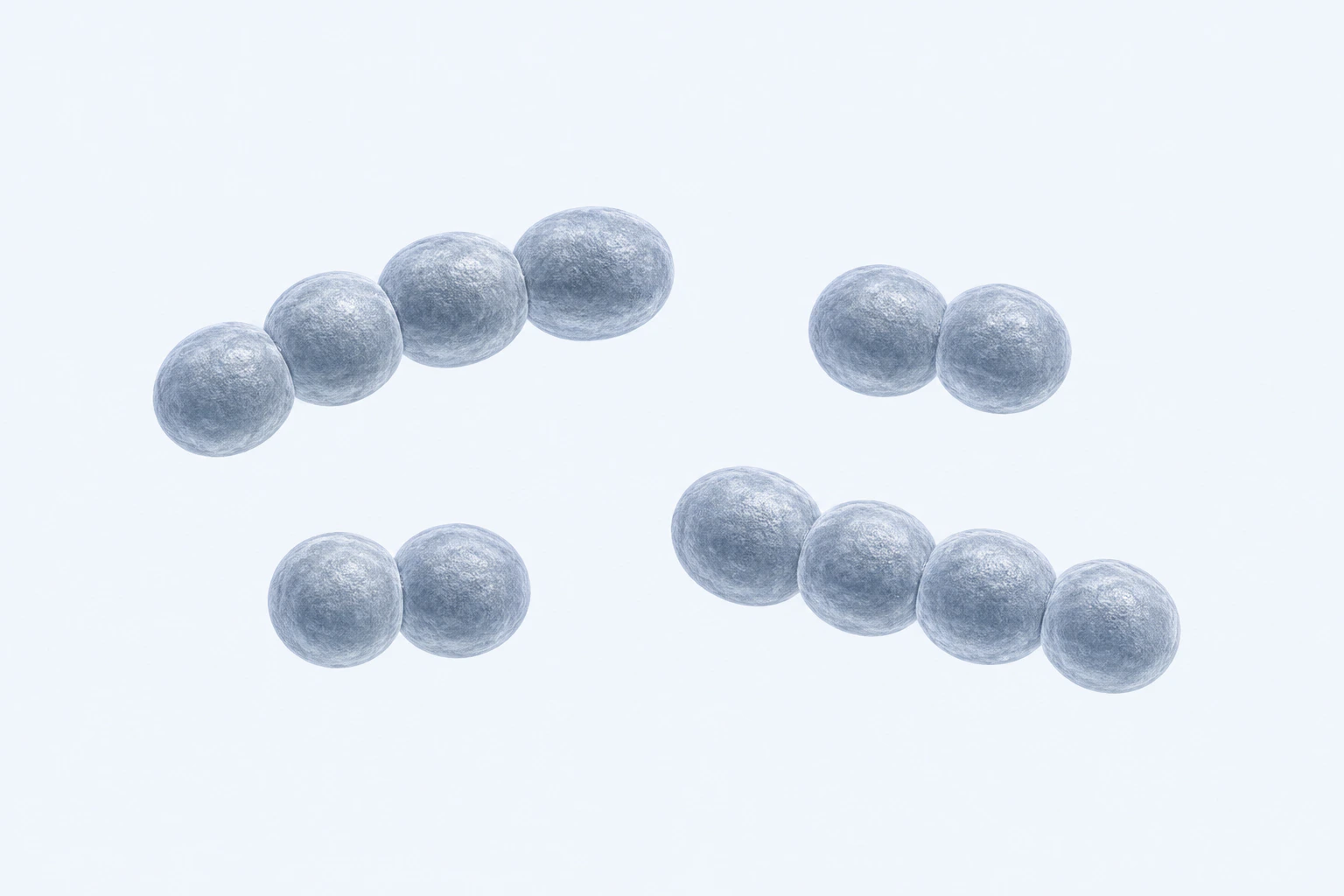
Type-strain-anchored Streptococcus gallolyticus reconstruction with twelve cocci in short chains and pairs. Representative, non-diagnostic, not a subspecies claim, and not a micrograph.
Scientific media record1 verified identifier
- Subject
- Streptococcus gallolyticustaxon · species
- Identifiers
- NCBITaxon:315405
- Review
- Editorial review completeIdentifiers authority-verified · Accessibility validated · · streptococcus-gallolyticus|streptococcus-gallolyticus-morphology-v1.webp
- Digital source
- Trained-algorithmic mediaCreated with a trained generative algorithm and reviewed by WikiBiome for subject identity, scientific framing, identifiers, provenance, and accessibility.
- Scientific basis
- Streptococcus gallolyticus — NCBI TaxonomyStreptococcus gallolyticus — LPSNStreptococcus — Medical Microbiology
- License
- CC BY-SA 4.0Created
A Gram-positive, facultatively anaerobic bacterium formerly classified as Streptococcus bovis biotype I that holds a unique position in clinical medicine as a sentinel organism for colorectal cancer.
The detection of S. gallolyticus in blood cultures (bacteremia or endocarditis) has been a recognized indication for colonoscopy since the 1970s—one of the oldest and most reliable microbiome-cancer associations in medicine.
Modern genomic and mechanistic studies have revealed why: S. gallolyticus possesses collagen-binding pili that give it tumor tropism, allowing it to selectively colonize colonic lesions where the basement membrane collagen is exposed.
Evidence map4 cited passagesInspect provenance +
The classic association. S. gallolyticus bacteremia or endocarditis in a patient without an apparent source triggers colonoscopy to search for occult CRC. Serum antibody levels to S. gallolyticus are consistently associated with CRC risk across systematic reviews. The organism is cataloged among the six bacteria with well-characterized pro-tumorigenic mechan
(review)—Cataloged S. gallolyticus among six CRC-associated bacteria with specific pro-tumorigenic mechanisms.
(systematic review)—Confirmed serum antibody levels to S. gallolyticus as a consistent CRC risk biomarker.
(review)—Documented S. bovis enrichment as part of CRC dysbiosis.
Contents
1. Taxonomy2. Metal Dependencies3. Key Enzymes and Virulence Factors4. Ecological Role5. Conditions Associated6. Key Studies7. Cross-ReferencesTaxonomy#
Streptococcus gallolyticus subsp. gallolyticus—the CRC-associated subspecies. Family Streptococcaceae, order Lactobacillales, class Bacilli, phylum Firmicutes. Formerly Streptococcus bovis biotype I; reclassified by Schlegel *et al.
* (2003). Clinical literature frequently uses the older name, creating confusion.
S. gallolyticus subsp. pasteurianus (formerly S. bovis biotype II/2) is less strongly associated with CRC.
Metal Dependencies#
Manganese. Like other streptococci, S. gallolyticus relies heavily on manganese for superoxide dismutase (SodA) activity, protecting against Oxidative Stress in the inflammatory tumor microenvironment. Manganese-dependent phosphoglyceromutase is essential for glycolytic metabolism.
Iron. S. gallolyticus has relatively modest iron requirements compared to siderophore-producing pathogens, relying primarily on manganese (Mn)-centered rather than iron (Fe)-centered enzymes for oxidative stress defense. The tumor microenvironment's iron excess from hemorrhage may indirectly benefit S. gallolyticus by supporting the growth of co-colonizing anaerobes that create favorable conditions.
Key Enzymes and Virulence Factors#
Tannase (gallate decarboxylase): The eponymous enzyme—S. gallolyticus can degrade gallotannins (found in tea, wine, and plant-derived foods) into gallic acid and glucose. This metabolic capability provides a nutritional advantage in the colonic environment and may generate antimicrobial metabolites that suppress competitors.
Collagen-binding pili (Pil1, Pil2, Pil3): The mechanistic basis of tumor tropism. These pili bind to exposed collagen in damaged or neoplastic colonic mucosa where the epithelial barrier has been breached, allowing S. gallolyticus to selectively colonize tumor sites.
COX-2 induction: S. gallolyticus upregulates cyclooxygenase-2 in colonic epithelial cells, driving PGE2 production. PGE2 promotes cell proliferation, angiogenesis, and immune evasion—a well-established pro-tumorigenic pathway.
Beta-glucuronidase: Contributes to estrogen and xenobiotic deconjugation; relevant to the broader estrobolome.
Ecological Role#
In the Healthy Gut#
S. gallolyticus is a low-abundance commensal of the human gut, also found in animals (cattle, sheep, birds) and dairy products. In healthy individuals with intact colonic epithelium, the collagen-binding pili have no exposed substrate, keeping S. gallolyticus at low colonization density.
Tumor Tropism#
When colorectal neoplasia develops and the basement membrane becomes exposed, S. gallolyticus gains a selective advantage through collagen binding. This creates a positive feedback loop.
Early neoplasia → collagen exposure → S. gallolyticus colonization. S. gallolyticus → COX-2/PGE2 → enhanced proliferation and Metal-Driven Inflammation. Tumor progression → more collagen exposure → denser colonization.
This makes S. gallolyticus both a biomarker of existing neoplasia and a potential accelerator of carcinogenesis.
Conditions Associated#
Colorectal Cancer#
The classic association. S. gallolyticus bacteremia or endocarditis in a patient without an apparent source triggers colonoscopy to search for occult CRC. Serum antibody levels to S. gallolyticus are consistently associated with CRC risk across systematic reviews.[1]A Systematic Review of Microbial Markers for Risk Prediction of Colorectal NeoplasiaYu L, Zhao G, Wang L et al. · 2022Open reference 1 ↓
The organism is cataloged among the six bacteria with well-characterized pro-tumorigenic mechanisms in the CRC microenvironment,[2]Immune System, Microbiota, and Microbial Metabolites: The Unresolved Triad in Colorectal Cancer MicroenvironmentHanus M, Parada-Venegas D, Landskron G et al. · 2021Open reference 2 ↓ alongside Fusobacterium nucleatum, Bacteroides fragilis, pks+ Escherichia coli, Peptostreptococcus anaerobius, and Enterococcus faecalis.
Infective Endocarditis#
S. gallolyticus is a recognized cause of infective endocarditis, particularly in elderly patients. The clinical triad of S. gallolyticus endocarditis + CRC + hepatobiliary disease has been documented for decades and remains a mandatory screening trigger.
Key Studies#
[2]Immune System, Microbiota, and Microbial Metabolites: The Unresolved Triad in Colorectal Cancer MicroenvironmentHanus M, Parada-Venegas D, Landskron G et al. · 2021Open reference 2 ↓ (review)—Cataloged S. gallolyticus among six CRC-associated bacteria with specific pro-tumorigenic mechanisms.
[1]A Systematic Review of Microbial Markers for Risk Prediction of Colorectal NeoplasiaYu L, Zhao G, Wang L et al. · 2022Open reference 1 ↓ (systematic review)—Confirmed serum antibody levels to S. gallolyticus as a consistent CRC risk biomarker.
[3]Dissecting the Role of the Gut Microbiome and Fecal Microbiota Transplantation in Radio- and Immunotherapy Treatment of Colorectal CancerLena Van Dingenen, Charlotte Segers, Shari Wouters et al. · 2023Open reference 3 ↓ (review)—Documented S. bovis enrichment as part of CRC Dysbiosis.
Cross-References#
- Colorectal Cancer—the defining disease association; bacteremia as a CRC screening trigger
- Fusobacterium nucleatum—co-enriched CRC pathobiont; complementary adhesion mechanism (FadA vs. collagen pili)
- Peptostreptococcus anaerobius—co-enriched in CRC tumor microenvironment
- Bacteroides fragilis—ETBF strains contribute to CRC via BFT toxin
- Enterococcus faecalis—superoxide-producing CRC contributor
- Escherichia coli—pks+ strains produce colibactin genotoxin
- Beta-Glucuronidase—S. gallolyticus contributes to estrogen/xenobiotic deconjugation
References 3
Numbered by first appearance in the article, then reconciled with its declared source list.
- 1
Yu L, Zhao G, Wang L et al. (2022). A Systematic Review of Microbial Markers for Risk Prediction of Colorectal Neoplasia. British Journal of Cancer.
- 2
Hanus M, Parada-Venegas D, Landskron G et al. (2021). Immune System, Microbiota, and Microbial Metabolites: The Unresolved Triad in Colorectal Cancer Microenvironment. Frontiers in Immunology.
- 3
Lena Van Dingenen, Charlotte Segers, Shari Wouters et al. (2023). Dissecting the Role of the Gut Microbiome and Fecal Microbiota Transplantation in Radio- and Immunotherapy Treatment of Colorectal Cancer. Frontiers in Cellular and Infection Microbiology.
Article network
Connect the evidence
Publicly readable discussion by ORCID-authenticated researchers. Questions, interpretation, methods, corrections, and new evidence stay attached to this record.
No discussion yet. Start with a precise question or a source-backed observation.
Activity and accepted changes
Accepted researcher context, editorial status, public discussion, and upstream Git revisions are shown together. Pending, declined, and withdrawn proposals remain private.
- published revision
Backfill oxidative stress concept links
Karen Pendergrass · +1 −1
Inspect exact Git diff ↗ - published revision
Backfill inflammation concept links
Karen Pendergrass · +1 −1
Inspect exact Git diff ↗ - published revision
Complete corpus-wide Dysbiosis linking
Karen Pendergrass · +1 −1
Inspect exact Git diff ↗ - published revision
massive wiki expansion: 149 stubs fixed, 100+ new pages, Rule 15 scan, keystone papers
WikiBiome Deploy Bot · +8 −8
Inspect exact Git diff ↗ - published revision
pre-overnight checkpoint 2026-04-18
WikiBiome Deploy Bot · +88 −0
Inspect exact Git diff ↗