
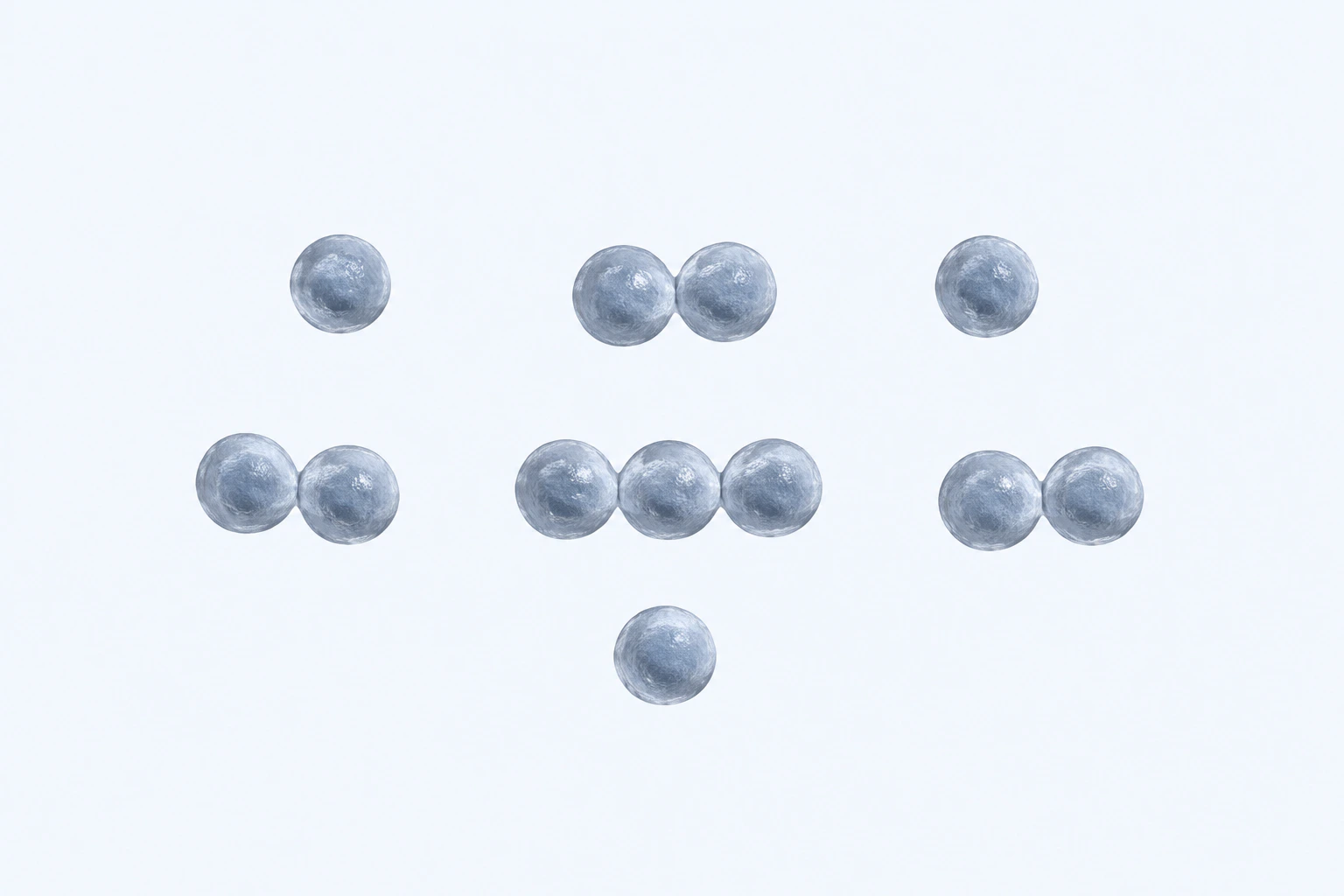
Type-strain-anchored Peptostreptococcus stomatis reconstruction showing twelve coccoid bodies in three single, three paired, and one three-body chain grouping. This species plate is representative, non-diagnostic, and not a micrograph.
Scientific media record1 verified identifier
- Subject
- Peptostreptococcus stomatistaxon · species
- Identifiers
- NCBITaxon:341694
- Review
- Editorial review completeIdentifiers authority-verified · Accessibility validated · · peptostreptococcus-stomatis|peptostreptococcus-stomatis-morphology-v1.webp
- Digital source
- Trained-algorithmic mediaCreated with a trained generative algorithm and reviewed by WikiBiome for subject identity, scientific framing, identifiers, provenance, and accessibility.
- Scientific basis
- Peptostreptococcus stomatis — NCBI TaxonomyPeptostreptococcus stomatis — LPSNPeptostreptococcus stomatis sp. nov., isolated from the human oral cavityPeptostreptococcus stomatis type strain — BacDive
- License
- CC BY-SA 4.0Created
Peptostreptococcus stomatis is a Gram-positive, obligately anaerobic coccus originally isolated from the human oral cavity (oral streptococcal species) that has emerged as a carcinogenic oral pathobiont enriched in colorectal cancer, particularly in advanced stages.
Unlike commensal oral streptococci, P. stomatis carries a polyketide synthase (pks) gene cluster homologous to colibactin biosynthesis operon found in pathogenic Escherichia coli strains, enabling it to produce colibactin and related genotoxic metabolites that cause DNA double-strand breaks in colonocytes.
This makes P. stomatis a direct contributor to the molecular carcinogenesis pathway in CRC, operating as a member of the oral-colorectal carcinogenic consortium alongside Fusobacterium nucleatum, Parvimonas micra, and Clostridium symbiosum. Its abundance correlates with advanced adenoma stage and presence of colibactin-associated DNA lesions (γH2AX foci in colonocyte nuclei).
Contents
1. Taxonomy and Basic Properties2. Colibactin Biosynthesis and Genotoxin Production3. Iron Dependency and Growth Characteristics4. Role in Colorectal Cancer and Carcinogenic Consortium5. Distinction from Non-Pathogenic Streptococci6. Detection and Quantification7. Typical Abundance Ranges8. Connections to WikiBiome Entities and Disease SignaturesTaxonomy and Basic Properties#
- Phylum: Firmicutes
- Class: Clostridia
- Order: Clostridiales
- Family: Peptoniphilaceae
- Genus: Peptostreptococcus
- Species: Peptostreptococcus stomatis
- Cell Type: Coccus (round); obligate anaerobe; non-motile
- Gram Stain: Positive (thick peptidoglycan; no outer membrane)
- Cell Size: 0.5–1.0 µm diameter (similar to Parvimonas micra; small for Gram-positive cocci)
- Genome: ~3.2 Mb (complete genome available)
- pks Cluster Status: Carries homologous pks gene cluster (53–55 kb) nearly identical to E. coli enterobacteria-specific pathogenicity island (ECPAT)
Colibactin Biosynthesis and Genotoxin Production#
Polyketide Synthase (pks) Gene Cluster#
P. stomatis harbors a pks operon encoding colibactin biosynthesis enzymes, making it one of the few non-Enterobacteriaceae bacteria capable of producing this compound. The pks cluster contains.
Polyketide synthase (PksA, PksB): Condensation and elongation of polyketide backbone. Tailoring enzymes: Cyclization, reduction, oxidation of intermediates. Transport/export systems: Secretion of mature colibactin across bacterial cell membrane.
Phylogenetic analysis suggests P. stomatis acquired the pks cluster via horizontal gene transfer from pathogenic E. coli strains, indicating a shared carcinogenic ancestry between oral and enteric genotoxigenic pathogens.
Colibactin Structure and Mechanism#
Colibactin is a hybrid polyketide-nonribosomal peptide (~1000 Da; partially characterized structure):
`` Colibactin (mature form) ↓ (secretion; uncertain cellular target) ↓ (proposed: cellular internalization via endocytosis or transporter) → Nuclear translocation [uncertain mechanism; possibly through nucleoporin disruption] → DNA binding / intercalation → Formation of DNA adducts (premutagenic lesions) → Replication fork stalling → Double-strand break (DSB) formation via replication machinery collision → γH2AX (histone 2AX phosphorylation) at DSB sites → p53 activation / cell cycle arrest / apoptosis (acute) → Genomic instability / aberrant DNA repair / mutation fixation (chronic) ``
Cellular Effects in Colonocytes#
| Effect | Mechanism | Consequence |
|---|---|---|
| DNA Double-Strand Breaks (DSBs) | Colibactin-DNA adduct + replication fork collision | γH2AX foci; p53 activation |
| Genomic Instability | Aberrant DSB repair (non-homologous end-joining errors) | Mutations in APC, KRAS, TP53 |
| Inflammatory Response | DSBs trigger TLR9 and cGAS-STING innate immune signaling | IL-6, IL-17 production; Th17 polarization |
| Cell Cycle Arrest/Apoptosis | p53-dependent senescence or programmed cell death | Epithelial shedding; cryptal hyperplasia |
| Mutagenesis | Fixed mutations in surviving cells | Adenoma initiation; clonal expansion |
The combination of direct genotoxicity + inflammatory amplification makes colibactin-producing P. stomatis a potent carcinogen; its effect on CRC risk is dose-dependent and strain-specific based on pks cluster expression level.
Iron Dependency and Growth Characteristics#
Iron Acquisition#
- P. stomatis is iron-dependent; requires iron(II) (Fe2+)/iron(III) for:
- Cytochrome biosynthesis (anaerobic electron transport)
- Iron-sulfur cluster assembly
- Polyketide synthase cofactor maturation (some PKS enzymes require iron-coordination)
- No siderophore production (unlike Parvimonas micra); relies on scavenging ferrous iron from the colonic lumen and competing with host hepcidin.
Growth in the CRC Microenvironment#
Obligate anaerobe: Inhibited by O2 >5 ppm; thrives in biofilms and mucin-rich colonic crypts. Biofilm-integrated: Does not form independent biofilms but integrates into polymicrobial biofilms nucleated by Parvimonas micra and Fusobacterium nucleatum.
Slow grower: Doubling time ~6–8 hours; slower than E. coli but faster than methanogens. In dense biofilms, growth is limited by nutrient/oxygen flux.
Role in Colorectal Cancer and Carcinogenic Consortium#
Stage-Dependent Enrichment#
Unlike Parvimonas micra and Fusobacterium nucleatum which enrich early (in adenomas), P. stomatis shows stage-dependent enrichment:
- Healthy adults: <10^3 copies/g feces; minimal
- Advanced adenoma (AJCC stage III): 10^4–10^6 copies/g feces (emerging enrichment)
- Incident CRC: 10^6–10^8 copies/g feces (dramatic enrichment)
- Advanced CRC (stage IV, metastatic): 10^7–10^9 copies/g feces (peak abundance)
This stage-specific enrichment pattern suggests P. stomatis accelerates the adenoma-to-carcinoma transition rather than initiating adenoma formation.
Oral-Colorectal Translocation and Pathobiont Consortium#
P. stomatis follows the same oral-colorectal axis as Parvimonas micra:
- Oral origin: Normal oral microbiota; enriched in periodontal disease.
- Periodontitis → intestinal Dysbiosis: Periodontal pathogens (including P. stomatis) → chronic Metal-Driven Inflammation → intestinal barrier disruption.
- Translocation: Leaky gut → bacteremia → fecal reseeding → colon recolonization.
- Biofilm integration: In dysbiotic colon, P. stomatis integrates into polymicrobial CRC biofilms:
| Partner | Synergistic Role |
|---|---|
| Parvimonas micra | Biofilm nucleator; iron scavenger; direct epithelial adhesin; supports P. stomatis microaerophilic niche |
| Fusobacterium nucleatum | FadA invasin; barrier breacher; further enables colibactin penetration to epithelium |
| Clostridium symbiosum | Bile acid metabolism → chronic inflammation; suppressed Butyrate → lower pH → favors anaerobic P. stomatis growth |
| Toxigenic Bacteroides fragilis (BFT+) | BFT toxin → epithelial barrier disruption; reduced epithelial integrity enables colibactin access to nuclei |
| pks+ Escherichia coli (AIEC, EAEC) | Synergistic colibactin production; redundant genotoxicity |
Colibactin-Mediated Carcinogenesis#
The CRC signature associated with P. stomatis includes. Elevated colibactin-specific DNA lesions: γH2AX+ colonocytes; pks-specific DNA adducts (detectable by LC-MS). Th17-skewed immunity: IL-17, IL-6 elevation; reduced IL-22 (gut barrier-protective cytokine).
APC mutations: Adenomatous polyposis coli (APC) gene disruption via colibactin-induced mutagenesis; truncating APC mutations enable adenoma initiation.
Field defect: Pre-neoplastic mucosa surrounding the tumor shows colibactin-induced DNA damage; indicates field carcinogenesis (multifocal transformation risk).
Distinction from Non-Pathogenic Streptococci#
P. stomatis is often confused with commensal oral streptococci (e.g., Streptococcus anginosus, S. viridans) because both originate from the oral cavity. Key differences:
| Feature | P. stomatis (pks+) | Commensal Streptococci |
|---|---|---|
| pks Gene Cluster | Yes; encodes colibactin | No |
| Genotoxicity | Potent; causes DSBs | None |
| CRC Enrichment | Dramatic; stage-dependent | Minimal or none |
| Virulence Factors | Multiple (colibactin, proteases) | Limited (hyaluronidase, streptokinase) |
| Periodontal Association | Strong; enriched in periodontitis | Weak; found in health and disease |
| DNA Damage Signature | γH2AX+ foci in colonocytes | No epithelial DNA damage |
Note: P. stomatis is likely a heterogeneous genus. Not all Peptostreptococcus strains carry the pks cluster; some P. stomatis isolates may be non-pathogenic. Clinical studies should ideally perform pks gene PCR or whole-genome sequencing to distinguish pathogenic (pks+) from non-pathogenic (pks-) strains.
Detection and Quantification#
Molecular Methods#
16S rRNA gene sequencing: Peptostreptococcus stomatis-specific primers; genus-level Peptostreptococcus detection is common, but species-level differentiation requires careful design. pks Gene PCR: Targets the polyketide synthase operon; distinguishes pks+ (genotoxigenic) from pks- strains. Shotgun metagenomics: P. stomatis genome is sequenced; read abundance correlates with qPCR. pks gene presence detectable in metagenomes.
qPCR: Species-specific 16S assays; pks-specific assays available in research settings.
Functional Assays#
Colibactin Detection: Bioassay on target cells (colonocyte lines) → genotoxicity (γH2AX); mass spectrometry for direct colibactin quantification (research setting). γH2AX Immunohistochemistry: Stain colonic biopsies with anti-γH2AX antibodies; visualize DNA damage foci in epithelium of P. stomatis-colonized patients.
Culture-Based Methods#
Anaerobic culture: Grows on Brucella agar + blood under 85% N2 / 10% H2 / 5% CO2; slower than Parvimonas micra. Colony morphology: Small (0.5–1 mm), translucent, mucoid colonies; similar to other Peptostreptococcus spp. 16S rRNA sequencing or MALDI-TOF mass spectrometry: Confirms identity.
pks PCR: Determines genotoxigenic potential.
Typical Abundance Ranges#
| Population | P. stomatis (copies/g feces; % microbiota) | Notes |
|---|---|---|
| Healthy adults | <10^3 (<0.001%) | Minimal; oral carriage only |
| Periodontal disease patients | 10^3–10^5 (0.01–0.1%) | Elevated in mouth; oral origin |
| Adenoma patients (early stage) | 10^3–10^4 (<0.1%) | Minimal enrichment |
| Advanced adenoma (stage III+) | 10^4–10^6 (0.1–1%) | Begin to enrich; integration into biofilms |
| Incident CRC | 10^6–10^8 (1–5%) | Dramatic enrichment; peak genotoxic activity |
| Advanced CRC (stage IV) | 10^7–10^9 (2–10%) | Very high abundance; strong biomarker |
Connections to WikiBiome Entities and Disease Signatures#
– Product; polyketide genotoxin; directly causes DNA double-strand breaks. – Gene cluster (pks); encodes colibactin biosynthesis. DNA Damage in Metal Carcinogenesis – Primary mechanistic output; γH2AX foci, mutations in APC/KRAS/TP53.
– Colibactin acts as a genotoxin; mutagen and carcinogen. Colorectal Cancer – Dramatically enriched; carcinogenic consortium member. – Enriched in advanced adenomas; drives adenoma-to-carcinoma transition.
Iron – Required for growth; iron-dependent; no siderophores produced. – Originates in oral cavity; translocates to colon. – Enriched in periodontal disease; periodontal disease correlates with CRC risk.
inflammation – Colibactin-induced DSBs trigger TLR9/cGAS-STING; Th17 polarization. Biofilm – Integrates into polymicrobial CRC biofilms (nucleated by Parvimonas micra); does not form independent biofilms. Parvimonas micra – Biofilm partner; nucleates structure that houses P. stomatis.
Fusobacterium nucleatum – Biofilm partner; FadA invasin facilitates colibactin epithelial penetration. Clostridium symbiosum – Biofilm partner; bile acid metabolism amplifies inflammation. Bacteroides fragilis (BFT+ strains) – Biofilm partner; toxin-driven barrier disruption enables colibactin access.
Escherichia coli (pks+ strains) – Evolutionary source of pks cluster; synergistic genotoxicity if both present. dysbiosis – Enriched in dysbiotic CRC microbiota; suppressed in healthy, butyrate-dominated microbiota. – IL-17-driven immune response to colibactin-induced DSBs.
– Downstream of colibactin-induced DNA damage; tumor suppressor response.
Peptostreptococcus stomatis exemplifies how oral pathogens, when equipped with carcinogenic metabolites (colibactin), translocate to the colon and become drivers of malignant transformation through direct DNA-damaging mechanisms integrated into a polymicrobial consortium.
References 8
Numbered by first appearance in the article, then reconciled with its declared source list.
- 1
Marius Troeseid, Susanne Dam Nielsen, Ivan Vujkovic-Cvijin (2024). Gut microbiome and cardiometabolic comorbidities in people living with HIV. Microbiome.
- 2
Youwen Qin, Xin Tong, Wei-Jian Mei et al. (2024). Consistent signatures in the human gut microbiome of old- and young-onset colorectal cancer. Nature Communications.
- 3
Zangeneh Z, Abdi-Ali A, Khamooshian K et al. (2021). Bacterial Variation in the Oral Microbiota in Multiple Sclerosis Patients. PLoS ONE.
- 4
Saito K, Koido S, Odamaki T et al. (2019). Metagenomic Analyses of the Gut Microbiota Associated with Colorectal Adenoma. PLOS ONE.
- 5
Qian Yang, Yaping Wang, Xinyi Wei et al. (2020). Yang 2020 — Vaginal Microbiome Alterations in HPV16 Infection by Shotgun Metagenomics. Frontiers in Cellular and Infection Microbiology.
- 6
Zhiguang Gao, Bomin Guo, Renyuan Gao et al. (2015). Microbiota disbiosis is associated with colorectal cancer. Frontiers in Microbiology.
- 7
Hanus M, Parada-Venegas D, Landskron G et al. (2021). Immune System, Microbiota, and Microbial Metabolites: The Unresolved Triad in Colorectal Cancer Microenvironment. Frontiers in Immunology.
- 8
Filipe T. Lira Neto, Marina C. Viana, Federica Cariati et al. (2024). Neto 2024 — Effect of Environmental Factors on Seminal Microbiome and Impact on Sperm Quality. Frontiers in Endocrinology.
Article network
Mentioned here 13
Pages linking here 5
Connect the evidence
Publicly readable discussion by ORCID-authenticated researchers. Questions, interpretation, methods, corrections, and new evidence stay attached to this record.
No discussion yet. Start with a precise question or a source-backed observation.
Activity and accepted changes
Accepted researcher context, editorial status, public discussion, and upstream Git revisions are shown together. Pending, declined, and withdrawn proposals remain private.
- published revision
Backfill inflammation concept links
Karen Pendergrass · +2 −2
Inspect exact Git diff ↗ - published revision
Complete corpus-wide Dysbiosis linking
Karen Pendergrass · +2 −2
Inspect exact Git diff ↗ - published revision
Add Interleukin-22 concept and contextual links
Karen Pendergrass · +1 −1
Inspect exact Git diff ↗ - published revision
massive wiki expansion: 149 stubs fixed, 100+ new pages, Rule 15 scan, keystone papers
WikiBiome Deploy Bot · +98 −92
Inspect exact Git diff ↗ - published revision
nightly maintenance: 94 stub demotions, 181 source_count fixes, 22 auto-discovered stubs, 5 adversarial audits, 3 boundary fixes, 3 evidence-level corrections
WikiBiome Deploy Bot · +3 −0
Inspect exact Git diff ↗ - published revision
WikiBiome update — 2026-04-15 17:23
WikiBiome Deploy Bot · +21 −21
Inspect exact Git diff ↗ - published revision
wiki: bulk entity upgrades, new article pages, and site regeneration
WikiBiome Deploy Bot · +6 −0
Inspect exact Git diff ↗ - published revision
WikiBiome update — integrity fixes, metallomic diet pages, cross-condition analyses
WikiBiome Deploy Bot · +31 −29
Inspect exact Git diff ↗ - published revision
WikiBiome update — 2026-04-10 17:16
WikiBiome Deploy Bot · +198 −0
Inspect exact Git diff ↗