
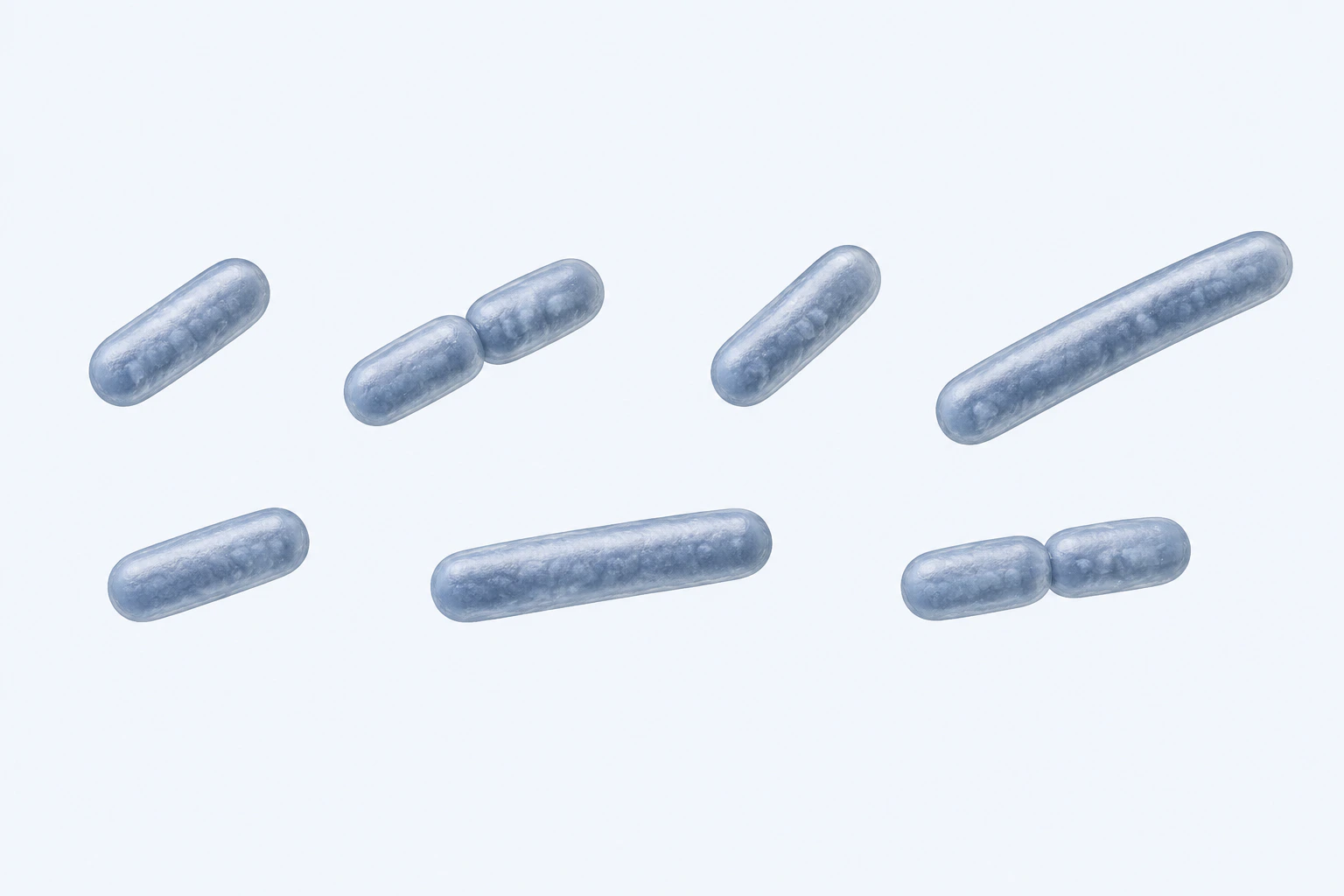
Type-strain-anchored Proteus mirabilis reconstruction with nine rods in five single and two paired groupings, including two modestly elongated singles. Swarming and flagella are intentionally absent and their omission makes no motility claim; this plate is representative, non-diagnostic, and not a micrograph.
Scientific media record1 verified identifier
- Subject
- Proteus mirabilistaxon · species
- Identifiers
- NCBITaxon:584
- Review
- Editorial review completeIdentifiers authority-verified · Accessibility validated · · proteus-mirabilis|proteus-mirabilis-morphology-v1.webp
- Digital source
- Trained-algorithmic mediaCreated with a trained generative algorithm and reviewed by WikiBiome for subject identity, scientific framing, identifiers, provenance, and accessibility.
- Scientific basis
- Proteus mirabilis — NCBI TaxonomyProteus mirabilis — LPSNProteus mirabilis type strain — BacDiveProteus mirabilis — Medical Subject Headings
- License
- CC BY-SA 4.0Created
A Gram-negative uropathogen whose nickel (Ni)-dependent Urease is the central driver of catheter-associated urinary tract infection (CAUTI) pathogenesis. Urease-mediated urea hydrolysis produces Ammonia and alkalinizes urine, triggering precipitation of struvite (magnesium ammonium phosphate) and apatite crystals that form kidney stones and encrust urinary catheters.
P. mirabilis has evolved specialized nickel handling proteins, including an accessory protein that is 39% Histidine—one of the most histidine-enriched proteins known.
Evidence map3 cited passagesInspect provenance +
Urease is essential for CAUTI pathogenesis and urinary stone formation.
The P. mirabilis HypB is remarkable: 39% histidine content in its histidine-rich region.
PMI1518: a nickel export protein essential for CAUTI pathogenesis.
Contents
1. Metal-Dependent Virulence Factors2. Metal Acquisition Systems3. Nutritional Immunity Evasion4. Disease Associations5. Connection to Environmental Metal Exposure6. ConnectionsMetal-Dependent Virulence Factors#
Ni-Dependent Urease—The Master Virulence Factor#
Urease is essential for CAUTI pathogenesis and urinary stone formation.[1]Role of Nickel in Microbial PathogenesisRobert J. Maier, Stéphane L. Benoit · 2019Open reference 1 ↓ Catalyzes: urea -> ammonia + bicarbonate. Ammonia production raises urine pH from ~5-6 to >7, causing precipitation of.
Struvite (MgNH4PO4): the primary stone mineral. Apatite (Ca10(PO4)6(OH)2): secondary mineral deposition. Crystalline biofilm formation: urease-mediated crystal precipitation creates a mineralized biofilm on catheter surfaces that.
Physically obstructs urine flow. Provides a protected niche for bacterial communities. Resists antibiotic penetration.
Extracellular crystal clusters in the bladder: urease induces crystal formation directly in bladder tissue, causing tissue damage and promoting ascending infection. Urease-negative mutants are dramatically attenuated in CAUTI models.
Urease Maturation—The HypB Accessory Protein#
HypB (also called UreG in some nomenclature): a GTPase required for nickel insertion into the urease active site. The P. mirabilis HypB is remarkable: 39% histidine content in its histidine-rich region.[1]Role of Nickel in Microbial PathogenesisRobert J. Maier, Stéphane L. Benoit · 2019Open reference 1 ↓
This extreme His-richness creates a high-capacity nickel-binding domain that likely serves as a nickel reservoir for urease metalation, ensuring urease is fully activated even under nickel-limited conditions.
Parallels the Hpn storage protein of Helicobacter pylori (47% histidine)—convergent evolution of His-rich nickel buffers in urease-dependent pathogens.
Metal Acquisition Systems#
Nickel Import#
ABC-type nickel transporters import nickel (Ni)(II) from the urinary tract environment. Urea is abundant in urine (~200-400 mM), so substrate is never limiting—nickel availability for urease metalation is the bottleneck. Nickel transport genes are co-regulated with urease genes, ensuring coordinated expression.
Nickel Export—PMI1518#
PMI1518: a nickel export protein essential for CAUTI pathogenesis.[1]Role of Nickel in Microbial PathogenesisRobert J. Maier, Stéphane L. Benoit · 2019Open reference 1 ↓ Required for nickel homeostasis: prevents nickel toxicity under conditions of high nickel availability. PMI1518 mutants are attenuated in CAUTI models, demonstrating that nickel export (not just import) is critical.
This highlights the importance of balanced nickel flux—too little nickel means inactive urease; too much is toxic.
Iron Acquisition#
Proteobactin and other siderophores for iron scavenging in the urinary tract. Heme uptake systems for accessing host hemoglobin during tissue-invasive infection. Iron acquisition is important for growth but urease/nickel is the dominant virulence axis.
Nutritional Immunity Evasion#
The urinary tract has relatively low metal restriction compared to blood/abscess environments, but. Urinary lactoferrin and lipocalin-2 restrict iron availability. Tamm-Horsfall protein (uromodulin) may modulate metal availability in urine.
P. mirabilis compensates with high-affinity nickel transporters and the His-rich HypB nickel buffer to ensure urease metalation. Catheter surfaces may concentrate metals from urine, creating a metal-enriched microenvironment favorable for P. mirabilis biofilm.
Disease Associations#
Catheter-associated urinary tract infections (CAUTI): primary clinical significance; P. mirabilis is a leading cause. Urinary stone disease (urolithiasis): struvite stones ("infection stones") are directly caused by urease activity. Pyelonephritis: ascending kidney infection, often complicated by staghorn calculi.
Bacteremia: secondary to urinary tract infection. Wound infections: less common but P. mirabilis can colonize chronic wounds.
Connection to Environmental Metal Exposure#
Dietary nickel is excreted primarily through urine, meaning higher dietary nickel intake increases urinary nickel concentration—potentially providing more cofactor for P. mirabilis urease.
Patients with indwelling catheters who consume nickel-rich diets may inadvertently support P. mirabilis urease activity. Environmental nickel exposure (occupational, dietary) could theoretically influence CAUTI severity, though this has not been directly studied.
Connections#
- Metal-Dependent Virulence—nickel (Ni)-urease as master CAUTI virulence factor; HypB 39% histidine
- Nickel—essential cofactor for urease; the His-rich HypB is one of nature's most concentrated nickel-binding proteins
- Helicobacter pylori—both use nickel-urease as a master virulence factor with His-rich nickel storage proteins
- Staphylococcus aureus—both use urease for niche-specific colonization (catheter vs. skin/kidney)
- Nutritional Immunity (Metal Sequestration)—urinary tract metal restriction is less characterized than blood/abscess but still relevant
- Escherichia coli—UPEC competes with P. mirabilis in the urinary tract; both use nickel-dependent enzymes
- Candida albicans—C. neoformans urease parallels P. mirabilis urease in nickel-dependence
References 4
Numbered by first appearance in the article, then reconciled with its declared source list.
- 1
★Robert J. Maier, Stéphane L. Benoit (2019). Role of Nickel in Microbial Pathogenesis. Inorganics.
- 2
Roy H. Stevens, Hongming Zhang, Michal Kajsik et al. (2023). Stevens 2023 — Successful Use of a Phage Endolysin for Treatment of CPPS/Chronic Bacterial Prostatitis. Frontiers in Medicine.
- 3
Khan F, Rizvi M, Shukla I et al. (2011). A Novel Approach for Identification of Members of Enterobacteriaceae Isolated from Clinical Samples. Biology and Medicine.
- 4
Babak Khorsand, Hamid Asadzadeh Aghdaei, Ehsan Nazemalhosseini-Mojarad et al. (2022). Khorsand 2022 — Overrepresentation of Enterobacteriaceae and Escherichia coli is the major gut microbiome signature in Crohn's and UC: comprehensive metagenomic analysis of IBDMDB datasets. Frontiers in Cellular and Infection Microbiology.
Article network
Mentioned here 10
Pages linking here 20
Connect the evidence
Publicly readable discussion by ORCID-authenticated researchers. Questions, interpretation, methods, corrections, and new evidence stay attached to this record.
No discussion yet. Start with a precise question or a source-backed observation.
Activity and accepted changes
Accepted researcher context, editorial status, public discussion, and upstream Git revisions are shown together. Pending, declined, and withdrawn proposals remain private.
- published revision
Add reviewed Histidine concept coverage
Karen Pendergrass · +1 −1
Inspect exact Git diff ↗ - published revision
Complete reviewed Urease contextual coverage
Karen Pendergrass · +1 −1
Inspect exact Git diff ↗ - published revision
Add reviewed Ammonia concept coverage
Karen Pendergrass · +2 −2
Inspect exact Git diff ↗ - published revision
massive wiki expansion: 149 stubs fixed, 100+ new pages, Rule 15 scan, keystone papers
WikiBiome Deploy Bot · +28 −26
Inspect exact Git diff ↗ - published revision
nightly maintenance: 94 stub demotions, 181 source_count fixes, 22 auto-discovered stubs, 5 adversarial audits, 3 boundary fixes, 3 evidence-level corrections
WikiBiome Deploy Bot · +3 −0
Inspect exact Git diff ↗ - published revision
WikiBiome update — 2026-04-15 17:23
WikiBiome Deploy Bot · +7 −7
Inspect exact Git diff ↗ - published revision
wiki: bulk entity upgrades, new article pages, and site regeneration
WikiBiome Deploy Bot · +6 −0
Inspect exact Git diff ↗ - published revision
WikiBiome update — integrity fixes, metallomic diet pages, cross-condition analyses
WikiBiome Deploy Bot · +9 −4
Inspect exact Git diff ↗ - published revision
WikiBiome v7 — interactive microbiome metallomics encyclopedia
Karen Pendergrass · +83 −0
Inspect exact Git diff ↗