
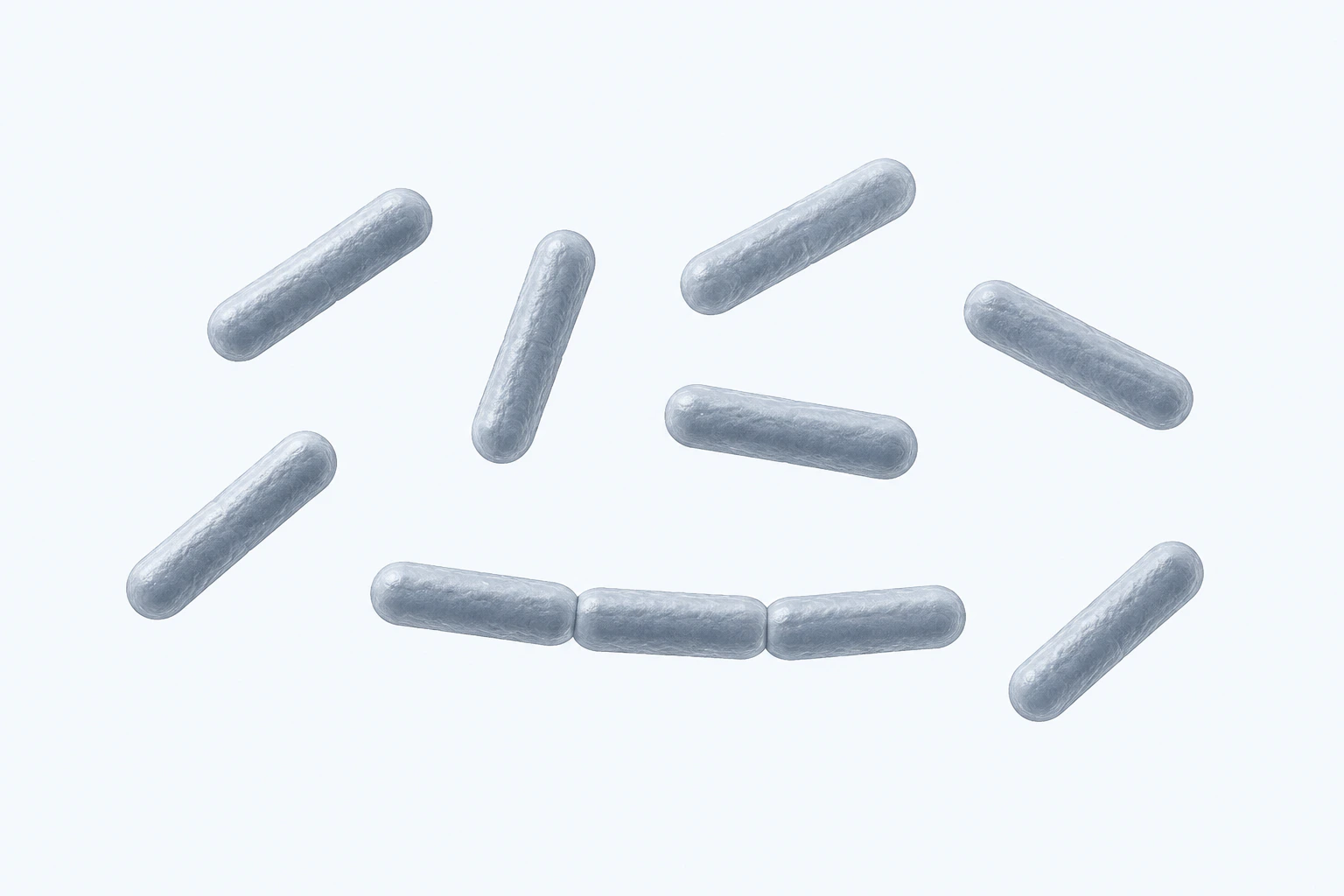
Type-species-anchored Turicibacter reconstruction with nine vegetative rods. Representative, non-diagnostic, and not a micrograph.
Scientific media record1 verified identifier
- Subject
- Turicibactertaxon · genus
- Identifiers
- NCBITaxon:191303
- Review
- Editorial review completeIdentifiers authority-verified · Accessibility validated · · turicibacter|turicibacter-morphology-v1.webp
- Digital source
- Trained-algorithmic mediaCreated with a trained generative algorithm and reviewed by WikiBiome for subject identity, scientific framing, identifiers, provenance, and accessibility.
- Scientific basis
- Turicibacter — NCBI TaxonomyTuricibacter — LPSNTuricibacter sanguinis gen. nov., sp. nov.
- License
- CC BY-SA 4.0Created
A Gram-positive, facultatively anaerobic genus within the class Erysipelotrichia (phylum Firmicutes) that has become one of the most frequently identified taxa in gut-brain and gut-immune Mendelian randomization studies.
Turicibacter sanguinis, the type species, possesses a remarkable property: it directly interacts with the host serotonin transporter (SERT), making it one of the few bacteria known to modulate host serotonin biology at the molecular level.
This serotonin connection, combined with MR evidence linking Turicibacter to Hashimoto's thyroiditis, coronary heart disease, and ASD, positions it as a multi-system immunomodulatory taxon.
Evidence map12 cited passagesInspect provenance +
Ketogenic diet: 120-fold increase in abundance in mice, among the most extreme dietary expansions reported for any gut taxon
Turicibacter is causally associated with increased HT risk (OR = 1.16, p = 0.020), alongside intestinimonas (OR 1.20). The serotonin-modulating capability of Turicibacter may be relevant: serotonin influences thyroid hormone synthesis and immune regulation in the thyroid gland.
Turicibacter increases CHD risk (OR = 1.12) via MR. The bile acid metabolism function may link Turicibacter to cholesterol homeostasis and cardiovascular risk.
MR suggests a possible positive association with ASD (OR = 1.14, borderline significance)
A systematic review found Turicibacter consistently decreased in ASD alongside Bifidobacterium, Blautia, Dialister, Prevotella, and Veillonella
Turicibacter is positively correlated with experimental autoimmune encephalomyelitis (EAE) severity in mice, consistent with a pro-inflammatory role in autoimmune neuroinflammation. Anti-CD20 B-cell depletion therapy in MS reverses the dysbiosis pattern including Turicibacter abundance.
Paradoxically, Turicibacter is protective against atrial fibrillation (OR = 0.904), showing that cardiovascular effects are outcome-specific.
(MR)—HT risk factor (OR 1.16).
(MR)—CHD risk factor (OR 1.12).
(MR)—Possible ASD association (OR 1.14).
(animal model)—120-fold ketogenic diet expansion.
(animal model)—EAE severity correlation.
Contents
1. Taxonomy2. Metal Dependencies3. Key Features4. Ecological Role5. Conditions Associated6. Key Studies7. Cross-ReferencesTaxonomy#
Turicibacter sanguinis—the type species; originally isolated from blood cultures, hence the species name. Family Turicibacteraceae, order Erysipelotrichales, class Erysipelotrichia, phylum Firmicutes. The genus is distantly related to the core Clostridia despite being within Firmicutes; Erysipelotrichia represents a distinct evolutionary lineage.
Metal Dependencies#
Iron. Turicibacter has modest iron requirements typical of low-GC Firmicutes. Iron-dependent oxidoreductases support its facultative metabolism.
The genus name sanguinis (from blood) reflects its original isolation site, not an iron-piracy strategy, though its ability to survive in blood suggests adaptation to iron-rich environments.
Key Features#
Serotonin Transporter Interaction#
Turicibacter is one of the few gut bacteria demonstrated to directly interact with the host serotonin transporter (SERT/SLC6A4). This interaction.
Allows Turicibacter to sense and respond to host serotonin levels. Influences local serotonin availability in the gut, affecting motility, secretion, and immune signaling. Creates a bidirectional communication channel between host serotonin biology and microbial ecology.
Connects to the broader serotonin regulation pathway where Clostridia stimulate EC cell serotonin production.
Bile Acid Metabolism#
Turicibacter participates in bile acid modification, contributing to the conversion of primary to secondary bile acids in the gut. This function links it to hepatic metabolism and cholesterol homeostasis.
Ecological Role#
In the Healthy Gut#
Turicibacter is a low-to-moderate abundance member of the gut microbiota. Its serotonin-sensing capability allows it to occupy a niche at the host-microbe interface, responding to intestinal serotonin gradients that vary with meal intake, stress, and circadian rhythms.
Dietary Responsiveness#
Turicibacter shows dramatic dietary responsiveness. Ketogenic diet: 120-fold increase in abundance in mice,[1]Ketogenic diet enhances neurovascular function with altered gut microbiome in young healthy miceDavid Ma, Amy C. Wang, Ishita Parikh et al. · 2018Open reference 1 ↓ among the most extreme dietary expansions reported for any gut taxon.
This extreme responsiveness suggests Turicibacter thrives on the metabolic byproducts of ketosis (ketone bodies, altered bile acid composition) rather than dietary fiber.
Conditions Associated#
Hashimoto's Thyroiditis (Causal Risk Factor)#
Turicibacter is causally associated with increased HT risk (OR = 1.16, p = 0.020),[2]Role of immune cells in mediating the effect of gut microbiota on Hashimoto's thyroiditis: a 2-sample Mendelian randomization studyPei XQ, Wang WH, Gao YH et al. · 2024Open reference 2 ↓ alongside Intestinimonas (OR 1.20). The serotonin-modulating capability of Turicibacter may be relevant: serotonin influences thyroid hormone synthesis and immune regulation in the thyroid gland.
Coronary Heart Disease (Risk Factor)#
Turicibacter increases CHD risk (OR = 1.12) via MR.[3]Gut Microbiota and Risk of Coronary Heart Disease: A Two-Sample Mendelian Randomization StudyXiang-zhi Hu, Ling-ling Fu, Bin Ye et al. · 2024Open reference 3 ↓ The bile acid metabolism function may link Turicibacter to cholesterol homeostasis and cardiovascular risk.
Autism Spectrum Disorder#
The picture is complex. MR suggests a possible positive association with ASD (OR = 1.14, borderline significance).[4]Li 2023 — Gut Microbiota and Autism Spectrum Disorders: A Bidirectional Mendelian Randomization StudyZhi Li, Shuai Liu, Fang Liu et al. · 2023Open reference 4 ↓
A systematic review found Turicibacter consistently decreased in ASD alongside Bifidobacterium, Blautia, Dialister, Prevotella, and Veillonella.[5]Liu 2019 — Altered Composition and Function of Intestinal Microbiota in ASD: A Systematic ReviewFeitong Liu, Jie Li, Fan Wu et al. · 2019Open reference 5 ↓
The discrepancy may reflect the difference between causal (MR) and observational findings, or treatment effects in observational cohorts.
Multiple Sclerosis / EAE#
Turicibacter is positively correlated with experimental autoimmune encephalomyelitis (EAE) severity in mice,[6]Variations in diet cause alterations in microbiota and metabolites that follow changes in disease severity in a multiple sclerosis modelLibbey JE, Sanchez JM, Doty DJ et al. · 2018Open reference 6 ↓ consistent with a pro-inflammatory role in autoimmune neuroinflammation. Anti-CD20 B-cell depletion therapy in MS reverses the Dysbiosis pattern including Turicibacter abundance.
Atrial Fibrillation (Protective)#
Paradoxically, Turicibacter is protective against atrial fibrillation (OR = 0.904),[7]Assessment of the Causal Relationship between Gut Microbiota and Cardiovascular Diseases: A Bidirectional Mendelian Randomization AnalysisXiao-Ce Dai, Yi Yu, Si-Yu Zhou et al. · 2024Open reference 7 ↓ showing that cardiovascular effects are outcome-specific.
Key Studies#
[2]Role of immune cells in mediating the effect of gut microbiota on Hashimoto's thyroiditis: a 2-sample Mendelian randomization studyPei XQ, Wang WH, Gao YH et al. · 2024Open reference 2 ↓ (MR)—HT risk factor (OR 1.16).[3]Gut Microbiota and Risk of Coronary Heart Disease: A Two-Sample Mendelian Randomization StudyXiang-zhi Hu, Ling-ling Fu, Bin Ye et al. · 2024Open reference 3 ↓ (MR)—CHD risk factor (OR 1.12).[4]Li 2023 — Gut Microbiota and Autism Spectrum Disorders: A Bidirectional Mendelian Randomization StudyZhi Li, Shuai Liu, Fang Liu et al. · 2023Open reference 4 ↓ (MR)—Possible ASD association (OR 1.14).
[1]Ketogenic diet enhances neurovascular function with altered gut microbiome in young healthy miceDavid Ma, Amy C. Wang, Ishita Parikh et al. · 2018Open reference 1 ↓ (animal model)—120-fold ketogenic diet expansion.[6]Variations in diet cause alterations in microbiota and metabolites that follow changes in disease severity in a multiple sclerosis modelLibbey JE, Sanchez JM, Doty DJ et al. · 2018Open reference 6 ↓ (animal model)—EAE severity correlation.
Cross-References#
- Hashimoto's Thyroiditis—causal risk factor via MR
- Intestinimonas—co-identified as HT risk taxon
- Serotonin—Turicibacter interacts with host serotonin transporter
- Clostridia—spore-forming Clostridia regulate EC cell serotonin, linking to Turicibacter's serotonin niche
- coronary-heart-disease—CHD risk factor via MR
- Autism Spectrum Disorder—complex association (MR risk vs. observational depletion)
- Bile Acid Metabolism—Turicibacter participates in bile acid modification
References 7
Numbered by first appearance in the article, then reconciled with its declared source list.
- 1
David Ma, Amy C. Wang, Ishita Parikh et al. (2018). Ketogenic diet enhances neurovascular function with altered gut microbiome in young healthy mice. Scientific Reports.
- 2
Pei XQ, Wang WH, Gao YH et al. (2024). Role of immune cells in mediating the effect of gut microbiota on Hashimoto's thyroiditis: a 2-sample Mendelian randomization study. Frontiers in Microbiology.
- 3
Xiang-zhi Hu, Ling-ling Fu, Bin Ye et al. (2024). Gut Microbiota and Risk of Coronary Heart Disease: A Two-Sample Mendelian Randomization Study. Frontiers in Cardiovascular Medicine.
- 4
Zhi Li, Shuai Liu, Fang Liu et al. (2023). Li 2023 — Gut Microbiota and Autism Spectrum Disorders: A Bidirectional Mendelian Randomization Study. Frontiers in Cellular and Infection Microbiology.
- 5
Feitong Liu, Jie Li, Fan Wu et al. (2019). Liu 2019 — Altered Composition and Function of Intestinal Microbiota in ASD: A Systematic Review. Translational Psychiatry.
- 6
Libbey JE, Sanchez JM, Doty DJ et al. (2018). Variations in diet cause alterations in microbiota and metabolites that follow changes in disease severity in a multiple sclerosis model. Beneficial Microbes.
- 7
Xiao-Ce Dai, Yi Yu, Si-Yu Zhou et al. (2024). Assessment of the Causal Relationship between Gut Microbiota and Cardiovascular Diseases: A Bidirectional Mendelian Randomization Analysis. BioData Mining.
Article network
Connect the evidence
Publicly readable discussion by ORCID-authenticated researchers. Questions, interpretation, methods, corrections, and new evidence stay attached to this record.
No discussion yet. Start with a precise question or a source-backed observation.
Activity and accepted changes
Accepted researcher context, editorial status, public discussion, and upstream Git revisions are shown together. Pending, declined, and withdrawn proposals remain private.
- published revision
Complete corpus-wide Dysbiosis linking
Karen Pendergrass · +1 −1
Inspect exact Git diff ↗ - published revision
massive wiki expansion: 149 stubs fixed, 100+ new pages, Rule 15 scan, keystone papers
WikiBiome Deploy Bot · +5 −5
Inspect exact Git diff ↗ - published revision
ingest: 87 papers (17 endometriosis, 67 erectile dysfunction, 3 cross-condition)
WikiBiome Deploy Bot · +1 −1
Inspect exact Git diff ↗ - published revision
pre-overnight checkpoint 2026-04-18
WikiBiome Deploy Bot · +100 −0
Inspect exact Git diff ↗