
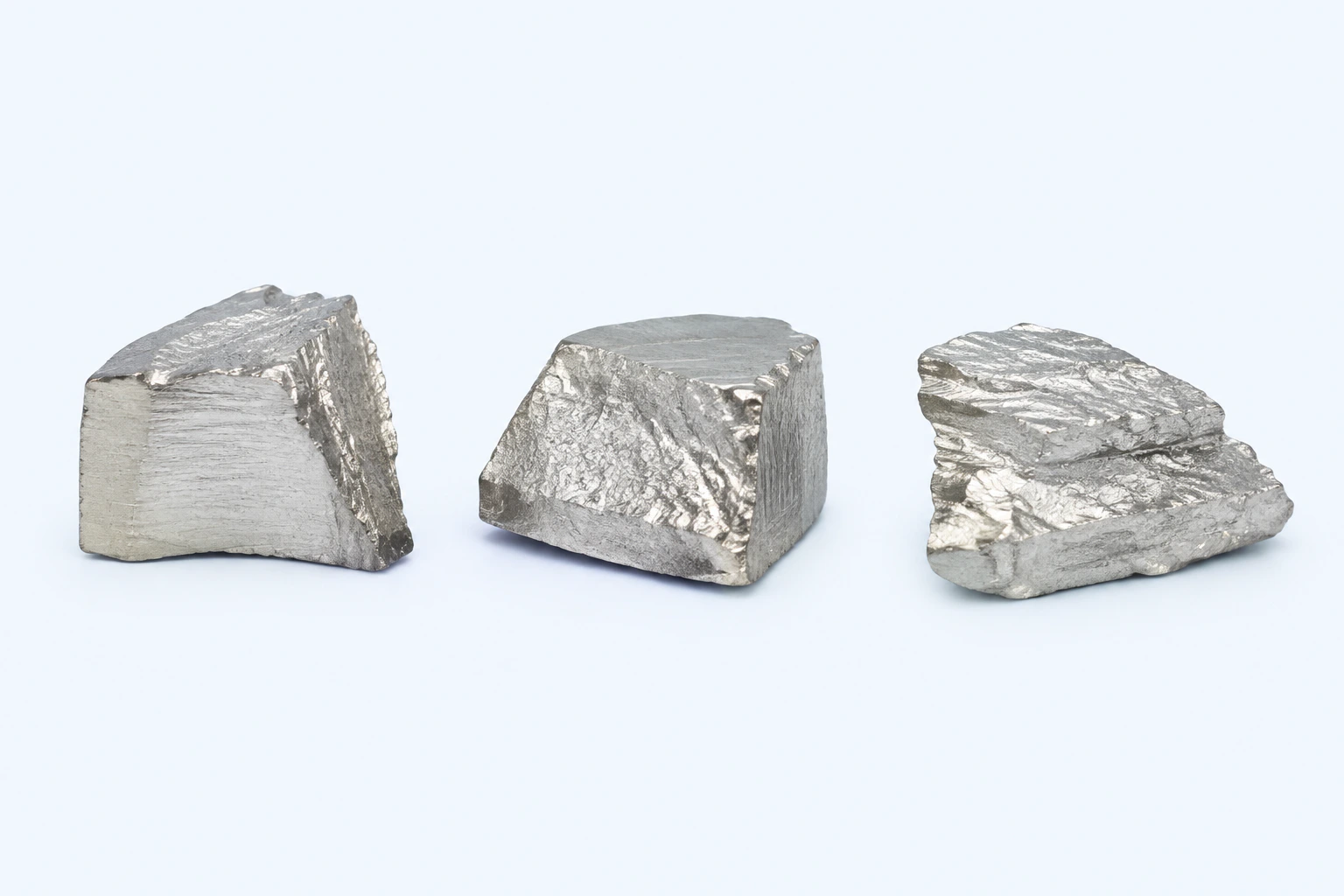
Elemental titanium (Ti), shown as three representative bright silvery-white worked specimens. Form and surface vary with purity and processing; this is not an implant, product, titanium dioxide, analytical reference material, or a photograph.
Scientific media record2 verified identifiers
- Subject
- Titaniumelement
- Identifiers
- Atomic number 22PubChem CID:23963
- Review
- Editorial review completeIdentifiers authority-verified · Accessibility validated · · titanium|titanium-technical-specimen-v1.webp
- Digital source
- Trained-algorithmic mediaCreated with a trained generative algorithm and reviewed by WikiBiome for subject identity, scientific framing, identifiers, provenance, and accessibility.
- Scientific basis
- Titanium — PubChem ElementTitanium, PubChem CID 23963
- License
- CC BY-SA 4.0Created
References 5
Numbered by first appearance in the article, then reconciled with its declared source list.
- 1
Pavlic A, Begic G, Tota M et al. (2021). Bacterial Exposure to Nickel: Influence on Adhesion and Biofilm Formation on Orthodontic Archwires and Sensitivity to Antimicrobial Agents. Materials.
- 2
Marchesi JR, Dutilh BE, Hall N et al. (2011). Towards the Human Colorectal Cancer Microbiome. PLOS ONE.
- 3
★Dominika Bartnicka, Miriam Gonzalez-Gonzalez, Joanna Sykut et al. (2020). Bartnicka et al. 2020 — Candida albicans Shields the Periodontal Killer Porphyromonas gingivalis from Recognition by the Host Immune System and Supports the Bacterial Infection of Gingival Tissue. International Journal of Molecular Sciences.
- 4
Servin Yesil Günal, Hikmet Saçmacı, Şerife Saçmacı et al. (2018). Effect of heavy metals and sialic acid in multiple sclerosis. International Research Journal of Public and Environmental Health.
- 5
Abdelmaksoud AA, Girerd PH, Garcia EM et al. (2017). Abdelmaksoud 2017 — Association between Statin Use, the Vaginal Microbiome, and Gardnerella vaginalis Vaginolysin-Mediated Cytotoxicity. PLOS ONE.
Connect the evidence
Publicly readable discussion by ORCID-authenticated researchers. Questions, interpretation, methods, corrections, and new evidence stay attached to this record.
No discussion yet. Start with a precise question or a source-backed observation.
Activity and accepted changes
Accepted researcher context, editorial status, public discussion, and upstream Git revisions are shown together. Pending, declined, and withdrawn proposals remain private.
- published revision
massive wiki expansion: 149 stubs fixed, 100+ new pages, Rule 15 scan, keystone papers
WikiBiome Deploy Bot · +9 −4
Inspect exact Git diff ↗ - published revision
nightly maintenance: 94 stub demotions, 181 source_count fixes, 22 auto-discovered stubs, 5 adversarial audits, 3 boundary fixes, 3 evidence-level corrections
WikiBiome Deploy Bot · +17 −0
Inspect exact Git diff ↗