

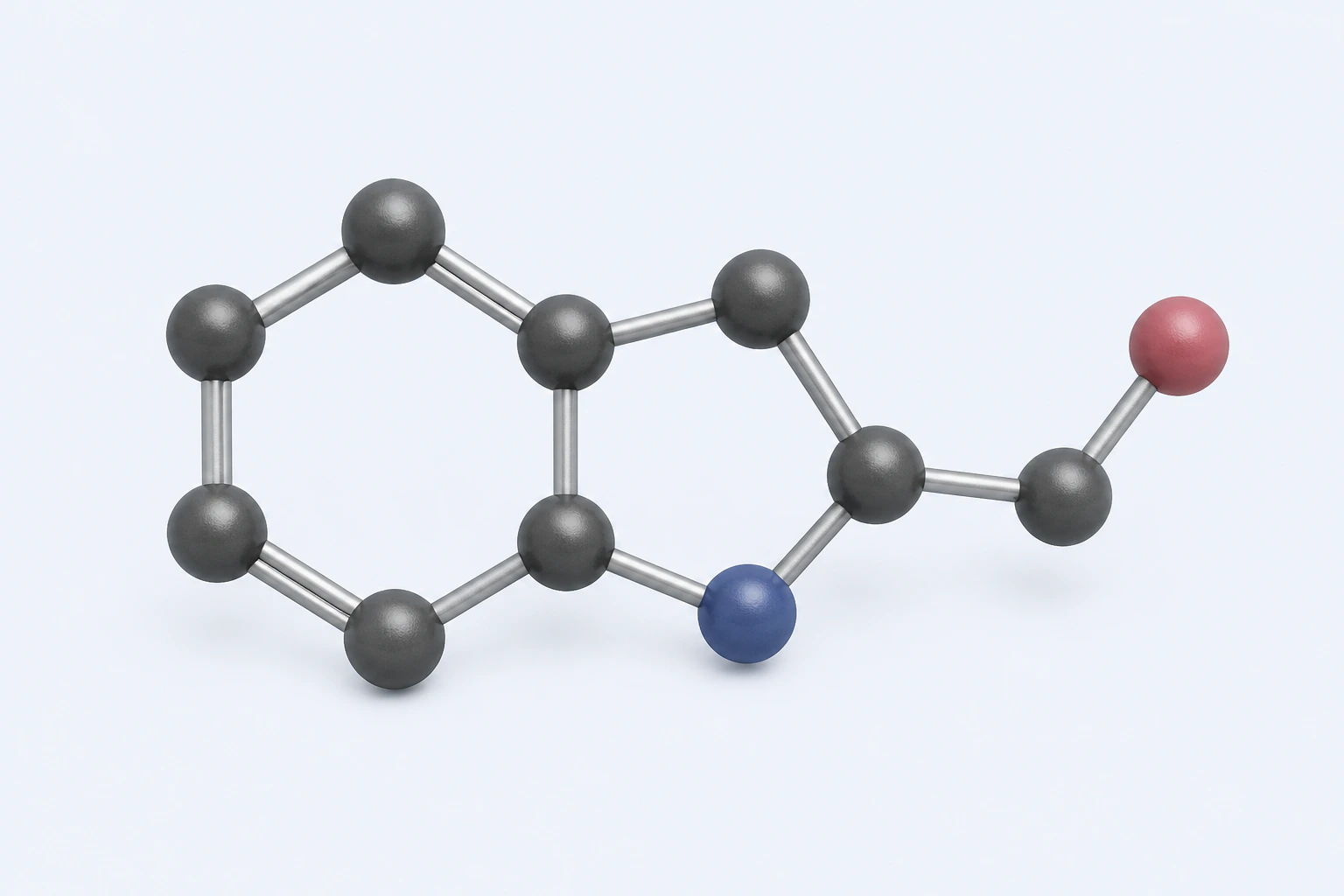
Heavy-atom connectivity orientation for neutral indole-3-carbinol. Hydrogens, a measured conformation, crystal packing, DIM, cruciferous-food source, supplement formulation, dose, metabolism, EGFR or drug interactions, microbiome effects, ovarian protection, efficacy, safety, and clinical claims are intentionally omitted; this is an educational reconstruction.
Scientific media record4 verified identifiers
- Subject
- Indole-3-carbinolintervention
- Identifiers
- WikiBiome:indole-3-carbinol-ovarian-cancerPubChem:3712ChEBI:24814InChIKey:IVYPNXXAYMYVSP-UHFFFAOYSA-N
- Review
- Editorial review completeIdentifiers authority-verified · Accessibility validated · · indole-3-carbinol-ovarian-cancer|indole-3-carbinol-ovarian-cancer-intervention-v1.webp
- Digital source
- Trained-algorithmic mediaCreated with a trained generative algorithm and reviewed by WikiBiome for subject identity, scientific framing, identifiers, provenance, and accessibility.
- Scientific basis
- Indole-3-carbinol — PubChemIndol-3-ylmethanol — ChEBIIndole-3-Carbinol in Ovarian Cancer
- License
- CC BY-SA 4.0Created
Indole-3-carbinol (I3C) and its metabolite 3,3'-diindolylmethane (DIM)—derived from cruciferous vegetables and also produced by gut bacteria from tryptophan metabolism—as multi-mechanism agents for ovarian cancer. Three independent papers support I3C through distinct pathways: EGFR inhibition (platinum resistance), bortezomib sensitization, and cisplatin chemoprotection.
This makes I3C one of the most well-triangulated supplement candidates for OC, though no human clinical trial exists yet.
Evidence map3 cited passagesInspect provenance +
Source: (computational prediction)
Source: (in vitro + animal model)
Source: (animal model)
Evidence#
EGFR Inhibition (Dash 2015)#
- I3C and DIM show significant inhibitory activity against EGFR tyrosine kinase in platinum-resistant OC (molecular docking + ADME)
- Source:[1]In silico analysis of indole-3-carbinol and its metabolite DIM as EGFR tyrosine kinase inhibitors in platinum resistant ovarian cancerDash R, Hosen SMZ, Karim MR et al. · 2015Open reference 1 ↓ (computational prediction)
Bortezomib Sensitization (Taylor-Harding 2012)#
- I3C sensitized OC cell lines to bortezomib; combination caused cell cycle arrest and apoptosis via ER stress and cytoskeletal disruption
- In vivo co-treatment significantly inhibited tumor growth in mice
- Source:[2]Indole-3-carbinol synergistically sensitises ovarian cancer cells to bortezomib treatmentTaylor-Harding B, Agadjanian H, Nassanian H et al. · 2012Open reference 2 ↓ (in vitro + animal model)
Cisplatin Chemoprotection (Zhu 2026)#
- I3C alleviates cisplatin-induced ovarian damage by inhibiting fibrosis through TGF-beta1/Smad pathway
- Preserves ovarian function during chemotherapy
- Source:[3]Indole-3-carbinol alleviates cisplatin-induced ovarian damage by inhibiting ovarian fibrosis through the TGF-beta1/Smad pathwayZhu F, Li F, Zhang R et al. · 2026Open reference 3 ↓ (animal model)
Mechanism#
I3C acts through at least three independent pathways. EGFR kinase inhibition: Targets platinum resistance directly. ER stress induction: Sensitizes tumor cells to proteasome inhibition.
TGF-beta1/Smad inhibition: Protects healthy ovarian tissue from chemotherapy damage.
Gut microbiome connection: I3C is an indole metabolite related to microbial tryptophan metabolism. The protective indole metabolites IPA and indoxyl sulfate (suppressed by antibiotics in OC) are in the same metabolic family.
Clinical Context#
I3C is available as a dietary supplement and from cruciferous vegetable consumption. The safety profile is well-established. The gap is human clinical trial data specifically in OC—preclinical evidence across three independent mechanisms argues strongly for clinical investigation.
References 3
Numbered by first appearance in the article, then reconciled with its declared source list.
- 1
Dash R, Hosen SMZ, Karim MR et al. (2015). In silico analysis of indole-3-carbinol and its metabolite DIM as EGFR tyrosine kinase inhibitors in platinum resistant ovarian cancer. Journal of Applied Pharmaceutical Science.
- 2
Taylor-Harding B, Agadjanian H, Nassanian H et al. (2012). Indole-3-carbinol synergistically sensitises ovarian cancer cells to bortezomib treatment. British Journal of Cancer.
- 3
Zhu F, Li F, Zhang R et al. (2026). Indole-3-carbinol alleviates cisplatin-induced ovarian damage by inhibiting ovarian fibrosis through the TGF-beta1/Smad pathway. Journal of Ovarian Research.
Article network
Mentioned here 1
Pages linking here 1
Connect the evidence
Publicly readable discussion by ORCID-authenticated researchers. Questions, interpretation, methods, corrections, and new evidence stay attached to this record.
No discussion yet. Start with a precise question or a source-backed observation.
Activity and accepted changes
Accepted researcher context, editorial status, public discussion, and upstream Git revisions are shown together. Pending, declined, and withdrawn proposals remain private.
- published revision
Deepen metal/concept entities + 8 new sources for T1D/schizophrenia
WikiBiome Deploy Bot · +65 −0
Inspect exact Git diff ↗