
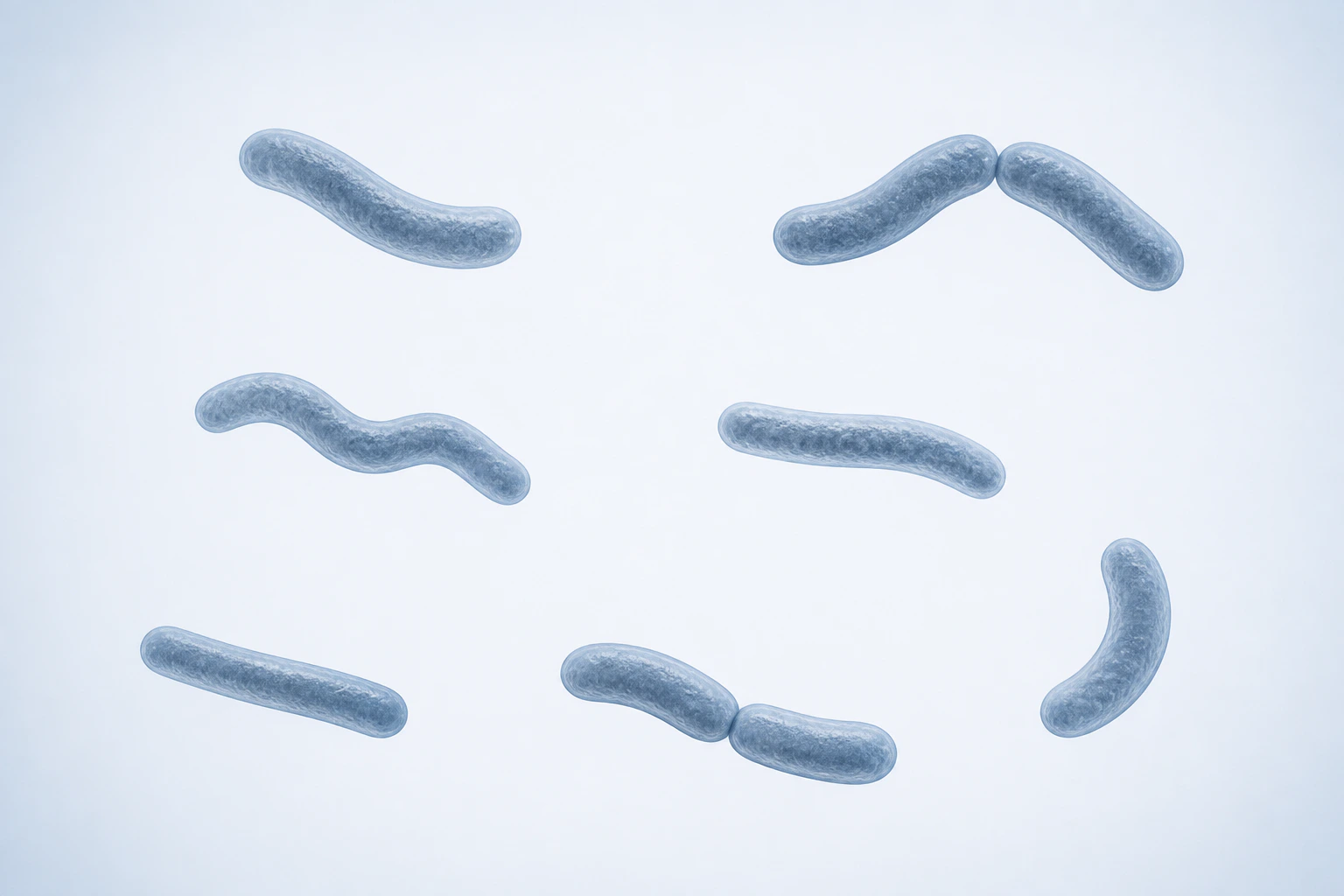
Selected type-species-anchored Desulfovibrio curved, near-straight, and restrained sigmoid rod forms, shown as nine bodies in seven groupings. This reconstruction is representative, non-diagnostic, and not a micrograph.
Scientific media record1 verified identifier
- Subject
- Desulfovibriotaxon · genus
- Identifiers
- NCBITaxon:872
- Review
- Editorial review completeIdentifiers authority-verified · Accessibility validated · · desulfovibrio|desulfovibrio-morphology-v1.webp
- Digital source
- Trained-algorithmic mediaCreated with a trained generative algorithm and reviewed by WikiBiome for subject identity, scientific framing, identifiers, provenance, and accessibility.
- Scientific basis
- Desulfovibrio — NCBI TaxonomyDesulfovibrio — LPSNDesulfovibrio authoritative genus treatmentMicroscopic identification of sulfate-reducing bacteria
- License
- CC BY-SA 4.0Created
A genus of Gram-negative, obligate anaerobic, sulfate-reducing bacteria (SRB) that produces hydrogen sulfide (H2S) as its primary metabolic end-product. H2S is a potent cytotoxin that disrupts colonocyte energy metabolism, damages the gut barrier, and promotes chronic Metal-Driven Inflammation.
Desulfovibrio enrichment is associated with multiple disease states including Endometriosis, Cardiovascular Disease, Parkinson's Disease, and cancer.
Evidence map3 cited passagesInspect provenance +
Mercury: Desulfovibrio species are enriched by mercury exposure in the gut, and some SRB can methylate inorganic mercury to neurotoxic methylmercury.
Cardiovascular disease: enriched in CVD; H2S can promote atherosclerotic plaque instability. Spermidine supplementation paradoxically increases Desulfovibrionaceae while improving cardiovascular outcomes, suggesting dose-dependent or context-dependent H2S effects.
Colorectal cancer: H2S-mediated DNA damage and NF-kB activation contribute to carcinogenesis. Desulfovibrio showed opposite directionality—increased in cancer, decreased in autoimmune disease.
Contents
1. H2S Production and Toxicity2. Metal Dependencies3. Disease Associations4. H2S as a Double-Edged Sword5. Key Metabolites6. ConnectionsH2S Production and Toxicity#
Desulfovibrio uses sulfate as a terminal electron acceptor in anaerobic respiration, reducing it to H2S via dissimilatory sulfate reduction. H2S toxicity mechanisms in the gut.
Cytochrome c oxidase inhibition: H2S blocks the terminal enzyme of colonocyte mitochondrial oxidative phosphorylation, starving epithelial cells of energy—analogous to cyanide poisoning at the cellular level.
Barrier disruption: energy-depleted colonocytes lose tight junction integrity, increasing gut permeability and enabling bacterial translocation. DNA damage: H2S generates reactive sulfur species and free radicals that cause genotoxic damage to colonocytes, contributing to Colorectal Cancer initiation.
NF-kB activation: H2S activates NF-kB inflammatory signaling in epithelial and immune cells, driving chronic inflammation.
H2S competes with Butyrate for colonocyte energy metabolism: when H2S levels rise and butyrate levels fall (due to depletion of Roseburia, Faecalibacterium prausnitzii), colonocytes shift from oxidative to glycolytic metabolism, further destabilizing the anaerobic gut environment.
Metal Dependencies#
Iron: Iron-sulfur clusters are central to the dissimilatory sulfate reduction pathway. Desulfovibrio requires substantial iron for its [iron (Fe)] Hydrogenase and ferredoxin electron carriers. Nickel: Some species possess [NiFe]-hydrogenase for hydrogen-dependent sulfate reduction, linking their metabolism to Nickel availability in the gut.
Molybdenum: Certain sulfate reductases use Molybdenum cofactors.
Mercury: Desulfovibrio species are enriched by Mercury exposure in the gut, and some SRB can methylate inorganic mercury to neurotoxic methylmercury.[1]Rezazadegan et al. 2025 — Heavy Metals and Gut Microbiota: A Systematic ReviewFatemeh Rezazadegan, Maryam Mahmoudi, Seyed Mohammad Mousavi · 2025Open reference 1 ↓
Disease Associations#
Endometriosis: H2S/NF-kB pathway activation promotes endometrial inflammation and lesion progression. Desulfovibrio enrichment may contribute to the inflammatory milieu driving Endometriosis.
Cardiovascular disease: enriched in CVD; H2S can promote atherosclerotic plaque instability. Spermidine supplementation paradoxically increases Desulfovibrionaceae while improving cardiovascular outcomes, suggesting dose-dependent or context-dependent H2S effects.[2]The potential links between human gut microbiota and cardiovascular health and disease - is there a gut-cardiovascular axis?Catia Almeida, J. Guilherme Goncalves-Nobre, Diogo Alpuim Costa et al. · 2023Open reference 2 ↓
Colorectal cancer: H2S-mediated DNA damage and NF-kB activation contribute to carcinogenesis. Desulfovibrio showed opposite directionality—increased in cancer, decreased in autoimmune disease.[3]Reproducible and opposing gut microbiome signatures distinguish autoimmune diseases and cancers: a systematic review and meta-analysisMd Zohorul Islam, Melissa Tran, Tao Xu et al. · 2022Open reference 3 ↓
Parkinson's disease: enriched in PD gut; H2S may compound mitochondrial dysfunction in the enteric nervous system. Bilophila wadsworthia (related SRB): metabolizes taurine-conjugated bile acids to produce H2S, linking high-fat diet (which increases taurine-conjugated bile acids) to sulfide-driven inflammation.
H2S as a Double-Edged Sword#
At physiological concentrations, H2S is a gasotransmitter with anti-inflammatory and cytoprotective effects (similar to NO and CO). At supraphysiological concentrations produced by Desulfovibrio overgrowth, H2S becomes cytotoxic and pro-inflammatory. This dose-response relationship complicates therapeutic targeting: complete elimination of SRB would remove physiological H2S signaling.
Key Metabolites#
Hydrogen sulfide (H2S)—primary output; cytochrome c oxidase inhibitor, DNA damaging agent, NF-kB activator. Acetate—secondary fermentation product from incomplete oxidation of organic substrates. Methylmercury—some species convert inorganic mercury to neurotoxic methylmercury (MeHg).
Connections#
- Endometriosis—H2S/NF-kB pathway activation drives endometrial inflammation
- Cardiovascular Disease—enriched in CVD; H2S affects plaque stability
- Colorectal Cancer—H2S genotoxicity and cancer-specific enrichment
- Parkinson's Disease—enriched in PD; mitochondrial dysfunction via H2S
- Iron—iron (Fe)-S clusters central to sulfate reduction metabolism
- Nickel—[NiFe]-hydrogenase in some species
- Mercury—methylation of inorganic mercury to neurotoxic methylmercury (MeHg)
- Molybdenum—molybdenum (Mo)-cofactor in sulfate reductases
- Oxidative Stress—reactive sulfur species drive oxidative DNA damage
- inflammation—H2S activates NF-kB; chronic inflammatory signaling
- Dysbiosis—enrichment signals sulfidogenic dysbiosis
- Ferroptosis—iron-dependent metabolism may intersect with ferroptotic pathways
- Gut-Metal-Microbiome Interactions—metal-dependent metabolism; enriched by mercury exposure
- Faecalibacterium prausnitzii—inversely correlated; butyrate vs H2S competition for colonocyte energy
References 5
Numbered by first appearance in the article, then reconciled with its declared source list.
- 1
Fatemeh Rezazadegan, Maryam Mahmoudi, Seyed Mohammad Mousavi (2025). Rezazadegan et al. 2025 — Heavy Metals and Gut Microbiota: A Systematic Review. Journal of Health, Population and Nutrition.
- 2
Catia Almeida, J. Guilherme Goncalves-Nobre, Diogo Alpuim Costa et al. (2023). The potential links between human gut microbiota and cardiovascular health and disease - is there a gut-cardiovascular axis?. Frontiers in Gastroenterology.
- 3
Md Zohorul Islam, Melissa Tran, Tao Xu et al. (2022). Reproducible and opposing gut microbiome signatures distinguish autoimmune diseases and cancers: a systematic review and meta-analysis. Microbiome.
- 4
Appunni S, Rubens M, Ramamoorthy V et al. (2021). Emerging Evidence on the Effects of Dietary Factors on the Gut Microbiome in Colorectal Cancer. Frontiers in Nutrition.
- 5
Svensson A, Brunkwall L, Roth B et al. (2021). Associations Between Endometriosis and Gut Microbiota. Reproductive Sciences.
Article network
Mentioned here 18
Pages linking here 25
Connect the evidence
Publicly readable discussion by ORCID-authenticated researchers. Questions, interpretation, methods, corrections, and new evidence stay attached to this record.
No discussion yet. Start with a precise question or a source-backed observation.
Activity and accepted changes
Accepted researcher context, editorial status, public discussion, and upstream Git revisions are shown together. Pending, declined, and withdrawn proposals remain private.
- published revision
Backfill inflammation concept links
Karen Pendergrass · +2 −2
Inspect exact Git diff ↗ - published revision
Complete Hydrogenase contextual coverage
Karen Pendergrass · +1 −1
Inspect exact Git diff ↗ - published revision
Complete Tight junctions contextual coverage
Karen Pendergrass · +1 −1
Inspect exact Git diff ↗ - published revision
massive wiki expansion: 149 stubs fixed, 100+ new pages, Rule 15 scan, keystone papers
WikiBiome Deploy Bot · +17 −17
Inspect exact Git diff ↗ - published revision
nightly maintenance: 94 stub demotions, 181 source_count fixes, 22 auto-discovered stubs, 5 adversarial audits, 3 boundary fixes, 3 evidence-level corrections
WikiBiome Deploy Bot · +1 −0
Inspect exact Git diff ↗ - published revision
Fix YAML parse errors in Desulfovibrio and ASD probiotics pages
WikiBiome Deploy Bot · +1 −1
Inspect exact Git diff ↗ - published revision
wiki: bulk entity upgrades, new article pages, and site regeneration
WikiBiome Deploy Bot · +6 −0
Inspect exact Git diff ↗ - published revision
WikiBiome update — integrity fixes, metallomic diet pages, cross-condition analyses
WikiBiome Deploy Bot · +11 −3
Inspect exact Git diff ↗ - published revision
WikiBiome update — 2026-04-10 13:49
WikiBiome Deploy Bot · +68 −0
Inspect exact Git diff ↗