

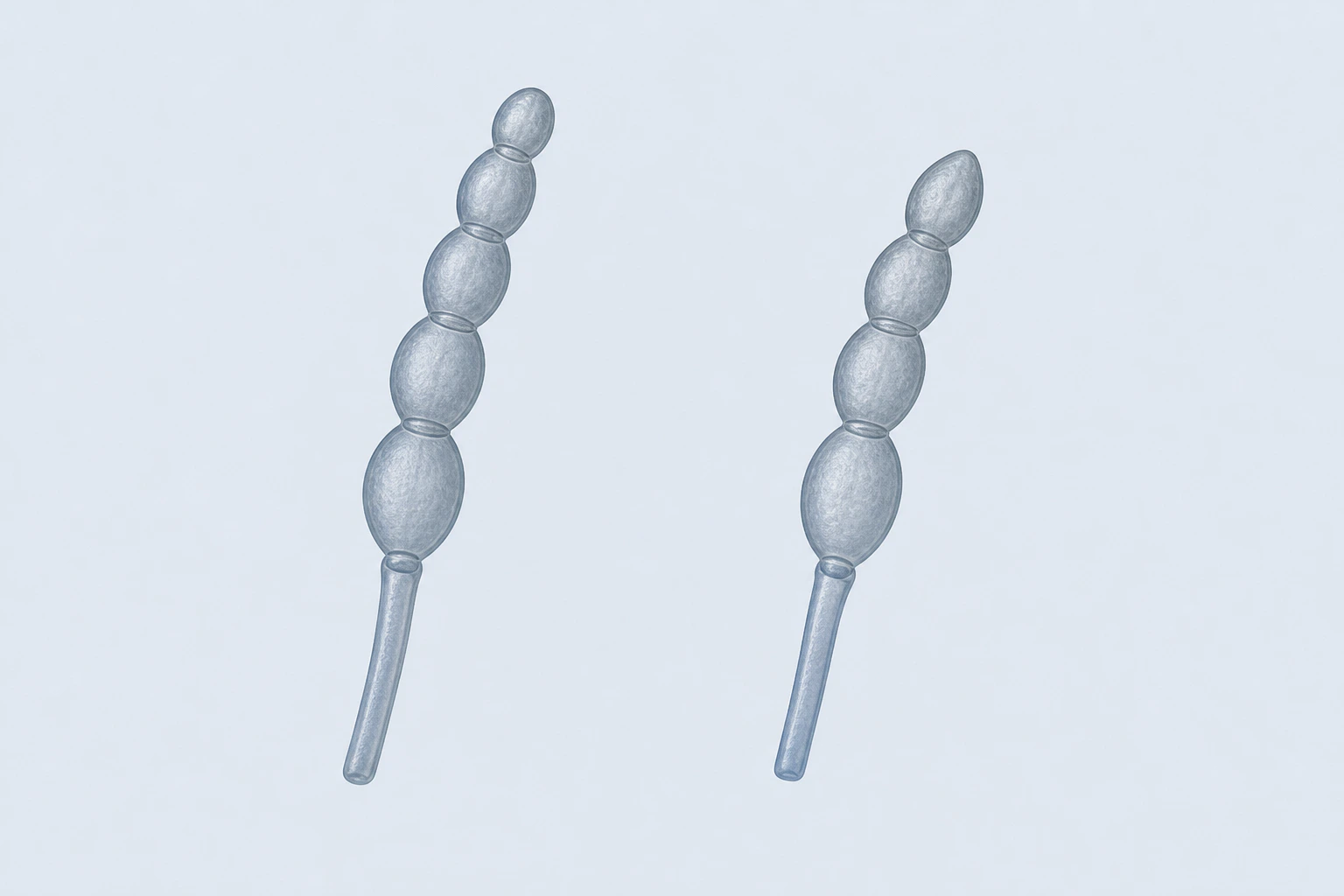
Two selected Cladosporium conidiophore-and-chain structures, each with five conidia. This genus-level reconstruction is representative, non-exhaustive, non-diagnostic, and not a micrograph.
Scientific media record1 verified identifier
- Subject
- Cladosporiumtaxon · genus
- Identifiers
- NCBITaxon:5498
- Review
- Editorial review completeIdentifiers authority-verified · Accessibility validated · · cladosporium|cladosporium-morphology-v1.webp
- Digital source
- Trained-algorithmic mediaCreated with a trained generative algorithm and reviewed by WikiBiome for subject identity, scientific framing, identifiers, provenance, and accessibility.
- Scientific basis
- Cladosporium — NCBI TaxonomyCladosporium monographic revision — PubMedCladosporium monographic revision — PubMed CentralCladosporium species complex revision
- License
- CC BY-SA 4.0Created
Cladosporium Link 1816 is the selected current genus name for NCBITaxon:5498 and is accepted as a genus by Species Fungorum.[1]NCBI Taxonomy — Cladosporium (NCBITaxon:5498)Author information pendingOpen reference 1 ↓[2]Species Fungorum — Cladosporium Link 1816Author information pendingOpen reference 2 ↓ Davidiella Crous & U. Braun 2003 was introduced for the sexual morph of Cladosporium sensu stricto.
Under one-fungus/one-name treatment, the International Commission on the Taxonomy of Fungi working group recommended the older and more widely used Cladosporium over Davidiella; the latter is therefore retained here only as a historical synonym, not as a second canonical genus.[3]Recommended names for pleomorphic genera in DothideomycetesAuthor information pending · 2015Open reference 3 ↓
Evidence map4 cited passagesInspect provenance +
Cladosporium Link 1816 is the selected current genus name for NCBITaxon:5498 and is accepted as a genus by Species Fungorum. Davidiella Crous & U. Braun 2003 was introduced for the sexual morph of Cladosporium sensu stricto. Under one-fungus/one-name treatment, the International Commission on the Taxonomy of Fungi working group recommended the older and more
The nomenclatural recommendation connects the type species through the sexual morph: Davidiella tassiana was described for the sexual state of Cladosporium herbarum, making the generic names synonyms for current editorial purposes. Historical articles may nevertheless print “Davidiella,” and WikiBiome preserves that wording when reporting what a source measu
Al Bataineh and colleagues reported “Unclassified Davidiella” among the fungal labels increased in 25 adults with type 2 diabetes compared with 25 controls in their Emirati pilot cohort. That source-era label is linked to the current Cladosporium record for traceability, but the study's unmatched age, body-mass index, diet, and treatment context precludes a
Other cited surveys and reviews use the current name Cladosporium in oral, gut, and broader human mycobiome contexts, including hypertension and chronic kidney disease, multiple sclerosis, rheumatoid arthritis, cancer, schizophrenia, and neurological-disease literature. These records support reported detection or differential abundance in their stated cohort
Nomenclature and Source-Label Boundary#
The nomenclatural recommendation connects the type species through the sexual morph: Davidiella tassiana was described for the sexual state of Cladosporium herbarum, making the generic names synonyms for current editorial purposes.[3]Recommended names for pleomorphic genera in DothideomycetesAuthor information pending · 2015Open reference 3 ↓
Historical articles may nevertheless print “Davidiella,” and WikiBiome preserves that wording when reporting what a source measured. Canonicalization does not retroactively establish a species-level assignment for an older amplicon label.
aluminum (Al) Bataineh and colleagues reported “Unclassified Davidiella” among the fungal labels increased in 25 adults with type 2 diabetes compared with 25 controls in their Emirati pilot cohort.[4]Al Bataineh 2020 — Gut Microbiome and Fungal Community in Type 2 Diabetes in Emirati SubjectsMohammad Tahseen Al Bataineh, Nihar Ranjan Dash, Pierre Bel Lassen et al. · 2020Open reference 4 ↓
That source-era label is linked to the current Cladosporium record for traceability, but the study's unmatched age, body-mass index, diet, and treatment context precludes a causal conclusion, and the unclassified result should not be read as a resolved species identification.
Reported Mycobiome Contexts#
Other cited surveys and reviews use the current name Cladosporium in oral, gut, and broader human mycobiome contexts, including hypertension and chronic kidney disease, multiple sclerosis, rheumatoid arthritis, cancer, schizophrenia, and neurological-disease literature.[5]Gut mycobiome dysbiosis contributes to the development of hypertension and its response to immunoglobulin light chainsYeqing Zou, Anxing Ge, Brako Lydia et al. · 2022Open reference 5 ↓[6]Exploring the gut mycobiome: differential composition and clinical associations in hypertension, chronic kidney disease, and their comorbidityJuan Qiu, Longyou Zhao, Yiwen Cheng et al. · 2023Open reference 6 ↓[7]Exploring the Mycobiota in Multiple Sclerosis: Its Influence on Disease Development and ProgressionAne Otaegui-Chivite, Miriam Gorostidi-Aicua, Laura Martins-Almeida et al. · 2025Open reference 7 ↓[8]Gut Bacteriome, Mycobiome and Virome Alterations in Rheumatoid ArthritisDagar S, Singh J, Saini A et al. · 2023Open reference 8 ↓[9]The mycobiome in human cancer: analytical challenges, molecular mechanisms, and therapeutic implicationsTing Ding, Chang Liu, Zhengyu Li · 2025Open reference 9 ↓[10]Oral mycobiota and pancreatic ductal adenocarcinomaAilin Wei, Huiling Zhao, Xue Cong et al. · 2022Open reference 10 ↓[11]Ling 2025 — Gut Mycobiota Dysbiosis and Systemic Immune Dysfunction in Chinese Schizophrenia Patients with Metabolic SyndromeZongxin Ling, Yiwen Cheng, Zhiyong Lan et al. · 2025Open reference 11 ↓[12]A Fungal World: Could the Gut Mycobiome Be Involved in Neurological Disease?Jessica D. Forbes, Charles N. Bernstein, Helen Tremlett et al. · 2019Open reference 12 ↓
These records support reported detection or differential abundance in their stated cohorts; they do not by themselves establish persistent colonization, causation, pathogenicity, or a genus-wide metal requirement.
References 12
Numbered by first appearance in the article, then reconciled with its declared source list.
- 1
Author information pending. NCBI Taxonomy — Cladosporium (NCBITaxon:5498). NCBI Taxonomy.
- 2
Author information pending. Species Fungorum — Cladosporium Link 1816. Species Fungorum.
- 3
Author information pending (2015). Recommended names for pleomorphic genera in Dothideomycetes. IMA Fungus.
- 4
Mohammad Tahseen Al Bataineh, Nihar Ranjan Dash, Pierre Bel Lassen et al. (2020). Al Bataineh 2020 — Gut Microbiome and Fungal Community in Type 2 Diabetes in Emirati Subjects. Scientific Reports.
- 5
Yeqing Zou, Anxing Ge, Brako Lydia et al. (2022). Gut mycobiome dysbiosis contributes to the development of hypertension and its response to immunoglobulin light chains. Frontiers in Immunology.
- 6
Juan Qiu, Longyou Zhao, Yiwen Cheng et al. (2023). Exploring the gut mycobiome: differential composition and clinical associations in hypertension, chronic kidney disease, and their comorbidity. Frontiers in Immunology.
- 7
Ane Otaegui-Chivite, Miriam Gorostidi-Aicua, Laura Martins-Almeida et al. (2025). Exploring the Mycobiota in Multiple Sclerosis: Its Influence on Disease Development and Progression. Frontiers in Immunology.
- 8
Dagar S, Singh J, Saini A et al. (2023). Gut Bacteriome, Mycobiome and Virome Alterations in Rheumatoid Arthritis. Frontiers in Endocrinology.
- 9
Ting Ding, Chang Liu, Zhengyu Li (2025). The mycobiome in human cancer: analytical challenges, molecular mechanisms, and therapeutic implications. Molecular Cancer.
- 10
Ailin Wei, Huiling Zhao, Xue Cong et al. (2022). Oral mycobiota and pancreatic ductal adenocarcinoma. BMC Cancer.
- 11
Zongxin Ling, Yiwen Cheng, Zhiyong Lan et al. (2025). Ling 2025 — Gut Mycobiota Dysbiosis and Systemic Immune Dysfunction in Chinese Schizophrenia Patients with Metabolic Syndrome. Frontiers in Immunology.
- 12
Jessica D. Forbes, Charles N. Bernstein, Helen Tremlett et al. (2019). A Fungal World: Could the Gut Mycobiome Be Involved in Neurological Disease?. Frontiers in Microbiology.
Connect the evidence
Publicly readable discussion by ORCID-authenticated researchers. Questions, interpretation, methods, corrections, and new evidence stay attached to this record.
No discussion yet. Start with a precise question or a source-backed observation.
Activity and accepted changes
Accepted researcher context, editorial status, public discussion, and upstream Git revisions are shown together. Pending, declined, and withdrawn proposals remain private.
- published revision
Merge Davidiella into Cladosporium
Karen Pendergrass · +24 −6
Inspect exact Git diff ↗ - published revision
Merge Davidiella into Cladosporium
Karen Pendergrass · +0 −60
Inspect exact Git diff ↗ - published revision
massive wiki expansion: 149 stubs fixed, 100+ new pages, Rule 15 scan, keystone papers
WikiBiome Deploy Bot · +12 −4
Inspect exact Git diff ↗ - published revision
massive wiki expansion: 149 stubs fixed, 100+ new pages, Rule 15 scan, keystone papers
WikiBiome Deploy Bot · +11 −7
Inspect exact Git diff ↗ - published revision
maintenance: 409 source fixes, 34 entity updates, 17 concept updates, 30 analysis outputs
WikiBiome Deploy Bot · +56 −0
Inspect exact Git diff ↗ - published revision
nightly maintenance: 94 stub demotions, 181 source_count fixes, 22 auto-discovered stubs, 5 adversarial audits, 3 boundary fixes, 3 evidence-level corrections
WikiBiome Deploy Bot · +21 −0
Inspect exact Git diff ↗