
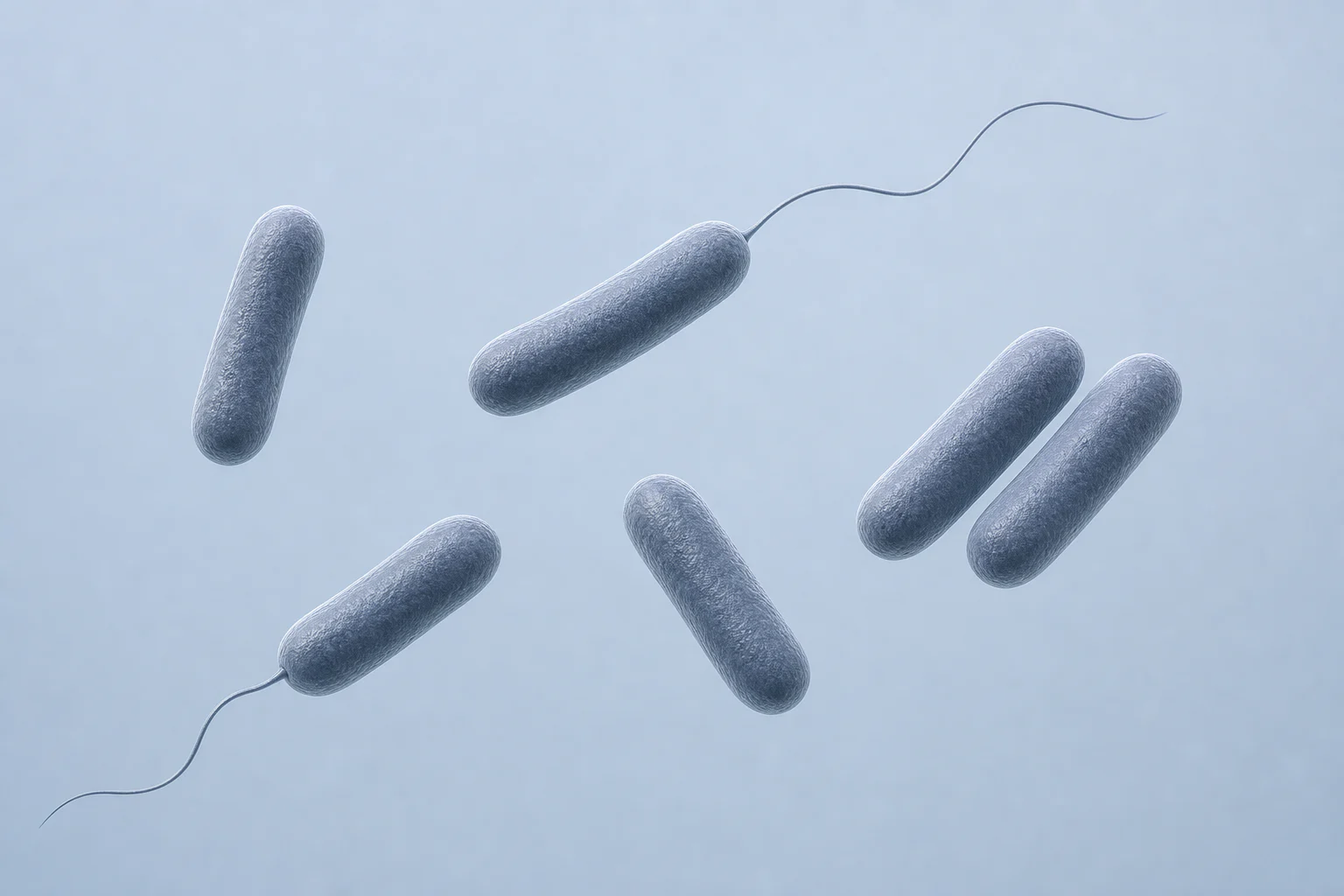
Representative Alishewanella rods showing genus-level variation. Two of six cells bear a single polar flagellum to represent motile members, while the original A. fetalis description is nonmotile; this reconstruction is not a micrograph or diagnostic image.
Scientific media record1 verified identifier
- Subject
- Alishewanellataxon · genus
- Identifiers
- NCBITaxon:111142
- Review
- Editorial review completeIdentifiers authority-verified · Accessibility validated · · alishewanella|alishewanella-morphology-v1.webp
- Digital source
- Trained-algorithmic mediaCreated with a trained generative algorithm and reviewed by WikiBiome for subject identity, scientific framing, identifiers, provenance, and accessibility.
- Scientific basis
- Alishewanella — NCBI TaxonomyDraft genomic sequence of Alishewanella strain GIDC-5Draft genomic sequence of a chromate- and sulfate-reducing Alishewanella strainAlishewanella fetalis gen. nov., sp. nov.Alishewanella aestuarii sp. nov.
- License
- CC BY-SA 4.0Created
Alishewanella is a genus of Gram-negative, facultative anaerobic bacteria within the class Gammaproteobacteria. Primarily known as environmental organisms, Alishewanella species have been identified in the microbiome of deep endometriosis—both in vaginal samples and within endometriotic lesions themselves.
The detection of Alishewanella in endometriotic lesion tissue suggests that non-classical environmental bacteria may colonize ectopic endometrial tissue, potentially contributing to local inflammatory microenvironments ([1]Microbiome Profile of Deep Endometriosis Patients: Comparison of Vaginal Fluid, Endometrium and LesionHernandes C, Silveira P, Sereia AFR et al. · 2020Open reference 1 ↓).
Its presence in both vaginal and lesion compartments supports the hypothesis of bacterial translocation between the lower reproductive tract and peritoneal disease sites ([2]Miyashira 2022 — The Microbiome and EndometriosisCarlos H Miyashira, Fernanda Reali Oliveira, Marina Paula Andres et al. · 2022Open reference 2 ↓).
Evidence map1 cited passagesInspect provenance +
The detection of Alishewanella in endometriotic lesion tissue suggests that non-classical environmental bacteria may colonize ectopic endometrial tissue, potentially contributing to local inflammatory microenvironments (). Its presence in both vaginal and lesion compartments supports the hypothesis of bacterial translocation between the lower reproductive tr
Contents
1. Cross-ReferencesCross-References#
- Endometriosis—deep endometriosis lesion microbiome
- Sphingobium—another environmental organism found in endometriosis-associated niches
- bacterial translocation—mechanism for non-commensal organisms reaching sterile sites
References 3
Numbered by first appearance in the article, then reconciled with its declared source list.
- 1
Hernandes C, Silveira P, Sereia AFR et al. (2020). Microbiome Profile of Deep Endometriosis Patients: Comparison of Vaginal Fluid, Endometrium and Lesion. Diagnostics.
- 2
Carlos H Miyashira, Fernanda Reali Oliveira, Marina Paula Andres et al. (2022). Miyashira 2022 — The Microbiome and Endometriosis. Reproduction and Fertility.
- 3
Camila Hernandes, Paola Silveira, Aline Fernanda Rodrigues Sereia et al. (2020). Hernandes 2020 — Microbiome Profile of Deep Endometriosis Patients: Comparison of Vaginal Fluid, Endometrium and Lesion. Diagnostics.
Article network
Mentioned here 2
Connect the evidence
Publicly readable discussion by ORCID-authenticated researchers. Questions, interpretation, methods, corrections, and new evidence stay attached to this record.
No discussion yet. Start with a precise question or a source-backed observation.
Activity and accepted changes
Accepted researcher context, editorial status, public discussion, and upstream Git revisions are shown together. Pending, declined, and withdrawn proposals remain private.
- published revision
massive wiki expansion: 149 stubs fixed, 100+ new pages, Rule 15 scan, keystone papers
WikiBiome Deploy Bot · +36 −0
Inspect exact Git diff ↗