

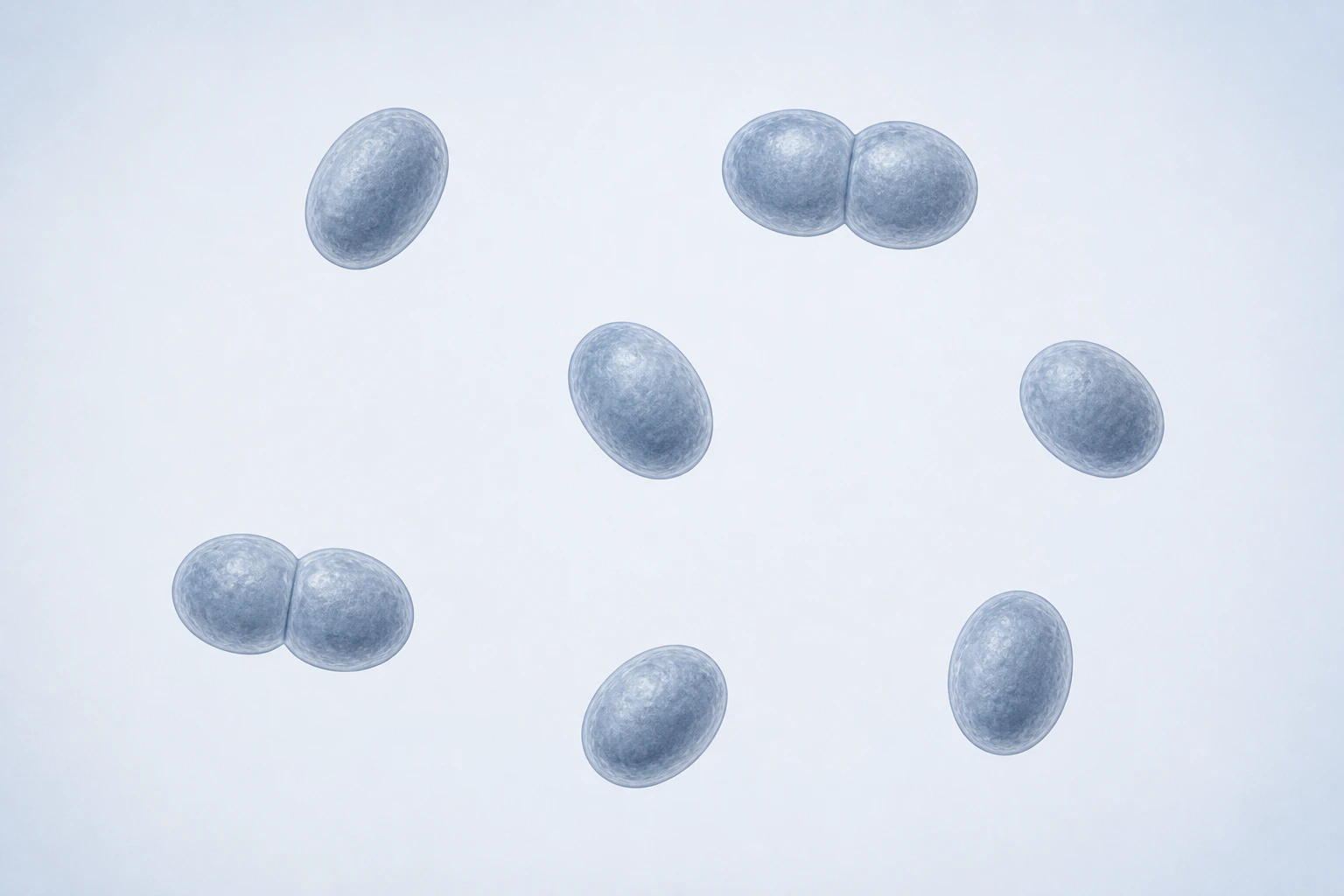
Representative Dialister histaminiformans ovoid forms, shown as nine bodies in seven single or paired groupings. This current-name reconstruction is non-diagnostic, makes no phenotype claim, and is not a micrograph.
Scientific media record1 verified identifier
- Subject
- Dialister histaminiformanstaxon · species
- Identifiers
- NCBITaxon:209880
- Review
- Editorial review completeIdentifiers authority-verified · Accessibility validated · · dialister-histaminiformans|dialister-histaminiformans-morphology-v1.webp
- Digital source
- Trained-algorithmic mediaCreated with a trained generative algorithm and reviewed by WikiBiome for subject identity, scientific framing, identifiers, provenance, and accessibility.
- Scientific basis
- Dialister histaminiformans — NCBI TaxonomyDialister histaminiformans — LPSNAllisonella histaminiformans original species descriptionDialister histaminiformans current combination
- License
- CC BY-SA 4.0Created
Dialister histaminiformans is the current name for the species originally described as Allisonella histaminiformans. NCBI Taxonomy assigns the species NCBITaxon:209880, and LPSN treats A. histaminiformans as its validly published homotypic synonym and basionym.[1]NCBI Taxonomy — Dialister histaminiformans (NCBITaxon:209880)Author information pendingOpen reference 1 ↓[2]LPSN — Dialister histaminiformansAuthor information pendingOpen reference 2 ↓
The unsupported species epithet used by the retired WikiBiome page is not retained as a taxon or synonym.
Evidence map3 cited passagesInspect provenance +
Dialister histaminiformans is the current name for the species originally described as Allisonella histaminiformans. NCBI Taxonomy assigns the species NCBITaxon:209880, and LPSN treats A. histaminiformans as its validly published homotypic synonym and basionym. The unsupported species epithet used by the retired WikiBiome page is not retained as a taxon or s
Garner, Flint, and Russell described Allisonella histaminiformans from histidine-enrichment cultures of bovine rumen contents. The type strain is MR2, also deposited as ATCC BAA-610, CCUG 48567, and DSM 15230. Heng and colleagues transferred the species to Dialister in 2025; NCBI and LPSN now apply the combination Dialister histaminiformans. It belongs to th
The original isolates were strictly anaerobic bacteria that used histidine as an energy source and produced histamine in the bovine-rumen experimental system. That evidence does not establish enrichment in human obesity, metabolic syndrome, mast-cell activation syndrome, or allergic disease, and it does not establish iron-dependent expansion or a therapeutic
Nomenclatural History#
Garner, Flint, and Russell described Allisonella histaminiformans from Histidine-enrichment cultures of bovine rumen contents. The type strain is MR2, also deposited as ATCC BAA-610, CCUG 48567, and DSM 15230.[3]Allisonella histaminiformans gen. nov., sp. nov.: a novel bacterium that produces histamine, utilizes histidine as its sole energy source, and could play a role in bovine and equine laminitisMatthew R Garner, Joseph F Flint, James B Russell · 2002Open reference 3 ↓
Heng and colleagues transferred the species to Dialister in 2025; NCBI and LPSN now apply the combination Dialister histaminiformans.[4]Description of Megasphaera jansseni sp. nov., a novel short- and medium-chain fatty acid-producing species isolated from faeces of a wild boar (Sus scrofa), and a taxonomic note on the family VeillonellaceaeY-C Heng, J K Y Lee, S Silvaraju et al. · 2025Open reference 4 ↓[1]NCBI Taxonomy — Dialister histaminiformans (NCBITaxon:209880)Author information pendingOpen reference 1 ↓[2]LPSN — Dialister histaminiformansAuthor information pendingOpen reference 2 ↓ It belongs to the family Veillonellaceae in the phylum Bacillota, not to Bacteroidetes.
Evidence Boundary#
The original isolates were strictly anaerobic bacteria that used histidine as an energy source and produced histamine in the bovine-rumen experimental system.[3]Allisonella histaminiformans gen. nov., sp. nov.: a novel bacterium that produces histamine, utilizes histidine as its sole energy source, and could play a role in bovine and equine laminitisMatthew R Garner, Joseph F Flint, James B Russell · 2002Open reference 3 ↓
That evidence does not establish enrichment in human obesity, metabolic syndrome, mast-cell activation syndrome, or allergic disease, and it does not establish iron-dependent expansion or a therapeutic target.
Human cohort results reported under the historical genus label Allisonella should remain attributed to that study label unless their sequence data support species-level assignment.
Literature Naming#
Older studies and databases may use Allisonella histaminiformans or the genus label Allisonella. Those names should be retained when accurately describing the terminology used by a source, while links and current taxonomic statements resolve to this record. Genus-level findings must not be silently rewritten as findings about D. histaminiformans.
References 4
Numbered by first appearance in the article, then reconciled with its declared source list.
- 1
Author information pending. NCBI Taxonomy — Dialister histaminiformans (NCBITaxon:209880). NCBI Taxonomy.
- 2
Author information pending. LPSN — Dialister histaminiformans. List of Prokaryotic names with Standing in Nomenclature.
- 3
Matthew R Garner, Joseph F Flint, James B Russell (2002). Allisonella histaminiformans gen. nov., sp. nov.: a novel bacterium that produces histamine, utilizes histidine as its sole energy source, and could play a role in bovine and equine laminitis. Systematic and Applied Microbiology.
- 4
Y-C Heng, J K Y Lee, S Silvaraju et al. (2025). Description of Megasphaera jansseni sp. nov., a novel short- and medium-chain fatty acid-producing species isolated from faeces of a wild boar (Sus scrofa), and a taxonomic note on the family Veillonellaceae. International Journal of Systematic and Evolutionary Microbiology.
Article network
Mentioned here 1
Pages linking here 2
Connect the evidence
Publicly readable discussion by ORCID-authenticated researchers. Questions, interpretation, methods, corrections, and new evidence stay attached to this record.
No discussion yet. Start with a precise question or a source-backed observation.
Activity and accepted changes
Accepted researcher context, editorial status, public discussion, and upstream Git revisions are shown together. Pending, declined, and withdrawn proposals remain private.
- published revision
Add reviewed Histidine concept coverage
Karen Pendergrass · +1 −1
Inspect exact Git diff ↗ - published revision
Reconcile current taxonomic identities
Karen Pendergrass · +43 −0
Inspect exact Git diff ↗