
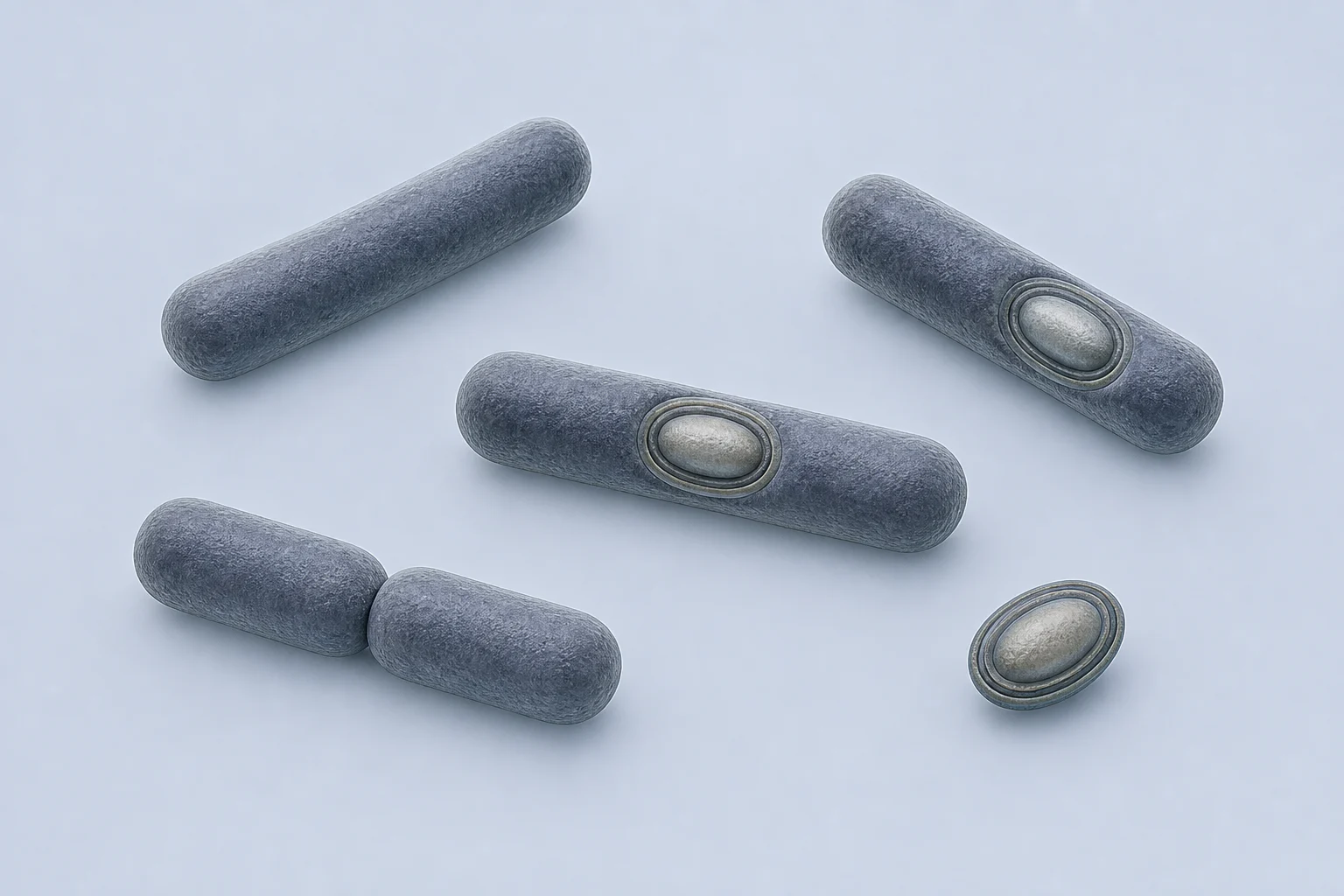
Representative Bacillus sensu stricto vegetative rods and dormant endospores. Spore position, cell shape, and motility vary by species; this reconstruction is genus-level and not diagnostic.
Scientific media record1 verified identifier
- Subject
- Bacillustaxon · genus
- Identifiers
- NCBITaxon:1386
- Review
- Editorial review completeIdentifiers authority-verified · Accessibility validated · · bacillus|bacillus-morphology-v1.webp
- Digital source
- Trained-algorithmic mediaCreated with a trained generative algorithm and reviewed by WikiBiome for subject identity, scientific framing, identifiers, provenance, and accessibility.
- Scientific basis
- Bacillus — NCBI TaxonomyThe genus Bacillus and its emendationBacillus endospore morphology
- License
- CC BY-SA 4.0Created
A Gram-positive, aerobic to facultatively anaerobic, spore-forming genus that bridges environmental and human microbiology. The genus encompasses both beneficial species (B. subtilis, B. coagulans as probiotics) and pathogens (B. cereus causing food poisoning, B. anthracis causing anthrax).
Bacillus species are distinguished by their exceptional metal resistance and metal-binding capabilities, making them important in the Gut-Metal-Microbiome Interactions framework for heavy metal detoxification.
Evidence map3 cited passagesInspect provenance +
B. subtilis and B. coagulans can bind and sequester heavy metals in the gut lumen, reducing intestinal absorption of cadmium, lead, and arsenic.
Proposed as living biosensors for heavy metal detection in food and environmental samples due to their metal-responsive gene expression systems.
Agricultural soil contaminated with heavy metals carries metal-resistant Bacillus that could transfer resistance genes to gut bacteria.
Contents
1. Spore-Forming Biology2. Metal Resistance and Detoxification3. Iron Acquisition4. Probiotic Applications5. Soil-Gut Axis6. Key Metabolites7. ConnectionsSpore-Forming Biology#
Bacillus endospores are among the most resistant biological structures, surviving extreme heat, desiccation, UV radiation, and gastric acid.
This spore-forming capability makes Bacillus probiotics (particularly B. subtilis and B. coagulans) uniquely heat-stable and shelf-stable, with guaranteed viability through gastric transit—a major advantage over non-spore-forming probiotics like Lactobacillus and Bifidobacterium.
Spores germinate in the small intestine, transitioning to vegetative cells that colonize transiently before being shed.
Metal Resistance and Detoxification#
- Bacillus species possess extensive metal resistance gene clusters enabling survival in metal-contaminated environments and active metal sequestration:
- Cadmium resistance via CadA efflux ATPase and metallothionein-like proteins
- Lead biosorption through cell wall teichoic acids and exopolysaccharides
- Arsenic resistance via ars operons (arsenate reductase, arsenite efflux)
- Zinc/copper homeostasis through P-type ATPases
- B. subtilis and B. coagulans can bind and sequester Heavy Metals in the gut lumen, reducing intestinal absorption of Cadmium, Lead, and Arsenic.[1]Potential Application of Living Microorganisms in the Detoxification of Heavy MetalsRunqiu Chen, Huaijun Tu, Tingtao Chen · 2022Open reference 1 ↓
- Proposed as living biosensors for heavy metal detection in food and environmental samples due to their metal-responsive gene expression systems.[2]Heavy Metal-Gut Microbiota Interactions: Probiotics Modulation and Biosensors DetectionLiliana Anchidin-Norocel, Oana C. Iatcu, Andrei Lobiuc et al. · 2025Open reference 2 ↓
Iron Acquisition#
B. subtilis produces bacillibactin, a catecholate siderophore structurally related to enterobactin, for iron acquisition under iron-limited conditions. Also produces petrobactin, which evades host siderocalin (lipocalin-2) capture, providing a stealth iron acquisition strategy relevant to B. anthracis pathogenesis.
Probiotic Applications#
B. subtilis#
Well-characterized probiotic with demonstrated immunomodulatory, antimicrobial, and gut barrier-supporting properties. Produces antimicrobial peptides (surfactin, iturin, fengycin) that inhibit pathogen growth. Used in traditional fermented foods (natto, cheonggukjang) with long safety history.
B. coagulans#
- Probiotic for digestive health and IBS symptom relief. Produces L-lactic acid utilized by Veillonella.
B. cereus—Pathogenic#
- Causes emetic and diarrheal food poisoning syndromes. Distinguished from probiotic species by cereus-group toxin genes.
Soil-Gut Axis#
Predominantly a soil organism; gut presence reflects the soil-gut axis (soil-to-food-to-gut microbial transfer).
Agricultural soil contaminated with heavy metals carries metal-resistant Bacillus that could transfer resistance genes to gut bacteria.[3]Heavy metal stress alleviation through omics analysis of soil and plant microbiomePhurailatpam L, Dalal VK, Singh N et al. · 2022Open reference 3 ↓
Key Metabolites#
- Bacillibactin—catecholate siderophore for iron acquisition
- Surfactin / iturin / fengycin—antimicrobial lipopeptides
- L-lactic acid—fermentation product (B. coagulans)
- Dipicolinic acid—spore component; metal chelator
Connections#
- Cadmium—metal resistance genes enable cadmium (Cd) biosorption and gut detoxification
- Lead—cell wall components bind lead (Pb), reducing intestinal absorption
- Arsenic—ars operon-mediated resistance and efflux
- Iron—bacillibactin siderophore production; shares iron acquisition strategies with other pathogens
- Manganese—manganese (Mn)-SOD enzymes for Oxidative Stress resistance
- Lactobacillus—fellow probiotic genus; Bacillus offers superior heat stability
- Bifidobacterium—complementary probiotic with different ecological niche
- Veillonella—lactate cross-feeding from B. coagulans
- Gut-Metal-Microbiome Interactions—metal resistance genes and biosorption capacity make it central to metal detoxification strategies
- Staphylococcus aureus—both Firmicutes with sophisticated iron acquisition; competitive relationship in polymicrobial contexts
- Nutritional Immunity (Metal Sequestration)—petrobactin evades host siderocalin, relevant to B. anthracis virulence
References 6
Numbered by first appearance in the article, then reconciled with its declared source list.
- 1
Runqiu Chen, Huaijun Tu, Tingtao Chen (2022). Potential Application of Living Microorganisms in the Detoxification of Heavy Metals. Foods.
- 2
★Liliana Anchidin-Norocel, Oana C. Iatcu, Andrei Lobiuc et al. (2025). Heavy Metal-Gut Microbiota Interactions: Probiotics Modulation and Biosensors Detection. Biosensors.
- 3
Phurailatpam L, Dalal VK, Singh N et al. (2022). Heavy metal stress alleviation through omics analysis of soil and plant microbiome. Frontiers in Sustainable Food Systems.
- 4
★Hui Duan, Leilei Yu, Fengwei Tian et al. (2020). Gut Microbiota: A Target for Heavy Metal Toxicity and a Probiotic Protective Strategy. Science of the Total Environment.
- 5
★Zhai Q, Wang G, Zhao J et al. (2016). Oral Administration of Probiotics Inhibits Absorption of the Heavy Metal Cadmium by Protecting the Intestinal Barrier. Appl Environ Microbiol.
- 6
★James E. Cassat, Eric P. Skaar (2012). Metal Ion Acquisition in Staphylococcus aureus: Overcoming Nutritional Immunity. Seminars in Immunopathology.
Article network
Connect the evidence
Publicly readable discussion by ORCID-authenticated researchers. Questions, interpretation, methods, corrections, and new evidence stay attached to this record.
No discussion yet. Start with a precise question or a source-backed observation.
Activity and accepted changes
Accepted researcher context, editorial status, public discussion, and upstream Git revisions are shown together. Pending, declined, and withdrawn proposals remain private.
- published revision
Backfill heavy metals concept links
Karen Pendergrass · +1 −1
Inspect exact Git diff ↗ - published revision
Backfill oxidative stress concept links
Karen Pendergrass · +1 −1
Inspect exact Git diff ↗ - published revision
massive wiki expansion: 149 stubs fixed, 100+ new pages, Rule 15 scan, keystone papers
WikiBiome Deploy Bot · +11 −11
Inspect exact Git diff ↗ - published revision
nightly maintenance: 94 stub demotions, 181 source_count fixes, 22 auto-discovered stubs, 5 adversarial audits, 3 boundary fixes, 3 evidence-level corrections
WikiBiome Deploy Bot · +1 −0
Inspect exact Git diff ↗ - published revision
WikiBiome update — 2026-04-15 17:23
WikiBiome Deploy Bot · +4 −5
Inspect exact Git diff ↗ - published revision
wiki: bulk entity upgrades, new article pages, and site regeneration
WikiBiome Deploy Bot · +6 −0
Inspect exact Git diff ↗ - published revision
WikiBiome update — integrity fixes, metallomic diet pages, cross-condition analyses
WikiBiome Deploy Bot · +12 −3
Inspect exact Git diff ↗ - published revision
WikiBiome update — 2026-04-10 13:49
WikiBiome Deploy Bot · +74 −0
Inspect exact Git diff ↗