
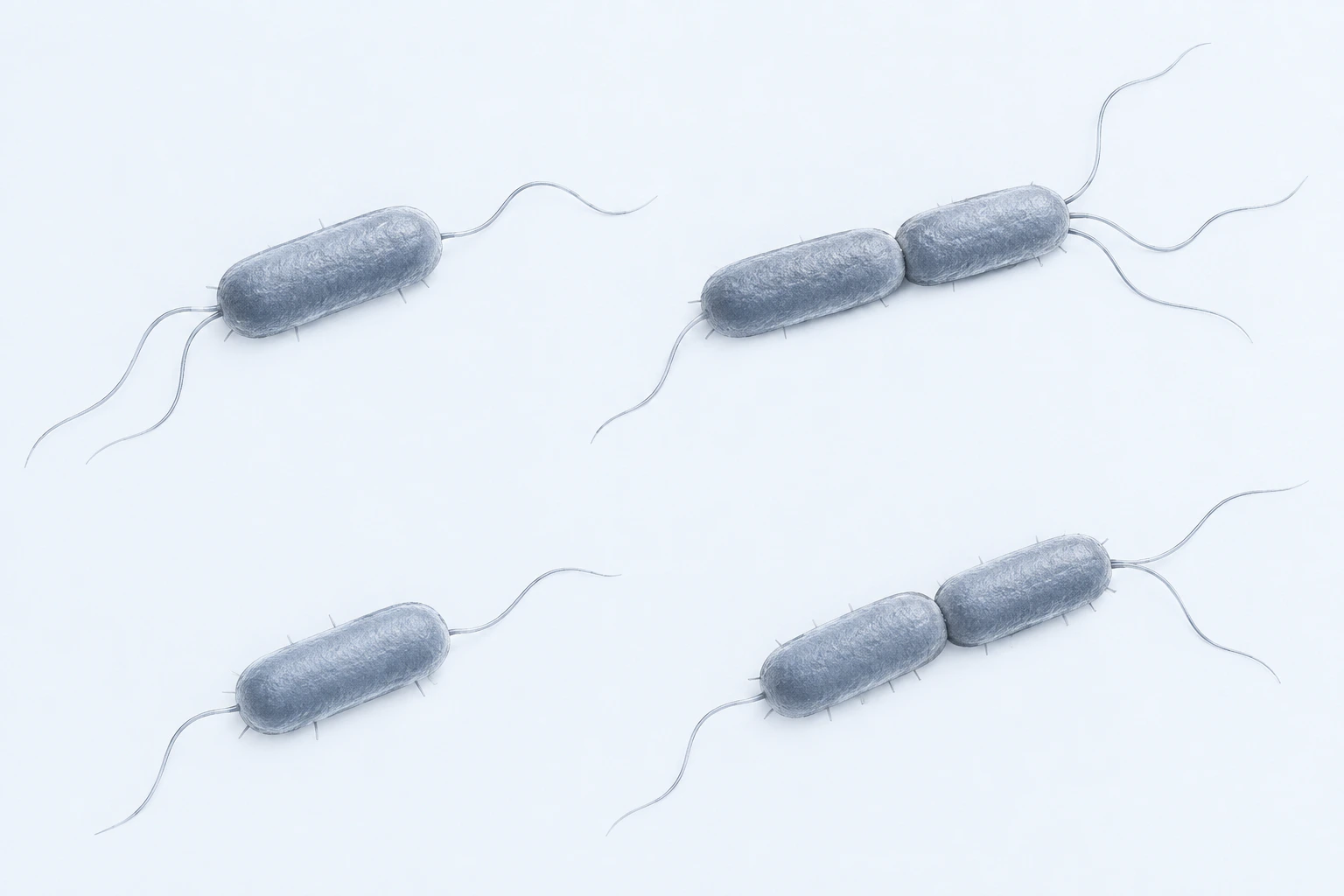
Strain-anchored morphology orientation for Escherichia coli Nissle 1917, shown as regular rods with simplified sparse flagella and pili. Morphology does not distinguish this strain from other E. coli and does not establish product identity, viability, purity, genome, dose, colonization, safety, probiotic action, or clinical effect; this is an educational reconstruction, not a micrograph.
Scientific media record3 verified identifiers
- Subject
- Escherichia coli Nissle 1917taxon · strain
- Identifiers
- NCBITaxon:316435GenBank:CP007799.1DSM:6601
- Review
- Editorial review completeIdentifiers authority-verified · Accessibility validated · · ecoli-nissle-1917|ecoli-nissle-1917-morphology-v1.webp
- Digital source
- Trained-algorithmic mediaCreated with a trained generative algorithm and reviewed by WikiBiome for subject identity, scientific framing, identifiers, provenance, and accessibility.
- Scientific basis
- Escherichia coli Nissle 1917 — NCBI TaxonomyEscherichia coli strain Nissle 1917 complete genomeSurface structures of E. coli Nissle 1917Complete genome sequence of E. coli Nissle 1917
- License
- CC BY-SA 4.0Created
> Research summary—not medical advice. This page synthesizes published research on a mechanism-level intervention. It is not a clinical recommendation.
Consult a qualified healthcare provider before making any changes to diet, supplementation, or treatment.
Evidence map2 cited passagesInspect provenance +
EcN outcompetes the key pathogenic taxa in the endometriosis signature through two primary mechanisms:
Breadth of competitive exclusion: EcN outcompetes pathogenic E. coli, B. fragilis, Group B Strep, F. nucleatum, C. albicans, K. pneumoniae, and S. typhimurium—covering nearly all enriched taxa in the endometriosis signature.
Mechanism of Action#
E. coli Nissle 1917 (EcN) is a non-pathogenic strain of E. coli that lacks virulence genes but retains superior competitive machinery (Primitive 8: Siderophore Competition and Iron Ecology).
EcN outcompetes the key pathogenic taxa in the endometriosis signature through two primary mechanisms:[1]Pendergrass 2026 — Endometriosis Conference Presentation (Amsterdam)Karen Pendergrass · 2026Open reference 1 ↓
Superior siderophore systems: EcN has more sensitive siderophores and better iron acquisition systems than pathogenic strains. In the iron-rich, siderophore-competitive environment of endometriosis, EcN wins the iron war.
Nickel uptake: EcN also uptakes nickel, depleting the cofactor that pathogenic strains need for glyoxalase (immune evasion), urease (pH disruption), and hydrogenase (hypoxia).
Hypoxic competition: Unlike many probiotics, EcN competes even in hypoxic environments—critical given that hypoxia is a defining ecological feature of the endometriosis microenvironment.
Breadth of competitive exclusion: EcN outcompetes pathogenic E. coli, B. fragilis, Group B Strep, F. nucleatum, C. albicans, K. pneumoniae, and S. typhimurium—covering nearly all enriched taxa in the endometriosis signature.[1]Pendergrass 2026 — Endometriosis Conference Presentation (Amsterdam)Karen Pendergrass · 2026Open reference 1 ↓
Triangle Evidence#
Condition: [[endometriosis]]#
I → f (EcN displaces signature pathogens): Strong evidence that EcN outcompetes each of the enriched pathogenic taxa through superior siderophore and nickel acquisition. This is the two-sided ecological engineering approach—suppress pathogens while occupying the niche.
I → D (EcN benefits endometriosis patients): EcN is an established probiotic with demonstrated ability to displace the specific pathogenic community driving endometriosis.
f → D (Displaced taxa drive endometriosis): The taxa outcompeted by EcN are responsible for estrogen recirculation (beta-glucuronidase), hypoxia (hydrogenase), immune evasion (glyoxalase), and tissue degradation (metalloprotease)—all core features of endometriosis.
Status: Promising
Note#
E. coli Nissle 1917 is sometimes genetically modified. The non-modified strain is preferred for this application. Available commercially as Mutaflor in some markets.
Sources#
[1]Pendergrass 2026 — Endometriosis Conference Presentation (Amsterdam)Karen Pendergrass · 2026Open reference 1 ↓
> Educational content, not medical advice. This page describes mechanisms by which the intervention interacts with the microbiome and metal ecology. It is not a treatment recommendation.
Clinical decisions about any intervention should be made with a qualified healthcare practitioner who knows your individual history.
References 1
Numbered by first appearance in the article, then reconciled with its declared source list.
- 1
Karen Pendergrass (2026). Pendergrass 2026 — Endometriosis Conference Presentation (Amsterdam). Conference Presentation.
Article network
Mentioned here 1
Pages linking here 9
Connect the evidence
Publicly readable discussion by ORCID-authenticated researchers. Questions, interpretation, methods, corrections, and new evidence stay attached to this record.
No discussion yet. Start with a precise question or a source-backed observation.
Activity and accepted changes
Accepted researcher context, editorial status, public discussion, and upstream Git revisions are shown together. Pending, declined, and withdrawn proposals remain private.
- published revision
massive wiki expansion: 149 stubs fixed, 100+ new pages, Rule 15 scan, keystone papers
WikiBiome Deploy Bot · +11 −11
Inspect exact Git diff ↗ - published revision
Adversarial audit fixes: confidence downgrades, disclaimers, STOP safety, entity cleanup
WikiBiome Deploy Bot · +9 −2
Inspect exact Git diff ↗ - published revision
v2 migration Priority 4: 13 interventions + 14 STOPs upgraded with cureva_status, karen_brain_primitives, evidence_level
WikiBiome Deploy Bot · +5 −0
Inspect exact Git diff ↗ - published revision
WikiBiome v2 migration: signature pages + safety fixes + gap analysis
WikiBiome Deploy Bot · +1 −0
Inspect exact Git diff ↗ - published revision
WikiBiome update — integrity fixes, metallomic diet pages, cross-condition analyses
WikiBiome Deploy Bot · +2 −0
Inspect exact Git diff ↗ - published revision
WikiBiome v7 — interactive microbiome metallomics encyclopedia
Karen Pendergrass · +61 −0
Inspect exact Git diff ↗